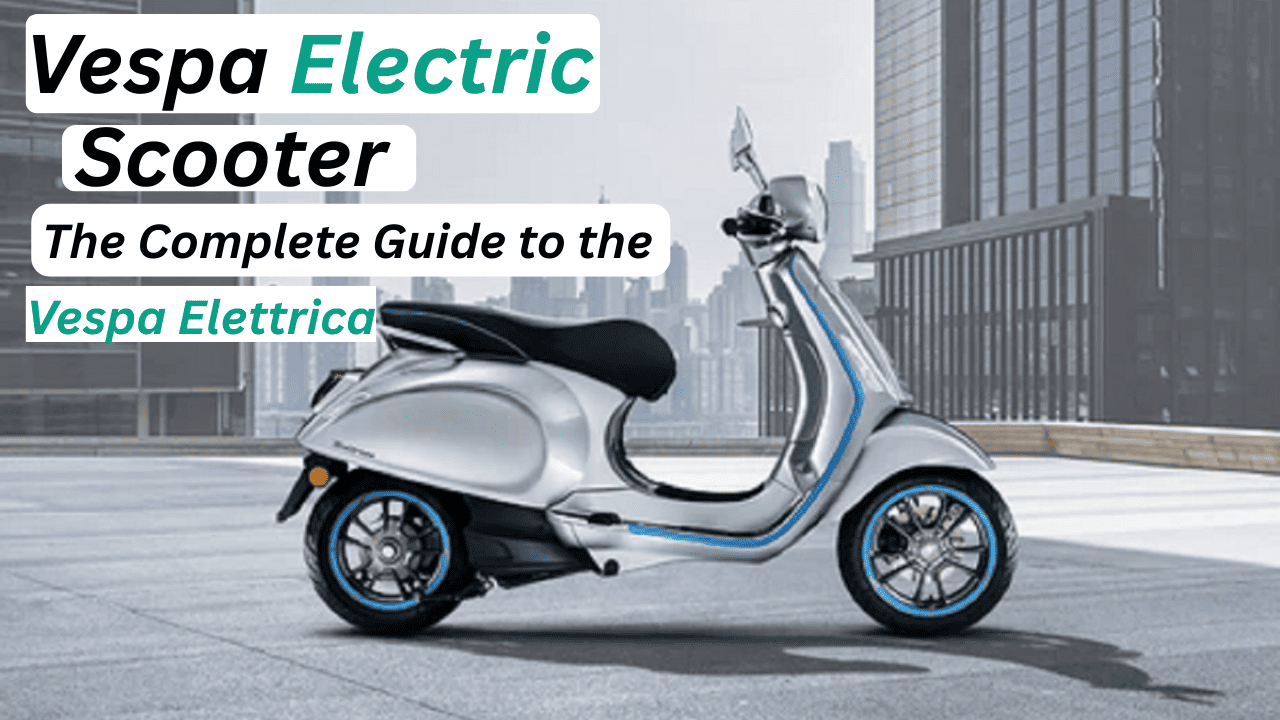
Vespa earned its name with a design that everyone recognizes, and an engine that everyone is able to sense coming. Its Vespa Electric Scooter keeps the form and eliminates sound. This is Piaggio’s solution to a question people are asking each year: Can a bike that is so iconic be converted to an electric one without losing the characteristics that made it unique?
This article explains the details of what the Vespa Electric Scooter really is and how it functions, as well as the cost it charges based on where you live and how it compares against other alternatives, which will help you determine if it is a good fit for the driveway of your home or in your dealership showroom.
What Is the Vespa Electric Scooter?
The Vespa Electric Scooter is designed for riders who want the classic Vespa experience while enjoying zero-emission urban transportation. Its Vespa Electric Scooter can be described as the only fully electric version of Piaggio’s Vespa line-up, introduced in 2018, and later expanded with a more powerful 70 km/h version as well as a more modern Primavera Elettrica Generation. The model swaps out the combustion engine in favor of an electric Power Unit that is brushless and lithium-ion battery with the same steel unibody form that’s been the hallmark of Vespa from the beginning of the 1940s.
The basic idea is an electric motorcycle that’s styled like a motorcycle (depending upon the version), manufactured by the Italian manufacturer Piaggio Group in Pontedera for people living in urban areas who would like to reduce emissions but still retain the traditional look of Vespas.
Vespa Electric Scooter specifications indicate that the model will have a 4.2 kWh lithium-ion battery. The battery can supply enough power to produce as much as 5.4 HP and 200 Nm of torque. Additionally, the battery could provide enough power for running the device for up to 100 km (62 miles) with a single charge, if it is turned on. The anticipated launch price of this model for the United States is $7,999.
Why the Vespa Electric Scooter Matters Right Now
Cities throughout Europe are enforcing strict low-emission zone (LEZ/ZTL) regulations as combustion-powered scooters are being restricted to traditional centres. This one regulatory change has made electric two-wheelers a new concept into a requirement for an increasing number of people.
The Elettrica is significant because it’s one of the very few top-quality, authentic Vespa electric scooters that compete in this space. Many of the competitors are young businesses with no history of design. This changes the way that the Elettrica is perceived more as a low-cost electric scooter, and more of an alternative that is designed to appeal to riders who have already come to appreciate the Vespa Electric Scooter brand name.
For B2B customers — dealers leasing fleets, rental companies, as well as Last-mile delivery providers– there is a distinct draw, but it is akin to regular running costs and no maintenance on engines, as well as a brand name, which customers trust.
Who the Vespa Electric Scooter Is Actually For
Some riders are not an ideal match. Having a clear and honest conversation about this in the beginning can save a good portion of buyer’s regret.
- Medium- to short-term urban commuters (under fifty kilometers round-trip) have the most optimal fitting, while staying within the Elettrica’s product range.
- Riders who have reliable outlets that are open for overnight, such as a garage at home or private parking, similar to this, can avoid the most significant friction point.
- Design-and-brand-conscious buyers who want a Vespa specifically, not just any electric scooter, will value what they’re paying for.
- Highway or long-distance riders should look elsewhere; a 70 km/h top speed and moped/motorcycle-class limits aren’t built for that use case.
- Budget shoppers looking for more mileage out of their money may discover that electric scooters provide additional mileage options.
Vespa Electric Scooter Models and Variants
Piaggio has launched the Elettrica in several different configurations. Mixing the two is among the most frequent mistakes made by researchers.
| Variant | Top Speed | Classification | What Sets It Apart |
| Elettrica 45 km/h | 45 km/h (~28 mph) | Moped | Original city-focused version; lower speed cap suits moped-license markets |
| Elettrica 70 km/h | 70 km/h (~43 mph) | Motorcycle | Higher-power variant, near-identical range to the 45 km/h version in Eco mode |
| Primavera Elettrica 45 | ~68 km/h (~42 mph) | Moped/motorcycle (market-dependent) | Newer generation with a smaller, removable 2.3 kWh battery, 5-inch TFT display, and keyless ignition |
This last difference, which is between fixed versus removable batteries, is truly crucial and is not explained in a clear manner in the literature. The Elettrica’s original 4.2 kWh batteries are constructed inside the frame. It can’t be taken out for charging inside. The more modern Primavera Elettrica is able to. If you’re lacking access to a power outlet close to your parking spot, that isn’t enough to determine the model that is best for you.
How the Vespa Electric Scooter Actually Works
The machines are much simpler than the combustion scooters. This is an aspect of their appeal.
- Direct drive with or without clutch: A brushless electric motor delivers power directly to the rear wheel via a 15:1 reduction. This gives immediate acceleration with a twist and go.
- Two riding modes are offered: Eco mode lowers speed and smooths throttle reactions to give you the maximum range. Power mode lets you enjoy full power over a limited distance. A reverse mode assists with parking.
- Regenerative braking, an energy recovery system (KERS) that is able to return energy to the battery in deceleration, moderately increases its capacity.
- Charging Cable storage beneath the seat. Plug it into any standard plug or charging station — there’s no specific Vespa charging network that is fast-charging.
- connectivity: The Vespa MIA or Vespa Connect app pairs over Bluetooth to the dashboard’s TFT screen and displays messages, calls, and ride information.
Full Technical Specifications
These numbers are taken from the official technical documents of Piaggio of the Vespa Electric Scooter at 70km/h.
| Spec | Value |
| Maximum power | 4 kW (≈5.4 PS) |
| Motor torque | 200 Nm at the wheel |
| Battery | 48V, 86Ah, 4.2 kWh (LG Chem cells) |
| Recharge time | 4 hours, 0–100% |
| Battery lifespan | 1,000 charge cycles to 80% residual capacity |
| Top speed | 70 km/h |
| Regenerative braking | Yes |
| Brakes | 200 mm front disc, 140 mm rear drum, combined braking system |
| Weight (with battery) | 130 kg |
| Range (Eco mode) | Up to 100 km (62 miles) |
| Display | 4.3-inch color TFT (5-inch on Primavera Elettrica) |
The real-world range may be less than the advertised figure with Power mode in the colder weather or a more hefty rider, similar to how the rated range of any electric vehicle is different from the daily conditions of driving.
Vespa Elettrica Pricing: What It Actually Costs
Pricing is the place where a lot of content on the internet is sloppy and sloppy, so let’s see what’s established and what’s not.
Pricing confirmed
- United States: $7,999 MSRP tax-free via the official Vespa U.S. store
- Eurozone (Italy Reference price): historically around EUR6,400-EUR6,700, depending on the type of variation, but prices fluctuate in time, and vary based on the dealer.
Unofficially confirmed
- The markets across South Asia, including India and Pakistan, have not yet officially announced the Vespa Electric Scooter launch as of right now. There are aggregator websites that quote “expected” prices with confident-looking prices. Consider these as speculation, not facts, until a dealer authorized to do so is able to confirm these numbers directly.
If you’re purchasing outside the U.S. or EU, the best option is to speak with an authorized Vespa Electric Scooter retailer directly instead of using a third-party “expected price” page.
Where to Buy and How to Find a Dealer
Vespa Electric Scooter offers its products via an official dealer network, rather than a direct national shipping option throughout the world. This makes it easier to browse and shop.
- Make use of the official dealer locator of Vespa in lieu of the general marketplace listings.
- The U.S. dealer coverage tends to be concentrated in major metropolitan cities. There are cities in Los Angeles, New York, Chicago, and Miami, each of which has established networks, but coverage of rural areas is not as widespread.
- In European cities such as Rome, Milan, or Barcelona, Elettrica directly benefits from the low-emission zone access that restricts motorbikes burning gasoline.
- If you’re in a place with no official sales, beware of imported gray market products. They can void the manufacturer’s warranty and hinder access to service and parts later on.
Charging: What to Actually Expect
Question Answer
| Question | Answer |
| Can I charge at home? | Yes, from any standard wall outlet |
| How long is a full charge? | About 4 hours from empty |
| Is the battery removable? | Only on the Primavera Elettrica; the original Elettrica’s battery is fixed |
| Is there fast charging? | No dedicated Vespa fast-charging network |
| Can I use public charging stations? | Yes, if compatible — apps like PlugShare or ChargePoint can help locate them, though most public infrastructure is still car-oriented |
Vespa Electric Scooter Versus. the Alternatives
The specs alone won’t reveal the whole story; however, they can be a good basis for comparison.
| Model | Top Speed | Range | Approx. Price (USD) | Best Fit |
| Vespa Electric Scooter | 70 km/h | ~100 km | ~$7,999 | Brand and design-focused urban riders |
| BMW C Evolution (reference, discontinued) | Higher performance class | Shorter relative range at speed | ~$13,995 (last MSRP) | Riders prioritizing performance over price |
| Budget electric scooters (various brands) | 30–40 mph | Varies widely | $3,000–$5,000 | Cost-focused buyers |
| Petrol Vespa (Primavera/Sprint, 50cc–150cc) | Higher | Fuel-based, refuels in minutes | Often lower than Elettrica | Riders needing longer range without charging downtime |
The truth is that the Elettrica isn’t the best car based on its specifications. Its top speed and range are lower than many competitors, as well as costing more than a lot of petrol Vespas. What it offers is branding equity, quality of design, and low-emission zone access, not just spec-sheet top-of-the-line.
A Simple Decision Framework
Before making a decision, go through the five following items in the order they are asked:
- Do you have a daily trip to work under 50km? If not, the range is a serious issue.
- Are you connected to a reliable outlet for overnight connection? If not, the four-hour charging time and the battery that is fixed on the original Elettrica can become real problems.
- Do you have an official Vespa retailer in your region? If you’re unsure, take the time to review the terms and conditions of the warranty thoroughly prior to purchasing from an unknown retailer.
- Do brand or design have any significance to you? Or is it purely a cost per mile choice? If it’s the former, an electric scooter will likely serve your needs better.
- Do emission-zone regulations local to you or incentives encourage electric bikes, depending on where you are? If yes, this could tip the balance towards Elettrica’s side.
Pros and Cons
What does it do to its advantage:
- Genuine Vespa construction and design
- Fast torque with smooth and silent acceleration
- Regenerative braking, which modestly increases its range
- No engine maintenance — meaning no oil changes or spark plugs
- Growing importance in cities that are limiting the use of combustion scooters
The areas where it falls short:
- Premium pricing compared to fuel-efficient petrol Vespas and budget-friendly e-scooters
- Approximately 100km Eco-mode range, which is a bit low compared to modern EV two-wheelers
- A fixed battery on the original Elettrica, which limits the charging options
- Limited market availability beyond the U.S. and the EU
- Lack of a fast-charging network
Licensing, Insurance, and Regulations
The requirements for specific countries differ based on the country you are in, as well as the kind of vehicle you buy, because mopeds and motorcycles aren’t homologated in the exact same way.
- Moped-class versions (lower speeds) typically qualify for lower-license conditions in several regions.
- Modifications for motorcycles (70 kilometers/hour) usually require a full motorcycle licence or an endorsement.
- Insurance is typically mandatory even though the categories for electric two-wheelers don’t necessarily have the same standardization as combustion vehicles. Make sure to contact your local insurer directly.
Regulations regarding electric scooter classification are constantly changing; checking with your local licensing authority prior to purchasing is a worthwhile step.
Maintenance and Ownership Costs
Electric drivetrains make ownership much simpler compared to combustion engines:
- There are no oil changes, spark plugs, or air filters to budget for.
- The battery’s capacity lasts for 1,000 charge cycles before dropping to 80% remaining capacity. It is worth factoring an eventual replacement cost into your long-term cost of ownership calculation.
- Brakes and tires wear out just like on any other scooter, and maintenance must be handled by an authorized dealer to keep the warranty protected.
- Software updates for the MIA/Connect system are typically performed during dealer service visits.
FAQ
What is the maximum distance a Vespa Elettrica goes on one charge?
Up to about 100 kilometers (62 miles) with Eco mode. According to Piaggio’s official numbers. In Power mode, the range is reduced.
What does a Vespa Electric Scooter set you back?
It is estimated that the U.S. MSRP is $7,999 and covers all taxes and charges. European prices vary from EUR 6,400 to EUR 6,700. These numbers can change according to the conditions of the market.
How long will it take to charge the Vespa Electric Scooter?
It takes about 4 hours to charge the entire amount using a standard wall outlet.
Do you think the Elettrica’s battery is changeable?
Not on the Elettrica’s original model — the 4.2 three kWh batteries are permanently mounted inside the frame. The latest Primavera Elettrica has a smaller, accessible 2.3 electrical energy battery.
What’s the highest speed for the Vespa Electric Scooter?
Mopeds have reached top speeds of 70 km/h (roughly 43 miles an hour). Original versions have reached 45 km/h top speeds.
Are the Vespa Elettrica accessible within India as well as Pakistan?
Not officially at the moment. There is no confirmation that an Elettrica launch has been announced in these countries, and other third-party “expected price” listings should be viewed with caution until an authorized dealer has confirmed the accuracy of these listings.
Do you require a motorcycle licence to drive the Vespa Elettrica?
It depends on the model and local laws. A motorcycle class version with 70 km/h generally requires a full-time license; however, lower-speed moped-class versions might not require a license.
Do you consider the Vespa Elettrica safe?
Piaggio backs it with a standard manufacturer’s warranty that is accessible through authorized dealers, and it is more mechanically simple than combustion-powered scooters, which can reduce the need for maintenance in the long term.
Final Thoughts
The Vespa Electric Scooter won’t be trying to compete in a spec-sheet competition. It shouldn’t be considered a contest. It’s made for people looking for a genuine Vespa ride without the exhaust for short city commutes, reliable charging, and the willingness to invest in design instead of price or range.
If you’re in that category and you’re interested, your next step is easy: Find an approved Vespa Electric Scooter dealer, arrange an appointment for a trial ride, and then compare Eco and Power settings against the actual route you take before making any commitments. If affordability or range are your primary concern, then it’s worthwhile to cross-shop against other electric scooters before you commit to the Elettrica in particular.
“The information on this website is gathered from industry reports, manufacturer specifications, expert reviews, and trusted sources such as Electroheads to provide accurate and valuable insights for our readers