If you’re thinking about buying an electric scooter to help with your son’s daily commute to school, the decision is down to more than the top performance and color choices. The best choice is based on the age of your child and his weight, as well as the state’s policy on motorized scooters that are geared towards minors, and whether the battery really meets the safety requirements. This guide will explain the entire process in simple words, so that you are able to purchase with confidence and not speculation.
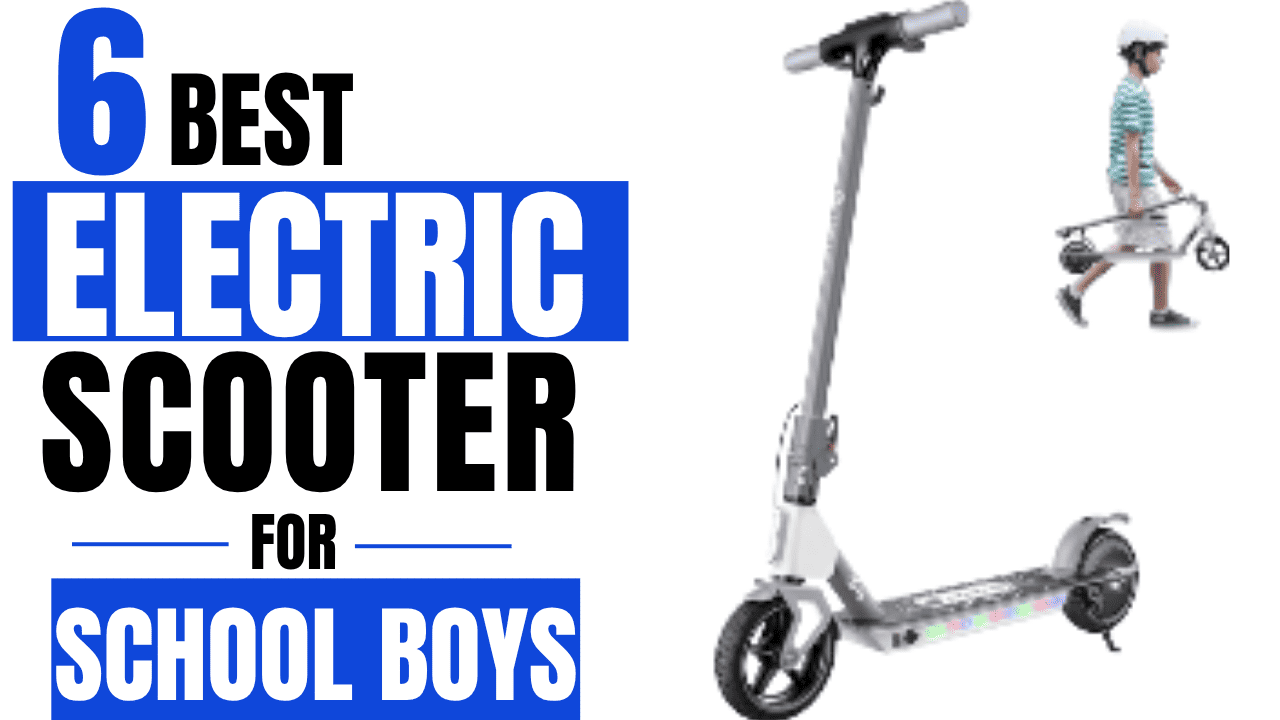
6 Best Electric Scooters for School Boys
A quick answer is that the best selections are based on weight and age. If you’re looking for a straightforward, elementary-school approach to narrow down a selection of models that is suitable for your needs, you can consider the FanttikRide C9 Pro and ECOROAD EK8, which fit elementary boys—the Isinwheel S4 as well as the JOYSTAR Starmoto 12 work well for middle schoolers. The Hiboy S2 Nova and NIU KQi3 Pro are designed for teens in high school who have longer commutes. If a model is more quickly than the age-specific guideline further down, this is explicit so that the two sections can agree.
Elementary School (roughly Ages 6-9)
FanttikRide C9 Pro
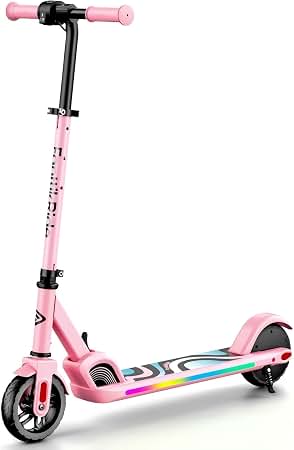
A quick answer is that the FanttikRide C9 Pro is a secure starting point for anyone who is a beginner in riding at ages 8-9 due to its 5-10 mph speed limit and the ability to adjust its frame.
- It is suitable for riders who are 3.9-5.2 ft tall. Weight: up to 132lbs
- Speed: Three modes5/8 /10 speed
- Handlebar: Adjustable to 31.7 “, 34.1″, or 36.5”
- Braking: Single rear fender brake
- Wheels: 6 inches of rubber, anti-skid
- The range is up to 5 miles/40 minutes of continuous usage.
- Additional features: LED ambient light, one-step fold, and a G-sensor deck switch (motor isn’t activated until a foot is on the deck)
- Certification: UL 2272-certified battery
The areas where it is lacking: It has only one brake (rear Fender). The front brake is not used for backup stopping capability. The range is on the smaller side, and it is suited for the short distance walk to school rather than an extended journey. The weight limit of 132 pounds isn’t ideal when you have a larger or taller 9-year-old. The 10 mph top setting can also exceed the 6- 8 mph guideline that this guide advises for children ages 6- 8. It’s ideal for a confident 9-year-old using the slow speed of 5 or 8 mph; however, a smaller or newer driver should be in the lowest setting.
Ideal for: A prudent first-timer, 8-9. They are on a brief ride that is flat and smooth. A parent is looking for a lower top speed but room to increase gradually in the various modes.
ECOROAD EK8
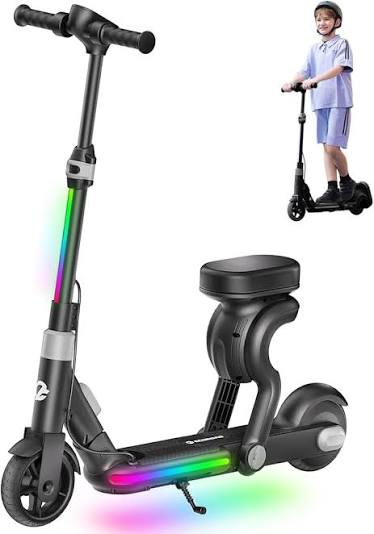
It’s a simple answer: the EcoROAD EK8 will be the ideal choice Electric Scooters for School Boys who want the ability to sit and stand or require a greater distance than what the C9 Pro C9 Pro offers.
- Motor 200W brushless
- Speed: three modes5 / 8 /10 speed
- Distance: Up to 9 miles
- Braking System: Dual brakes (front and rear)
- Fit: Adjustable 35.4 “- 40.7 “; fits children between 110 and 160 cm (ages 6- 12)
- Additional features: 2-in-1 seat/stand conversion, IPX4 waterproof rating, sturdy tires, Bluetooth music, and RGB lights
- Certification: ANSI/CAN/UL2272 certified (tested with TUV Rheinland)
It’s not perfect. Its seat attachment is a source of some weight, which makes it less mobile in comparison to a standing scooter that is purely stationary. It also requires some assembly work and more effort to move parts in order to maintain it.
Ideal for: A child close to the upper end of the elementary group (9-11) with a lengthy commute or who’s not sure about being able to stand for the entire trip and would benefit from a seating alternative.
Middle School (roughly Ages 11-13)
isinwheel S4
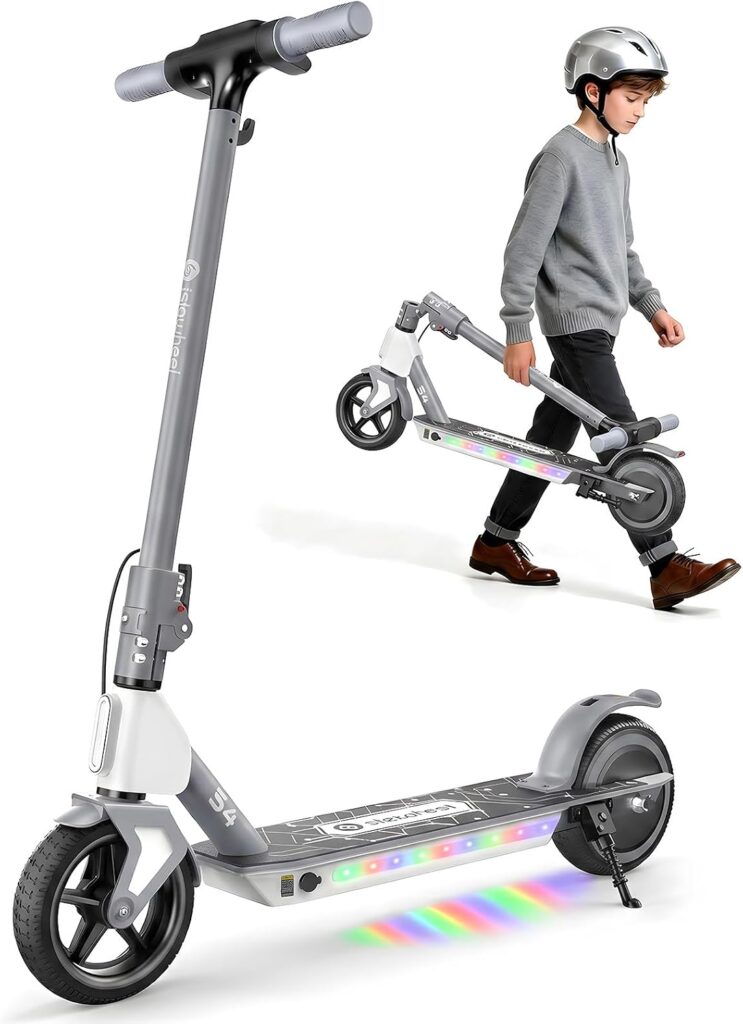
It’s simple: the isinwheel S4 is the lightest and most mobile option available in this bracket. It is crucial when your child must carry it to an office or locker.
- Motor: 200W
- Speed: three modes5/8 12 mph
- Range: 5-9 miles, 60+ minutes continuous use
- Weighs: 15.2 pounds. Folds in around 3 seconds
- Max load: 154lbs
- Braking: Two brakes: electronic brake and the rear foot brake
- Extras: Bluetooth speaker, LED smart dashboard, colorful ambient lighting
- Certification: The charger is UL accredited by TUV Rheinland — be aware that this only covers the charger, and it is not a complete UL 2272 certificate for the battery packs, similar to the other models in this list. Check with the seller directly if the battery packs themselves are certified UL 2272 prior to purchasing.
The only thing it doesn’t have is that the handlebar isn’t adjustable, which means it’s a fixed fitting instead of one that expands as your child gets older. Its solid 6.5″ tires provide the least amount of cushioning when driving on uneven surfaces as compared to air-filled alternatives.
The ideal choice for a middle schooler who needs to move the scooter throughout the day and who prefers lightweight over force. The top speed of 12 mph is in line with the guidelines for 8-12 mph in the age group 9-11, as shown in the following table, and is perfect for a 12-year-old who is smaller in size.
JOYSTAR Starmoto 12
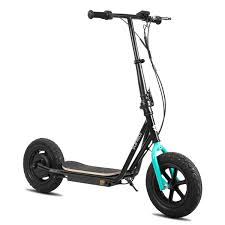
A quick answer is that the JOYSTAR Starmoto 12 is the strongest option for a larger-built middle schooler. It has the ability to lift more weight and a sturdy metal frame.
- Motor: 250W
- Speed: up to 13.6 miles per hour, controlled with an electronic throttle that the thumb can operate.
- Distance: up to 8 miles
- Wheels: 12 inches, more suitable for uneven sidewalks
- Max load: 220lbs
- Braking: Electronic brake plus rear foot brake
- Certification: UL-2272, and CPC certified
The areas where it fails: The handlebar is not adjustable in height, and an all-metal frame means it is heavier than the ISINWHEEL S4. The company officially promotes this model to children aged 6-12 years old; the best way to use it is as an appropriate fit for an experienced 11-12-year-old, not being stretched out to fit a taller 13-year-old, and to fit the person before you purchase. The 13.6 mph top speed is slightly higher than the recommended 8-12 mph speed for sizing in this age group, which makes it a great choice for the heavier or more experienced driver, though it’s better kept on a lower setting for a newer rider.
Ideal for: A larger or taller-than-average 11-12-year-old who requires more weight capacity and stronger construction than the lightweight alternatives provide.
High School (roughly Ages 15+)
Hiboy S2 Nova
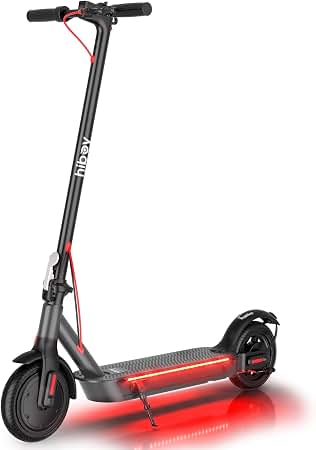
Answer: The Hiboy S2 Nova suits an older and experienced teenager who needs a range of commutes and isn’t averse to a bike that’s not classroom-related.
- Motor Power: 350W (up to 420-430W maximum)
- Speed: Up to 19 mph
- The range can be as long as 20 miles
- Tires: 8.5″ set-up hybrid — solid front, pneumatic rear, and suspension in the rear.
- Braking: Dual system: electronic brake (eABS) and rear drum brake
- Weight: 34.5 lbs, foldable
- Fitness: Recommended for riders ranging from 4’11 “-6’1”
- Extras: App control (speed modes, ride stats, remote lock), LED headlight/taillight/ambient lighting
The area where it isn’t quite enough: the speed of 19 mph is beyond the range of 10- 15 mph. The guide suggests even for the earliest age 12-15 group, which means it’s suitable for people at the advanced middle in high school (roughly 15+) and not the typical 12-year-old entering this category.
The status of certification for the manufacturer’s model: the specific model was not clearly provided when we wrote this article. Check the current UL 2272 certification of the battery directly at the store before purchasing, and make sure you have your state’s and school’s permission to allow the speed to be used for small. It’s not a removable battery with a weight of 34.5 pounds; it’s heavier than middle school choices.
The ideal candidate is a skilled, confident high schooler who has a truly long commute. Where local laws and school policies permit faster speeds.
NIU KQi3 Pro
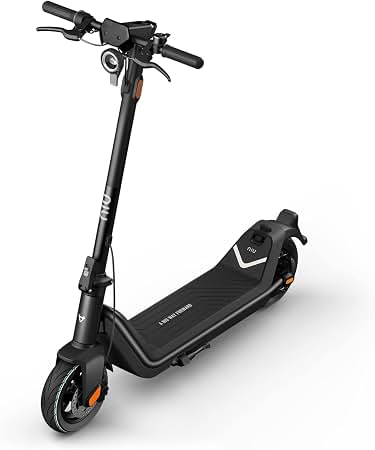
Answer: The NIU KQi3 Pro model is our best choice for those who want the longest commute to school and trade portability in exchange for the most performance and range.
- Motor: 350W nominal / 700W maximum
- Speed: Up to 20 mph
- The range can be as long as 31 miles
- Tires: 9.5″ tubeless pneumatic, no suspension
- Braking: Two mechanical disc brakes (front and rear) and regenerative brakes
- The weight is 44.7 pounds; maximum load: 220 lbs
- The recommended age/height (per manufacturer): 14-50 years old, 3’9 “-6’6”
- Additional features include: four riding modes, Bluetooth app, water resistance IP54
The areas where it isn’t quite as good: It weighs 44.7 pounds; it’s by far the biggest of the models on this list. This makes it difficult for daily use indoors. There’s no suspension, despite the bigger tires. Like the Nova, it has a 20-mph maximum speed, which is higher than this guide’s standard 10- 15 mph age guidelines — and the same checks for local law and school policies apply. Similar to the Nova, check the latest UL 2272 certification of the battery directly with the seller; there was no clear indication of it when we wrote this guide.
The best choice is an older teenager who has the longest commute in the group. The scooter can be parked or stored instead of being moved around. Range is more important than portability.
Comparison Table: Best Electric Scooters for School Boys
| Model | Best Age Group | Top Speed | Range | Max Weight | Braking | Certification |
| FanttikRide C9 Pro | 8-9 (Elementary) | 5-10 mph | 5 miles | 132 lbs | Single rear brake | UL 2272 |
| ECOROAD EK8 | 9-11 (Elementary) | 5-10 mph | 9 miles | The brand does not provide any specifics. | Dual brakes | UL 2272 (TUV verified) |
| isinwheel S4 | 11-13 (Middle) | 5-12 mph | 5-9 miles | 154 lbs | Dual brakes | Certified chargers by UL. Check that your battery meets UL 2272. |
| JOYSTAR Starmoto 12 | 11-12 (Middle) | Up to 13.6 mph | 8 miles | 220 lbs | Dual brakes | UL 2272 + CPC |
| Hiboy S2 Nova | 15+ (High School) | Up to 19 mph | 20 miles | This model is not specified. | Double brake (eABS + drum) | Check the current status of UL 2272 prior to purchasing. |
| NIU KQi3 Pro | 15+ (High School) | Up to 20 mph | 31 miles | 220 lbs | Dual disc + regenerative | Check the current status of UL 2272 prior to buying |
Make sure to verify the latest list and UL 2272 status before purchasing, since the certifications can differ based on the exact version of the model and also by the retailer.
What Is a Kids’ Electric Scooter, Exactly?
A kid’s electric scooter powered by batteries is a stand-up ride designed especially for children and is not a re-scaled version of a commuter model for adults. There are differences that matter more than the way they appear on a specification page.
As compared to adult models, the models for youth typically include:
- A speed regulator that limits the motor to keep it well under adult speed.
- The deck is lower so shorter feet and legs remain well-balanced
- The frame is lighter and sized for the weight of a child.
- A simplified braking system — typically using a foot brake, discs in the rear, or a simple-to-pull hand lever
- Security features such as LED lighting and puncture-resistant tires
It’s built on a child’s body and their reaction time, not the adult’s. That’s the single most important factor that separates a truly secure purchase from a flimsy one.
Why the Right Fit Actually Matters
It’s tempting to purchase “up” — a somewhat faster, stronger model that your child can “grow into.” Product engineers and safety researchers generally discourage this with good reason. Children react to traffic or obstacles and abrupt stops in a different way than adults can. An adult-oriented scooter’s reactions put children at a disadvantage when something happens unexpectedly.
Also, there’s an advantage to doing this correctly. An electric scooter that is properly designed is able to:
- Shorten the walk (or car journey) to get there
- Develop a sense of the importance of independence and accountability
- Reduce the load of pickups and drops on parents.
All of this is irrelevant, but it’s not a matter of whether the vehicle itself is safe. Lack of safety gear and speed are frequently identified as major contributors to accidents involving children on scooters — and not the category of the vehicle itself. It’s a significant distinction since it implies that the solution doesn’t “avoid electric scooters.” The solution is “buy the right one, and gear up properly.”
Who This Is For: Matching Age, Height, and Weight
Age alone doesn’t provide a solid sizing reference — a younger or less experienced 12-year-old must be considered as a rider aged 9-11 and not solely sized by the year of birth. The following is an overall framework.
| Age Range | Recommended Max Speed | Deck Height | Notes |
| 6-8 years old | 6-8 mph | Low (under 4″) | Adult supervision is required at all times |
| 9-11 years old | 8-12 mph | Low-Mid | Simple hand brakes are the most popular |
| 12- 15 years | 10-15 mph | Mid | Hand brakes with discs preferred, and helmets are mandatory |
If your child is in the younger or smaller portion of his age range, take a step back a size. This is a safer choice rather than going up. Certain high-performance scooters listed are included in this article (19-20 miles per hour) over the table’s limit, even for the bracket between 12 and 15. Consider them suitable for the best-informed, older teens only (roughly 15or more), not a typical 12-year-old.
Types of Electric Scooters for School-Age Boys
Every kid’s e-scooter can be built in the same manner. Knowledge of the various categories can make shopping easier. The six options below cover standing kick and sitting categories in particular; The other categories below are important to be aware of even though this guide isn’t recommending any specific models in each category.
- Standing kick-style e-scooters – Most commonly used. The lightweight and foldable design is usually the ideal choice for a simple school trip. (All six choices above are in this category and its seat-based version.)
- Three-wheel electric scooters – With extra stability, they are the ideal stepping stones for first-time or younger riders prior to moving on to a two-wheel model.
- Electric scooters with a seat can be useful for males with balance issues. The seat helps reduce the demands on coordination when sitting while on the road. (The EcoROAD EK8 model above has this feature as a convertible model.)
- Off-road and all-terrain models: Knobby tires designed to withstand uneven terrain. More suitable for recreational riding rather than the smooth pavement route for school.
- Hybrid scooters that kick and electric — combine manual push with an electric boost to give the more experienced, confident riders some more control over their speed.
The Buying Decision Framework
When you have a good idea of the size of your son and the level of his riding, you can run the model you’ve selected through the following checkpoints:
- Weight compliance and age. Check the weight limit of the manufacturer to ensure that he is well below it and allow for expansion.
- Speed governors with various modes. Models that offer normal and beginner modes are better than ones that run at a single maximum speed.
- A battery that is certified. Make sure to look for UL2272, which is the U.S. safety certification covering electrical and fire risks in personal devices that use e-mobility. It is essential to confirm before doing anything else. Uncertified batteries constitute the primary source of fire hazards, which make the news.
- Dual brakes. Combining mechanical and electronic braking can stop more quickly and with greater predictability than a single mechanism.
- Tire type. Tire type. (air-filled) Tires can absorb bumps more effectively, while good tires offer some cushion with lower maintenance.
- Range versus actual commute. Compare battery range with the actual distance round trip to school. Add some buffers for detours and any off days.
- Portability. When the scooter has to be folded to transport it into the locker or classroom, the fold mechanism and weight are as important as the speed.
- Access to parts and warranty. Tire and battery replacements must be simple to locate. Make sure to verify this prior to purchase, and not later after purchase.
Comparing the Categories
| Category | Best For | Typical Speed | Typical Range |
| Entry-level 3-wheel | Ages 6-8 Ages 6-8, first scooter | 6-8 mph | 3 to 5 miles |
| Standard 2-wheel kick-electric | Ages 9-12, regular school Use | 8-12 mph | 5-10 miles |
| Models of youth performance | Ages 13-15+, longer commute | 10-20 mph, based on experience of rider as well as local regulations | 10-31 miles |
| Seated hybrid | Supporting the balance | 8-10 mph | 5-8 miles |
This “performance youth model” range is intentionally broader than the older guidance table above, as the two picks for high school within this manual (19-20 miles per hour) are designed for the most senior, proficient riders. They are not the typical 13-year-old.
Safety Standards and the Legal Picture
Two certificates are important to know by name:
- The UL 2272 is the U.S. standard covering electrical safety for personal electric mobility devices, such as the battery pack as well as charging equipment. This is the only crucial label you should look for.
- CPSC guidelines -The U.S. Consumer Product Safety Commission has published general safety standards for children riding on products that UL-certified scooters are built to fulfill.
What’s more complicated is in the actual law. The rules on e-scooters for minors differ greatly from state to state- and even from cities in the same state. Certain jurisdictions have an age limit for riding, and others limit sidewalk or street-based use. Helmet regulations aren’t uniform.
Do not rely on one universal answer. The best way to go is to research your local and state’s rules prior to letting your child ride regularly, and you can search “[your state] electric scooter law for minors” and verify with your local city. You should also contact your school directly. Many schools prohibit motorized scooters within their grounds, even though local laws allow them in public areas, which means the campus’s policy could be a different obstacle altogether.
Step-by-Step: Choosing the Right Model
- Find out your child’s height and weight as well as shoe size to determine if the deck will fit.
- Find out the laws of your state as well as your school’s policies regarding motorized scooters.
- Create a speed limit that is suitable for the age of the rider and level of riding.
- Choose two or three models that can meet the criteria for speed, weight, as well as a UL 2272 certificate.
- Check battery range against the actual commute time.
- Do a test drive; be attentive to how the brakes respond.
- Get safety gear simultaneously, including knee pads and wrist guards.
- Establish clear rules for usage before your first ride. These include route approval, including the speed limit, as well as monitoring level.
Common Mistakes Parents Make
- Selecting a model that is based on speeds at the top instead of speeds that are appropriate for your age
- Disregarding the weight limit because “he’s tall for his age”
- Doing away with the label for battery certification completely
- Let a child go full-speed before learning basic braking techniques are established
- It is assumed that walking on sidewalks is permissible, but it’s not everywhere
- You’re buying a helmet that’s the right dimensions “for now,” which reduces protection considerably
What Can Go Wrong: Real Risk Factors
The battery that is not certified or damaged packs are a danger of overheating and fire. Always make sure you use the original charger; do not leave your scooter charging for too long. The uneven or wet surface can extend the stopping distance significantly on light scooters. Additionally, riding close to traffic with no high-visibility equipment increases the risk of collision, particularly at dawn and dusk. The group riding experience — with several children racing one another -is also a typical cause of collisions that can be avoided, and it’s best to establish goals for yourself and not simply give the scooter away and a helmet.
Alternatives Worth Considering
Electric scooters aren’t always an option; that’s all there is. However, it’s certainly not the most suitable choice.
- Traditional kick scooters are safe from battery risks and operate at slower speeds, typically the best base for children or newer riders.
- Bicycles help build physical fitness as well as a longer-term skill for riding.
- Electric skateboards are usually not recommended for children who are just starting school, as the balance demand is higher than most kids’ scooters.
- The option of carpooling or walking remains an ideal option for small distances, or in areas where the law prohibits motorized vehicles for minors.
Keeping It Running Safely
Certain habits are a big help:
- The scooter should be charged and stored inside a room that is ventilated -not under the mattress or in a way that blocks an exit.
- Check for a short 30 seconds prior to each trip the condition of your tires, the brake’s response, and whether the fold mechanism is secured.
- Be sure to supervise early rides until your horse shows stable control, and then let loose the reins slowly.
- Replace damaged tires and brake pads when you start to feel wear. Do not wait until something breaks.
- Check your local rules each year; local and state laws on minors change.
One More Thing Worth Planning For
The growth of children is typically faster than the scooter’s scheduled life span. Consider resale value or the possibility of a hand-me-down plan in your purchase decision from the start, in particular for boys at the upper end of their category of age or weight, instead of making a one-time purchase.
FAQ
Is it safe for a school-age boy to ride an electric scooter?
Yes, as long as the vehicle is appropriate for his weight and age and the battery is UL 2272-certified, and the rider wears a safety helmet under the supervision of an adult until he has demonstrated his abilities.
What’s the most efficient speed to use for an electric scooter that a child can ride?
The typical speed is 6-8 mph for children 6-8. This can be increased to 10-15 mph for children 12-15, based on their experience as well as what the local law will allow.
Does a kid need a license to ride an electric scooter?
In most places, it is not necessary to have a license for youth scooters with low speeds; however, minimum age requirements and sidewalk-versus-road laws still apply. Be sure to verify your state and town.
How long does the battery last for a daily school commute?
The majority of models for youth offer 3 to 15 miles on a single charge that typically cover one or two school rides prior to the need for a recharge.
What safety gear should go with the scooter?
An appropriately fitted helmet is a must, as are knee and wrist protectors. Knee pads are highly recommended for those who are just beginning to learn.
Can he ride the scooter on school grounds?
Not always A lot of schools ban motorized vehicles on their campus, regardless of whether local laws permit their use on public streets; make sure to check with your school.
Final Thoughts
The best, safest, and most enjoyable Electric Scooters for School Boys isn’t necessarily the most powerful, but one that is sized appropriately to his weight and age, with a certified battery and clearly defined rules of the road starting from the first day. First, you must confirm the local school’s policy and laws as well, and then the choice becomes a bit simpler.