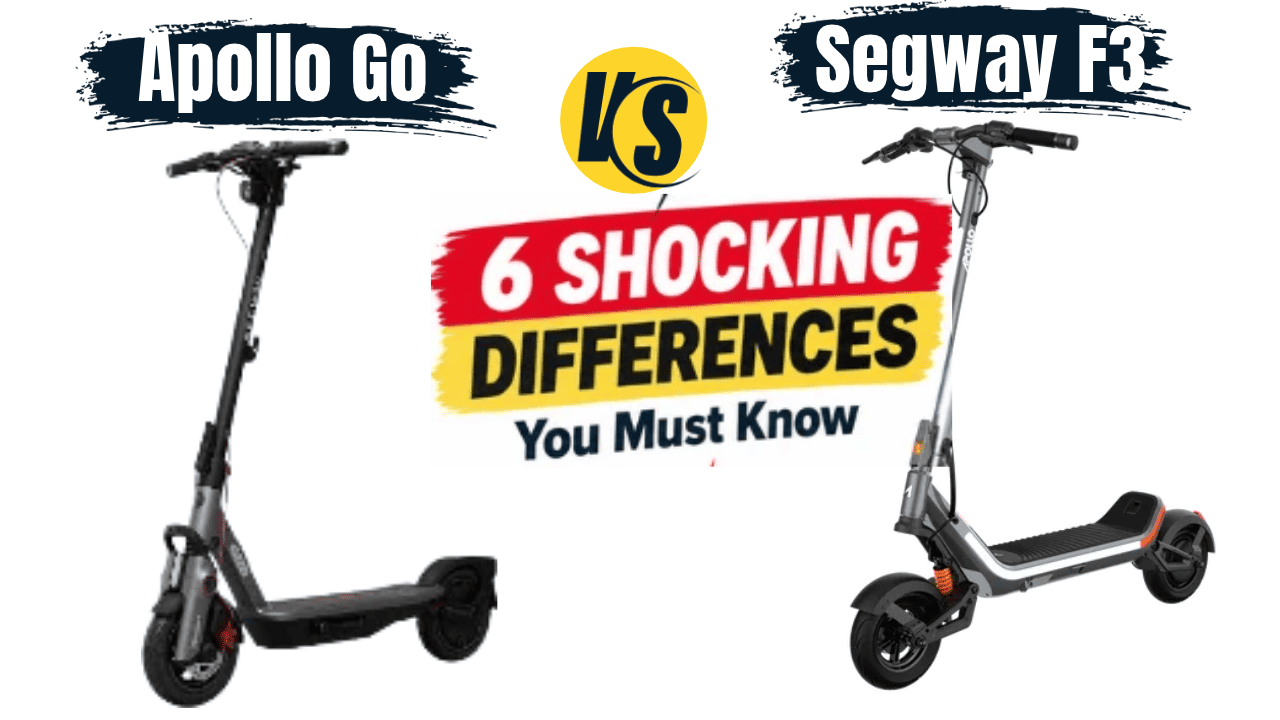
If you’ve narrowed the search to these two model choices, then Apollo Go vs Segway F3 essentially comes down to two different ways of commuting: speed and power on the hill (Apollo Go) against range and value (Segway F3).
This article explains exactly the advantages of each so that you’re able to choose the right commuter electric scooter for the route you’ll be taking rather than just the spec sheet.
Apollo Go vs Segway F3: Quick Comparison
| Spec | Apollo Go | Segway F3 |
|---|---|---|
| Motor | Two 750W motors | Single motor |
| Top speed | 28 mph | 20 mph |
| Range | Below F3 (exact amount varies according to the riding style) | Up to 44 miles |
| Resistance to water | IP66 | Standard rating (check for a listing) |
| Smart features | App-based ride customization, regenerative braking | A smart lock that is based on proximity and phone integration |
| Price | ~$800-$1,300 | ~$730-$850 |
| Best for | Stop-and-go, hills, acceleration commutes | A long, smoother commute for a reasonable price. |
Apollo Go: Best for Speed and Hill Power
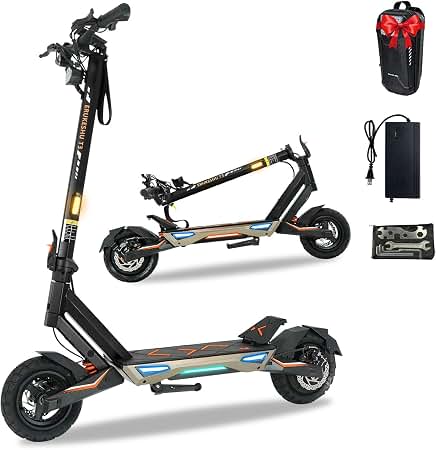
In Apollo Go vs Segway F3, the Apollo Go is built around two motors, which gives an impressively higher acceleration than many single-motor scooters in the same price bracket. If your commute involves roads with hills, stop-and-go traffic, or you’re not looking for a bike that is overloaded at 15 mph, this is the model that was designed for you. In the Apollo Go vs Segway F3 comparison, the Apollo Go is easily foldable and waterproof to IP66, as well as paired with a smartphone application that allows you to adjust the braking and acceleration to suit your preferences.
Pros:
- The dual motors are powerful and provide excellent acceleration and Hill performance at a reasonable price.
- A top speed of 28 mph provides an actual headroom advantage over budget scooters
- IP66 water resistance, self-healing tires
- Ride customization via app
- Regenerative brakes recover some battery at every stop
Cons:
- Its range is lower than the F3.
- The heavier, the better; that is important when you’re lifting it the stairs every day.
- The mechanism for folding has been described as somewhat finicky by some reviewers.
- Its higher-end pricing range ($1,200-$1,300) is beginning to close within the premium range, without being able to compete with the higher-end choices.
Segway F3: Best for Range and Value
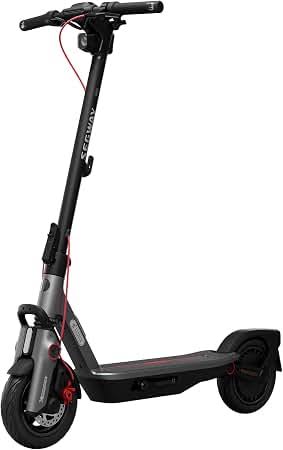
In Apollo Go vs Segway F3, the Segway F3 trades top-end speed in exchange for a range of travel, and it makes that trade very well. It can travel as long as 44 miles on a charge, meaning that your typical weekday commutes don’t need charging every day. The F3 also comes with smart features like proximity-based locking as well as an elegant display that leans toward its “smart commuter” angle more than pure speed. In the Apollo Go vs Segway F3 comparison, if you’re traveling to a flat area and you’re looking for reliability along with the distance, this model is a simple, less risky option.
Pros:
- Long-range relative to cost — one of the most efficient miles-per-mile ratios that you can find in this category.
- The features of smart locking and phone integration
- Supported by Segway’s experience in the field
- Price point lower than Apollo Go. Apollo Go
Cons:
- A top speed of 20 miles per hour may feel slow to those who are experienced with speedier motorbikes or scooters.
- A single motor means it works harder on hilly terrain than Go’s dual-motor configuration.
- Sometimes, the price drops to less than $800. This positions it more as an investment choice than the top-of-the-line model.
Head-to-Head: Category Winners
- Performance in the Apollo Go vs Segway F3 comparison: Apollo Go wins clearly at 28 mph against 20 speed. If you’re looking for a bike that keeps up with the fastest electronic bikes, or isn’t sluggish, then it’s the Apollo that has the edge.
- The range of the Segway F3 is impressive, with up to 44 miles, meaning fewer charging cycles and greater options for multi-stop or longer rides.
- In Apollo Go vs Segway F3, the hill-climbing Apollo Go wins — Dual 750W motors are able to handle steep slopes with much less stress than F3’s single motor.
- Cost: Segway F3 wins -The price starts at around $730. It’s about $ 70- $ 500 cheaper than Go. Go, depending on its configuration.
- Smart features: It’s an even tie. The Go uses apps for riding tuning as well as regenerative brakes, and the F3 makes use of proximity-based locking as well as phone integration. The most important thing is what you value more: riding experience or the convenience of features.
- Resistance to water: Apollo Go has a distinct advantage with its IP66 rating. It is worth considering when riding during stormy conditions.
Which One Should You Actually Buy?
In the Apollo Go vs Segway F3 comparison, purchase an Apollo Go if your ride is steep, you’re looking for more powerful acceleration, or you’re in more humid conditions and would like the IP66 rating. The Apollo Go is the most cost-effective option, at approximately $1,300, in case performance is more important than saving money.
Choose Segway F3 Segway F3 if your daily commute is mostly smooth and you’d prefer to charge lower amounts than speed up in order to keep your costs closer to the mark of $800. This is the best option for commuting long distances and is simple with a tight budget.
Apollo Go vs Segway F3 isn’t really about which scooter is “better” — they’re made for different uses. Pick the one that is compatible with the terrain you’re riding on and your budget rather than relying on the specifications by themselves.
FAQs
Is the Apollo Go worth the price compared to the Segway F3?
If you’re looking for more speed and hill performance, yes, the Go is reasonably priced in relation to what it can offer. If price and range matter more than speed, then the F3 is the best value.
Apollo Go vs Segway F3 — which one is the better all-around?
The two aren’t comparable in terms of everything. Both are equally good in the Apollo Go vs Segway F3 comparison. Apollo Go wins on speed and power uphill, while the F3 is a winner on pricing and range. The way you commute (hilly or flat, hilly vs. straight, shorter vs. long) will determine which compromise will be more important for you.
How quick is the Segway F3 compared to the Apollo Go?
The F3 has a top speed of 20 mph. While the Apollo Go reaches 28 mph, that’s a substantial difference when you ride alongside speedier motorbike or scooter riders.
Which is more reliable, Apollo Go or Segway F3?
It’s the Segway F3 that has the clear advantage here, with a range of as long as 44 miles, compared to Go’s shorter range.
Is a dual-motor scooter like the Apollo Go worth it over a single-motor scooter like the F3?
If speed, hills, or a heavier load for your rider is a regular part of your cycling, then yes. If you’re in flat terrain and you’re a fan of range and cost with the F3’s single-motor configuration, it can be a good choice for a fair price.
Are either of these legal to ride at full speed where I live?
This is entirely dependent on the state and city you live in. Some states limit legal speeds for e-scooters that are lower than the speed they physically attain. Make sure you are aware of local regulations prior to assuming that you are able to use the maximum speed, in particular with Go’s speed limit of 28 mph.
Final Recommendation
If you commute on hills or you want to keep extra speed on your side and you’re looking for a more reliable option, you’ll find that the Apollo Go is the better option, despite its higher price. If you’re traveling on flat surfaces and are looking to invest more while using it less frequently, then this Segway F3 is the smarter choice. Select based on the location and budget, not the one with more flashy top-of-the-line specs.
About the Author
Huzaifa is the creator of Electric Scooter Analysis, a blog that covers electric scooters of all kinds, including off-road, city, and special circumstances. Data is obtained from manufacturer specs, as well as opinions from riders. Figures are flagged if there’s no proof.
“The information on this website is gathered from industry reports, manufacturer specifications, expert reviews, and trusted sources such as gyroor to provide accurate and valuable insights for our readers