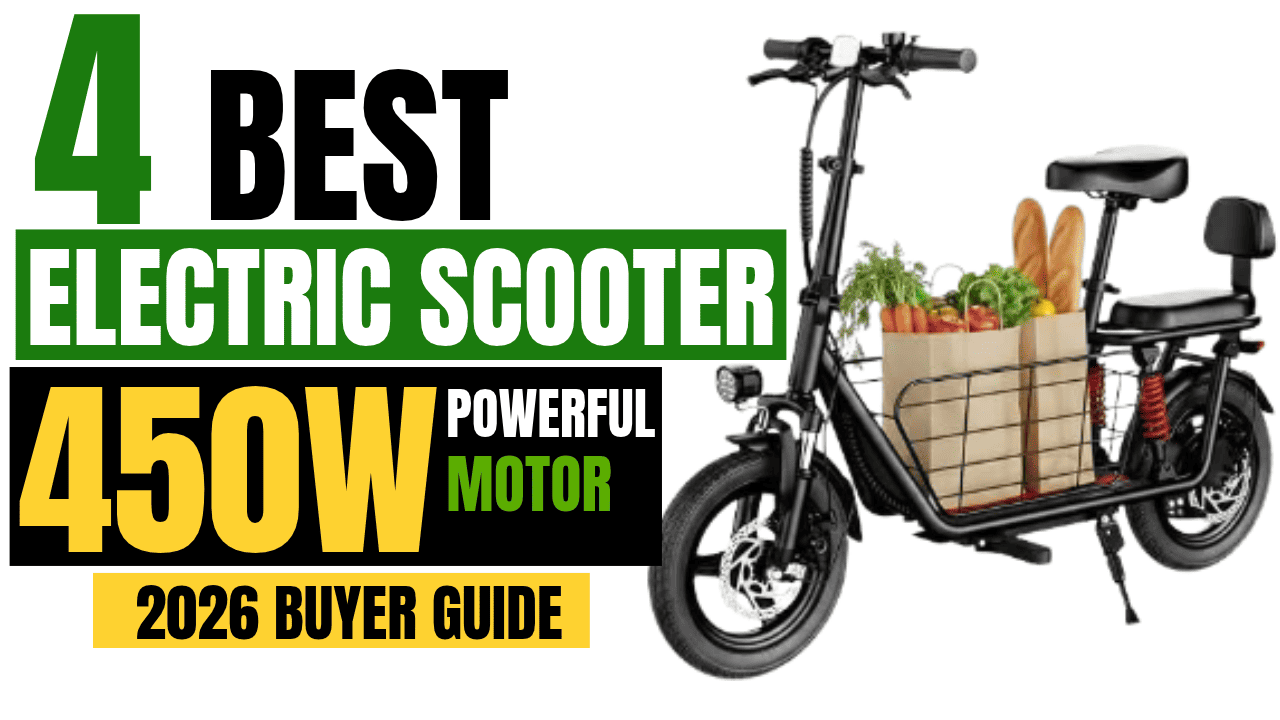
The 450-watt motor is an odd middle position within the marketplace of electric scooters. It’s way too powerful for “basic,” but it’s advertised alongside scooters that boast 800W, 1000W, or even 2000W. These are numbers that make 450W sound weak when compared to them. Most of the time, however, it’s not.
An authentic rated 450W motor generally climbs 15 to 20 percent grade and can handle riders weighing between 220 and 265 pounds. It’s sufficient for urban trips with moderate slopes. The top speed, however, isn’t as simple as the power number itself suggests (as the comparison of models below will show that 2 “450W” scooters can differ by a couple of mph based on the tuning of the gears as well as battery voltage, in addition to the motor’s energy. The amount of power you need is contingent on the particulars that this article outlines.
4 Best electric scooter 450w powerful motor
Answer: The most powerful selections for 450W riders currently are the Hover-1 Alpha 2.0, AWWSCOOTER C1, and RIDWIND Electric Scooter that has a seat, and Caroma P2. Each one is suited to an individual type of rider that ranges from low-cost commuters to riders who require additional range and storage space.
The following is what each really delivers, and what it doesn’t, as well as who it’s best suited for, according to the manufacturer’s specifications, as well as independent tests and the sales material.
Hover-1 Alpha 2.0 — Best for Budget, Flat-Ground Commuting
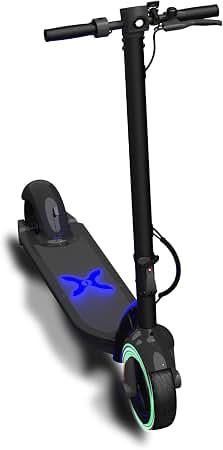
Answer: The Alpha 2.0 is the pick to get a small, low-slung scooter ideal for flat, short commutes with a limited budget, but not for hilly terrain.
The Hover-1 markets its Alpha 2.0 as a “450W” scooter, but independent tests showed it’s the equivalent of a nominal 350W motor, with a peak of 450W — an excellent real-world illustration of the gap between rated and peak labeling that’s covered in the next report. Even with a lower rating, the Hover 2.0 has the highest top speed among the four models in this review (18.2 mph measured), as a warning that top speed and the torque for hill climbing don’t measure in the same manner.
Properties:
- 350W nominal / Peak brushless power of 450W
- Top speed: 18 miles per hour (independently tested at 18.2 miles per hour — among the fastest within its price range)
- The range can be as long as 12 miles
- Max rider weight is 264 pounds.
- 10″ tire with air-filled, disc brakes on the rear
- Foldable, 34.4 lbs, UL 2272 & UL 2271 certified
- Bluetooth speaker, LED deck lights, cruise control
Where it falls short:
- Independent hill-climb tests took just 28 seconds at a 10% incline, which was slow for the entire class. It also confirmed the true 350W nominality that lies behind”450W” in the “450W” label
- No zero-start throttle
- The seat is not available.
- 12 miles is the lower end of this class of power.
Best for: People who prefer smooth pavement and want an easy-to-fold scooter, with fun accessories (speaker and lights) but don’t require the real strength to go up hills.
AWWSCOOTER C1 — Best for Seated Commuting and Errands
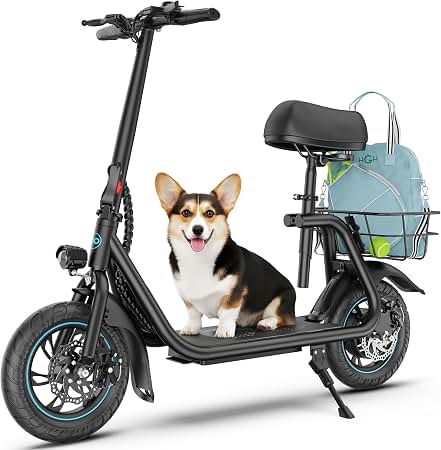
Answer: The AWWSCOOTER C1 will be the best choice for cyclists who require a seat, a basket, as well as twenty miles of distance above the speed of an actual.
Properties:
- High-torque motor rated at 450W.
- The top speed is 16 mph in three types (16, 12 / 9 miles)
- The range can be as long as 20 miles
- Maximum weight of the rider: 265 pounds
- 12″ pneumatic tires with anti-slip, two brakes, front and back LED lights
- Seats that can be adjusted (fits users 5’1″-6’1″ and ages 12and over) with rear basket LCD
- Certified by UL 2272
Where it falls short:
- The top speed of 16 mph is a bit low compared to other scooters of this category. The Alpha 2.0 is designed to maximize torque, range, and comfort, rather than speed. Don’t count on it to go as swiftly as the Alpha 2.0 above, despite having more watts of power.
- There is no suspension beyond the pneumatic tires. So the rougher surface is likely to be perceived.
- The product is sold under various similar name rebadged versions (Gyroor, Urbanmax, Everyfun, all of which use the exact “C1” design); therefore, the build quality may differ depending on the seller. Check reviews on the listing you’re looking at purchasing.
Best for: The ideal choice for commuters in the city and college students or senior citizens who need an enjoyable ride in a comfortable seat equipped with a basket for shopping or running errands. Also, they appreciate the range of motion and torque on hills over speed.
RIDWIND Electric Scooter with Seat: Multi-Terrain Leisure Riding
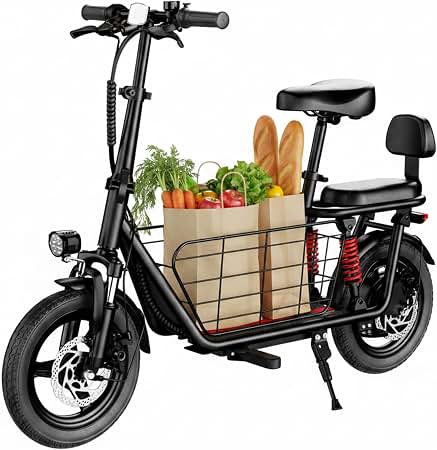
A quick answer is that the RIDWIND is the best choice if you’re looking for a leisurely sitting ride on grass, sand, or dirt paths, rather than a hurried journey.
Properties:
- Rated brushless motor of 450W
- Speed: 15.5 mph
- The range is up to 20 miles (36V 8AH battery)
- Max rider weight: 265 pounds
- 12″ tires that are suitable for trails, grass, and sand roads. highways
- Front and rear dual disc brakes, comfortable cushioned seat, wide footboard, 13 ” x 11 ” back basket
- 35.5 lbs, 95% pre-assembled
The areas where it fails:
- The slowest top speed among the four (15.5 miles per hour). Again, the result of tuning to lower-speed, multi-terrain torque than a weaker motor.
- The safety certification listed on the listing is “UL2277” rather than the regular UL 2272 on some websites. Be sure to confirm that the certificate is valid directly with the seller before purchasing.
- Similar format for seated commuters as C1 from AWWSCOOTER C1; therefore, the decision between them usually depends on the seller’s reputation and price more than any significant specification distinction.
Best for: Ideal for casual riders looking for a comfy sitting scooter that is able to take on a mix of terrains such as campgrounds, parks, and unpaved roads in a comfortable manner instead of a frantic road trip.
Caroma P2: Best for Range & Payload
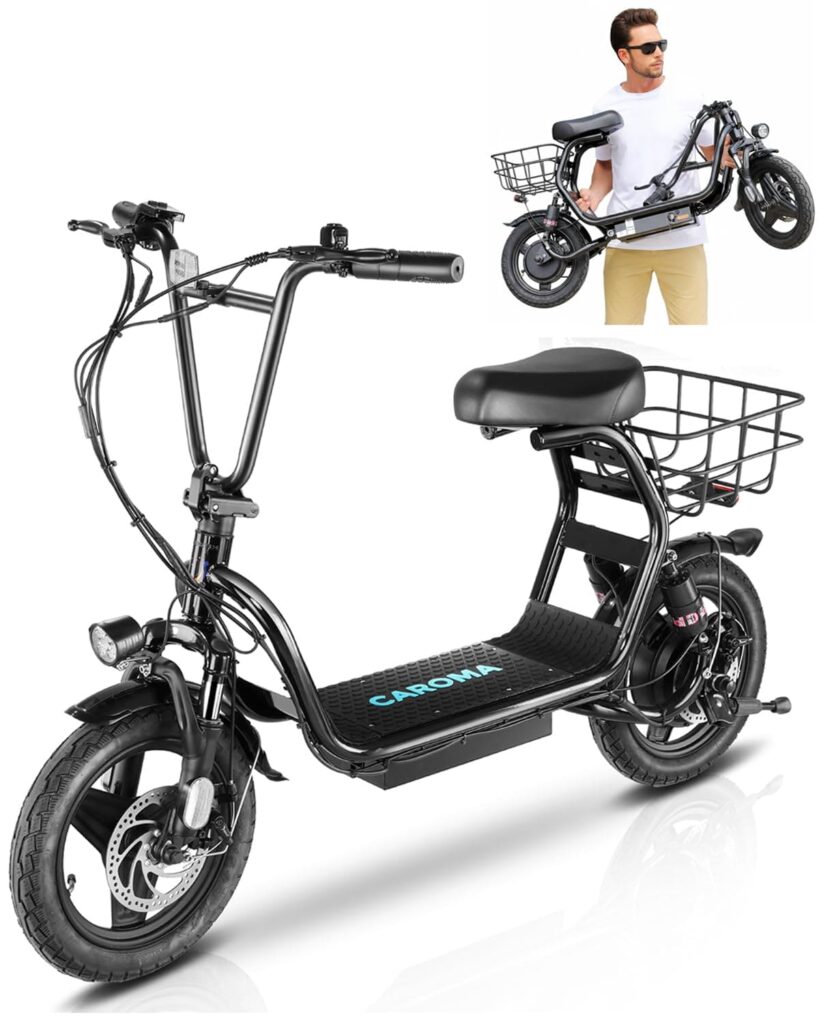
A quick answer: Caroma P2 is actually built around a motor of 500W (819W maximum), which is an upgrade from the 450W level — and is an ideal choice if you need more speed, range, and capacity for weight and aren’t afraid of taking on a little more.
It’s worth noting that although it’s sometimes grouped alongside scooters that have 450W ratings in searches, the Caroma’s own specification sheet declares the P2 to be an 819W rating, rated at 500W maximum motor. This is because it’s an often-used next step when shopping within the 450W category, but not since it’s actually a 450W model.
Properties:
- Motor is rated at 500W and has a peak of 819W. motor
- Maximum speed: 20 mph
- Distance: 25 miles (48V battery)
- Max rider weight: 300 pounds
- 14″ tires, two disc brakes that have an automated power cut-off
- Height-adjustable handlebars and a seat
- Around $260. 3.8/5 is the average score from the number of reviews.
Where it falls short:
- It is heavier at 56 lbs, and it is more difficult to lift the steps or fit it into a car trunk.
- The price is higher than the standard price of 450W.
- There are fewer reviews compared to more established budget models. Therefore, it is more difficult to verify consistency.
Best for: Recommended for riders who are considering 450W scooters but require more hill-climbing capacity, a larger payload capacity, or a longer range for their daily use, and would be willing to sacrifice portability and cost in exchange.
450W Scooter Comparison Table
| Model | Rated / Peak Power | Top Speed | Range | Max Load | Seat | Best For |
| Hover-1 Alpha 2.0 | 350W maximum rated and 450W peak | 18 mph | 12 mi | 264 lbs | No | Flat-floor commuting on a budget |
| AWWSCOOTER C1 | Rated at 450W | 16 mph | 20 mi | 265 lbs | Yes | Seated commuting and errands |
| RIDWIND with Seat | Rated at 450W | 15.5 mph | 20 mi | 265 lbs | Yes | A casual, multi-terrain ride |
| Caroma P2 | 500W max. rated, 819W peak. | 20 mph | 25 mi | 300 lbs | Optional | Extra range & payload margin |
Be aware of the figures above. The table above is an excellent example of how power alone can’t tell you the speeds. The two rated models with 450W ratings on this list (AWWSCOOTER C1 and RIDWIND) are, in fact, the two slower models, with top speeds of 16 miles per hour and 15.5 miles per hour, while the 350W nominal Hover-1 is able to reach 18.2 miles per hour.
It’s because both models that are rated 450W have been tuned to provide performance, comfort in the seat, and range, not flat-ground speed. Be wary of the assumption that a higher Wattage means that it’s a more powerful scooter. Instead, check the speed spec of the model you’re looking at, not just that motor’s class.
What’s the bottom line with the four models: If you are looking for a rated 450W motor with seating and an actual range, then the AWWSCOOTER C1 and RIDWIND are closest to each other. Choose between them depending on your terrain (RIDWIND is multi-terrain; AWWSCOOTER C1 leans toward paved commuters). The Hover-1 Alpha 2.0 can be used for a lighter, more affordable, no-seat commute on plain ground. It’s one of the most efficient, even though it has a lower watt rating. Its Caroma P2 is worth considering for those who are interested in going beyond 450W to gain more power, speed, and load capacity.
The Number That Actually Matters More Than 450W
Prior to comparing the power class, there’s an issue with labeling that’s important to address, since it’s a concern for almost all scooters that are advertised as having a wattage number.
Manufacturers provide wattage information by one of two methods:
Rated (continuous) power is the power that the motor can handle in normal use without causing excessive heat.
Peak power is a small burst that can be used for just a few seconds in an acceleration that is hard or a climb that is steep, typically 1.5-2x the figure that is rated.
The scooter that’s listed with “450W” might mean a real continuous 450W motor, or it may refer to an older motor that has a 450W peak, but the output is lower over time. Both motors behave very differently after a short time on a steep road. The one with the highest rating is more powerful on the road, but it will noticeably drop as the motor accelerates to prevent overheating.
Which one you’re viewing: Check the guide or the page to find the terms “rated,” “continuous,” or “nominal” next to the Wattage number. If the listing shows only one number without a qualifier, consider it to be the term used to describe marketing rather than assured sustained output. Also seek out independent reviews which mention times for hill climbs or sustained speed when under load.
The distinction is more important than the actual wattage value since two scooters marked “450W” can perform noticeably differently in actual use — and, as the table below shows, the top speed by itself isn’t an accurate substitute for wattage.
What a 450W Motor Actually Delivers
In the event of a real rating of 450W and a 450W motor, what can you expect from a real-world application? These are standard ranges throughout the entire category. Actual maximum speed is different for each model’s tuning. The four scooters above demonstrate:
| Metric | Typical Range |
| The top speed (flat ground) | 15 to 20 mph. Some are tuned to go up to higher speeds. |
| Capacity to climb hills | 15% to 20% grade |
| Capacity of payload | 220-265 lbs |
| Range | 15-25 miles (battery-dependent and not motor-dependent) |
| Acceleration | Noticeably quicker than sub-350W motors. |
Torque — which is the driving power behind speed and climbing- is what a larger horsepower motor actually buys in terms of a more precise indicator of level than speed. A motor with a 450W rating can generally surpass a 350W nominal one even though the top speed on flat ground is lower, as the performance on a hill is based on continuous torque and not on maximum velocity.
A point of clarification that confuses many buyers is that the story of range is one about batteries, not a motor one. A 450W motor coupled with a small battery will travel less when compared with a 350W motor with a bigger battery. If distance is important to your travel plans, be sure to look up the battery’s watt-hour (Wh) rating in isolation from the motor’s wattage – two distinct specs answer two issues.
Who a 450W Scooter Actually Fits
Instead of considering the notion that “more power is always better,” it’s better to align the class of your motor with your commute.
A 450W motor will be suitable if:
- Find a path that has regularly moderate hills (10-15 percent grade is typical in neighborhoods with hilly terrain)
- Weights should be in the 180 to 240 pounds range, and motors with lower watts begin to show visible stress.
- Are you looking to increase your acceleration or hill-climb margin, but without the cost of the more expensive, heavier 600W+ machines
- The pavement is mixed with ride — cracks in curb cuts, sidewalks, lightly sanded areas — in which torque under load is more important than the more powerful top speed.
A motor with 450W is likely not enough for you if:
- The slopes are consistently steep with a grade of more than 20%.
- You must carry a passenger or cargo weight of more than 260 lbs.
- Are you looking for more extensive off-road capability, in which dual-motor configurations of 600W+ provide more reliability?
You may need higher than you actually need it to be in the event that you.
- The ride is almost completely flat. Short routes, less than a few miles
- Consider a light, more compact scooter over one with a motor.
500W in comparison to. the remainder of the Power Ladder
Comparing 450W to its peers makes it simpler to decide if this is the appropriate level. Take these tendencies as general instead of guarantees; as we’ve seen above, the individual designs within a class could differ:
| Power Class | Best Suited For | Typical Top Speed | Typical Hill Grade |
| 250-300W | Flat commutes, lighter riders | 12-16 mph | Up to 10% |
| 350-400W | Normal flat-to-mild-hill commute | 15-19 mph | 10-13% |
| 450W | Moderate hills and mixed terrain | 15-20 mph | 15-20% |
| 500-600W | Higher hills, more riders | 20-25 mph | 20-25% |
| 700W+ (often dual motor) | High-speed, off-road, and performance riding | 25-35+ mph | 25-30%+ |
In the same way as with the issue of peak vs. rated previously mentioned, some brands have a “450W” figure that’s actually an unofficial rating, paired with the much larger peak figure specifically for the purpose of separating between burst and sustained power. It’s the same; be sure to determine which one the advertising is using, as well as check for independent hill-climb or acceleration tests, if they are available, before comparing two scooters using wattage only.
Single Motor in comparison to Dual Motors at this Power Level
A few scooters with 450W achieve this number with just one motor; other models split it between two motors (for instance, two motors with 225W that total together 450W).
Single 450W motors are generally smaller, more energy-efficient, and simpler mechanically. Good default for dry, paved commuting.
Dual motor setups are often able to offer better stability and traction, particularly in rainy weather or on surfaces that are uneven, due to the fact that power is divided between the two wheels. They can weigh more and may drain the battery quicker under hard acceleration.
If you are commuting somewhere that has frequent rain or rougher pavement, a dual motor can be worth the weight. If you’re looking for an easier, lighter-weight scooter, the single motor 450W typically will win.
Reading the Rest of the Spec Sheet
The motor isn’t operating on its own. A number of other elements affect the way a 450W electric scooter rides:
- Battery (Wh) is the unit that determines its range independent of motor wattage, in the manner mentioned above.
- Tires: Good tires require lower maintenance. The pneumatic (air-filled) tires provide greater performance and comfort, especially in rough terrain and on steep hills.
- Brakes: At speeds that a motor with 450W can achieve, disc brakes generally provide greater stability in stopping than the simplest electronic brake on its own.
- Resistance to water (IP rating): Ratings like IP54 and IPX4 show water resistance. Higher numbers like IP65 and IP56 hold up better in actual rain. That’s important when your travel plans aren’t just fair-weather.
- Certification of the battery: Search for a UL 2272 certificate, which confirms that the battery and electrical system adhere to a safety standard. This is something to be aware of regardless of the motor’s amps.
Is a 450W Scooter Street Legal in the US?
That’s why a lot of consumers get caught out due to the fact that “legal” depends on more than the motor’s power.
On a federal scale, electric scooters are usually considered low-speed when they have a motor under 750 watts and a top speed of 20 mph (this is an initial classification and not an operating law that is universally applicable. Cities and states layer their own regulations over it, and the rules can be quite different and shift over time; thus, consider the following guidelines as an overview and not current advice from a legal expert. Check your city’s and state’s current regulations before purchasing or using:
- The majority of states permit operation up to around 20 mph on bike lanes. No licensing or registration is needed for an individual low-powered scooter.
- California limits operating speeds to 15 mph. It also prohibits the use of sidewalks regardless of the motor’s power rating. Its scooter statute does not set limits on wattage as it does for its e-bike regulations, and I don’t believe that the 750W amount is the same for scooters.
- New York similarly caps scooters at speeds of 15mph, despite the fact that the vehicle itself is capable of speeds up to 20 mph.
- Scooter regulations have changed across a variety of states over the past few years, as well as some changes to previous restrictions. Rules for this field change regularly enough that an individual state-by-state guideline here will be outdated in a short time, so make sure to check with your state’s DMV or your transportation department’s latest page in the first place.
- Requirements for helmets, thresholds for riding, as well as access to sidewalks are determined state-by-state and, sometimes, city-by-city in addition to that.
A motor with 450W is within the federal baseline wattage nearly everywhere in the US. One thing that varies is speed limits for top speeds as well as the places you’re allowed to drive — thus, you should check your particular state’s rules before thinking that the 750W/20mph federal limit will be the only thing to consider.
What to Expect to Pay
| Budget Tier | Typical Price (USD) | What You Get |
| Entry | 300-500 | Rated or peak-marketed motor 450W, less battery size, solid tires |
| Mid-range | 500-900 | True-rated 450W motor, more battery capacity, and pneumatic tires. Also disc brakes |
| Premium | 900-1,500+ | 450W (often double-motor, or in conjunction with an extremely high capacity). App connectivity, suspension, and extended reach |
Pricing can vary based on brand and promotions at retailers, and the figures are based on the general US market instead of a specific seller’s price.
Common Mistakes Worth Avoiding
- The treatment of peak wattage as though it was the power that is sustained. A “450W” listing with no “rated” or “nominal” qualification warrants a second glance.
- The assumption is that a higher wattage means more duration. Battery Wh, not motor power, determines range. A high-watt motor could burn the battery more quickly.
- The assumption that a higher wattage is rated will automatically translate into a greater top speed. In the above model, as the comparison indicates, a electric scooter with a nominal 350W is able to outrun the 450W model on flat ground. The wattage of a vehicle is a far better gauge of torque on the hill than top speed.
- Do not ignore payload limitations. Remaining in constant contact with or exceeding the weight capacity of the motor reduces the battery and motor’s lifespan.
- Do not do away with the formal checking. An item that is legal to market nationally might not be legal for you to use at full speed, or on sidewalks, within your particular state or in your city. The regulations change regularly, so make sure to check for current information rather than using a single source.
- It is not a good idea to buy based on the wattage. Water resistance and the battery’s certification can all impact the way a scooter of 450W performs and will last as time passes.
FAQ
Are 450W motors powerful enough to power the scooter?
In most urban areas with a moderate hill, yes — the 450W motor has plenty of performance and torque, yet is not too powerful for daily cycling.
What is the speed of the 450W model?
The speed varies more than one would think — usually 15 to 20 mph when on flat terrain; however, the actual speed varies with the weight of the driver, tires, battery charge, and the way in which the model is geared. A few 450W-rated models are more focused on power and speed over top speed. They top out in the mid-teens.
Does 450W suffice to conquer mountains?
A rated 450W motor typically can handle inclines of 15-20% without a lot of strain. The steepest terrain may reduce its performance more than a higher-wattage motor.
What’s the distinction between the 450W and 1000W scooters?
Most of the time, it’s about the way they’re labeled, not their pure power. For instance, some “1000W” scooters use that number as a maximum rating of a lower nominal motor. Other models are equipped with a real continuous 1000W motor that is more powerful for continuous hill climbs as well as heavier weights.
What is 450W? Does it mean rated power as well as peak power?
This can mean either, depending on the brand. You can look up the terms “rated,” “continuous,” or “nominal” next to the power level to determine which is actually what you’re receiving.
Can a 450W electric scooter be considered street-legal everywhere in the US?
The motor’s performance is within the low-speed base for all vehicles; however, the maximum speed limit and the areas you are allowed to ride vary by state and shift over the course of time. California as well as New York, for instance, limit operating speeds to 15mph, regardless of what the motor can do. Make sure you know the current regulations in your state prior to buying.
Is a single 450W motor or a dual motor more effective?
A single 450W motor is typically lighter and better when it comes to dry, asphalt commuting. A dual-motor setup with the same wattage combined tends to provide better traction under wet and uneven conditions, with the added weight.
Bottom Line
A motor with 450W is a decent middle ground option, sturdy enough for commuters who are hilly and heavier users, but without the costs, weight, and battery consumption of moving upwards to 600W or higher. It’s not enough to provide all the information you need; however, the article’s models’ own comparisons demonstrate that it’s not even able to forecast the speed at which you’ll reach.
Before purchasing, verify that the wattage figure listed is either measured or peak. Also, verify the battery’s Wh ratings separately from the specifications for the motor, as well as look up independent hill-climb tests rather than the top speed figure alone. Also, make sure you look at your state’s current electric scooter speed as well as riding regulations. These checks are more important for your everyday experience than the numbers that are printed on the package.
About the Author
Huzaifa is the creator of Electric Scooter Analysis, a blog that covers electric scooters of all kinds, including off-road, city, and special circumstances. Data is obtained from manufacturer specs, as well as opinions from riders. Figures are flagged if there’s no proof.
“The information on this website is gathered from industry reports, manufacturer specifications, expert reviews, and trusted sources such as gyroor to provide accurate and valuable insights for our readers