Answer: An 800W electric scooter falls in the moderate-power commuter class, which typically is 25-30 mph and travels between 20 and 30 miles on a single charge (up to 50 miles with larger capacity models) The scooter is made to handle the rigors of hills and larger riders But “street legal” depends entirely on the state’s speed limits rather than the wattage of the device.
- Four models from this guide are:
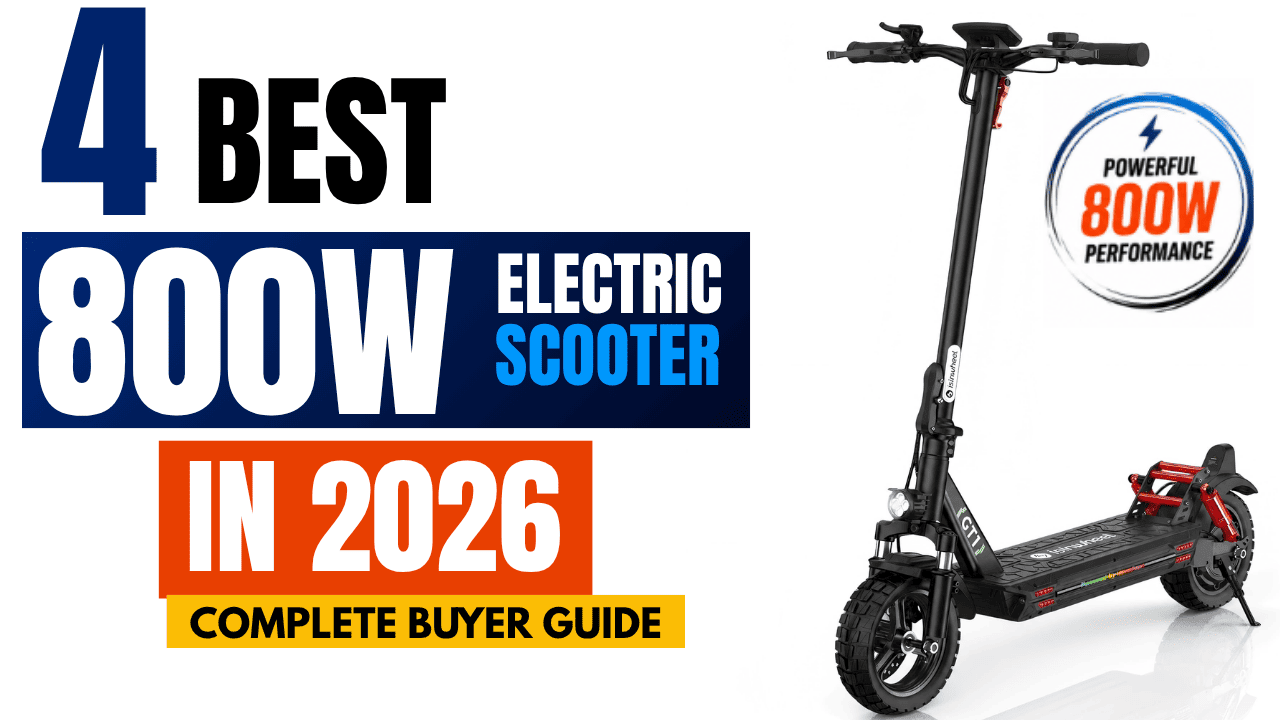
- isinwheel GT1 the best overall for Hills and heavier Riders
- Caroma P1 — Best for Comfort and Casual Commuting
- Segway Ninebot MAX G3 — Best Premium, Long-Range Option
- KOWOEE E10 Pro Max — Best Value for Maximum Range
If you’re trying to compare electric scooters but keep landing at the 800W electric scooter level, then you’re probably asking the correct question. The amount of power doesn’t necessarily reveal the entire story. It’s just a good base to determine what kind of scooter is best suited to your terrain as well as your weight and your daily commute, without leaving you stuck halfway up the hill.
There’s a problem that many buying guides miss: “800W” on a list could refer to the engine’s constant output or a high-frequency peak in a short burst; in some instances, it may not match the actual motor in the box. The one thing that can make a difference is the speed at which a scooter climbs the hills, how long it can actually travel, as well as what it’s allowed to do in the streets depending on where you live. Before you start making recommendations, be sure to know what exactly you’re buying.
Below, we’ve put together the four 800w electric scooters worthy of being considered in 2026which includes a true-to-spec model and one budget model that prioritizes comfort as well as a premium model, which is just above the class as well as a higher-wattage scooter that is crossed-shopped within this category -and then everything else you’ll need to know what speed and range operate, what’s legally legal for your particular state as well as how 800W ranks against other power-tiers, as well as the major mistakes made by many novice purchasers.
4 Best 800W electric scooters in 2026
The quick answer is: for most users I would suggest the isinwheel GT1 is the best all-around real-800W option, while and the Caroma P1 is the best choice for budget-conscious riders, and the Segway Ninebot MAX G3 is the most reliable long-range pick (850W which is slightly above the 800W category) as well as the KOWOEE E10 Pro Max is an excellent value option to get the most range with an lower cap on speedalthough it has an engine that is 1000W rather than an exact 800W motor.
We chose these four models because they are the true range of what the concept of “800W” means in the marketplace today. From an actual 800W motor designed for off-road terrain and a 500W/800W peak comfort scooter, to a high-end longer-range model that is just a bit higher than the class, as well as an affordable budget scooter with a higher wattage that can still be found with the 800W model. This is how each works, what areas each does not perform, as well as who the product is designed to serve.
isinwheel GT1 — Top Overall for Hills and heavier Riders
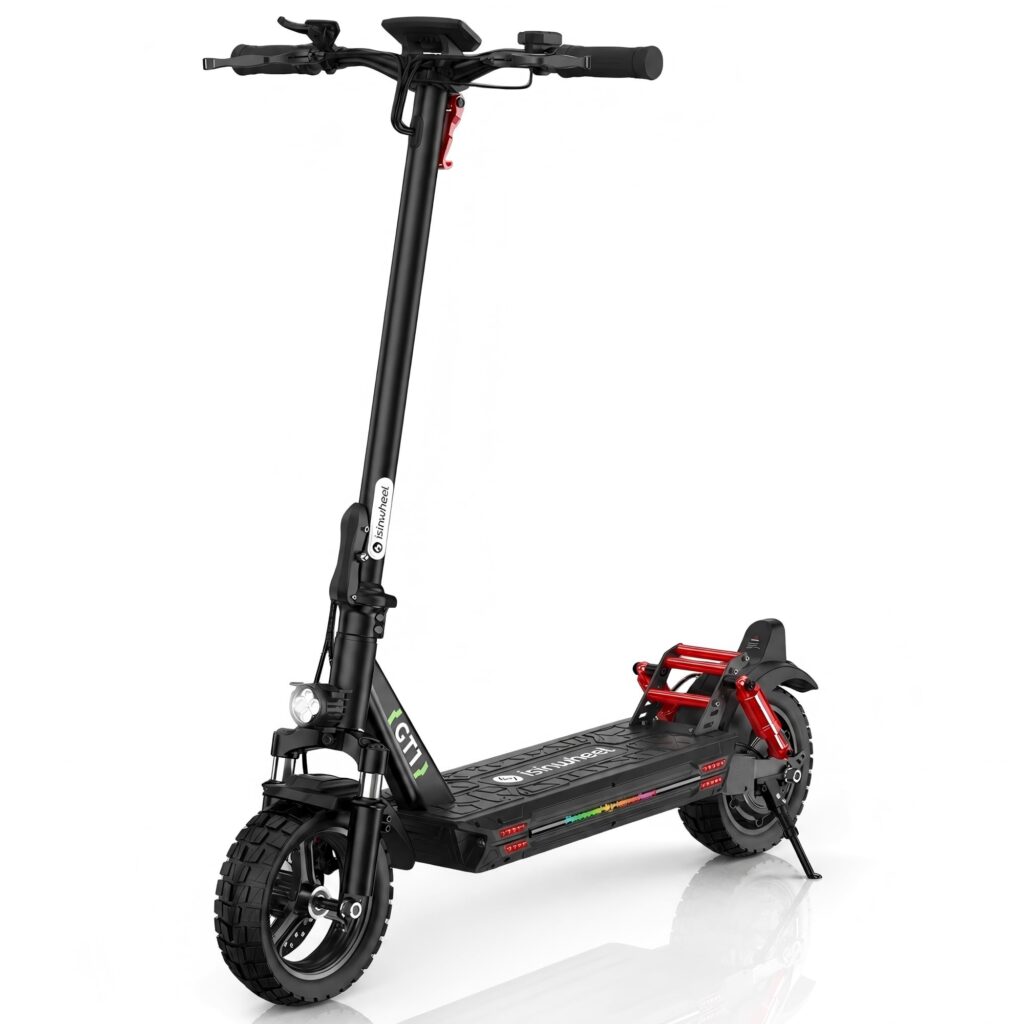
It’s a simple answer: the GT1 is the only “true to spec” 800w electric scooter available, with a real 800W nominal motor, paired with off-road tires, and a capacity of 330 pounds.
The key specifications:
- Brushless motor 800W (rated as continuous) with 4 speeds 9/15 / 21/28 speed
- 48V 10.4Ah battery (~500Wh) with a 28-mile range, 4-5-hour charge
- 10-inch pneumatic off-road tires with rear and front suspension
- Dual disc brakes, plus Electronic anti-lock (E-ABS) system.
- Maximum rider weight of 330 pounds
- Complete lighting kit (headlight and taillights, turn signals, light sources, and ambient lights) and also app connectivity
- Certified UL 2272
- Around $530
It’s not perfect:
- With a weight of 52 pounds, this is one of the largest foldable scooters available in this category and is not the best choice for those who have to carry it on their back every day.
- The water resistance rating is IP54. This is sufficient for drizzle, but not for torrential downpours or Puddles.
- The top speed that is unlocked (28 miles per hour) surpasses the legal limit in many states, which means you’ll need to turn on your built-in street mode to ensure roads that are road-safe.
Recommended for: Riders dealing with real terrain or who have more weight. Capacity of 330lbs and double suspension make it the best selection for riders who are heavier than average or traveling on bumpier roads.
Caroma P1 — Best for Comfort and Casual Commuting
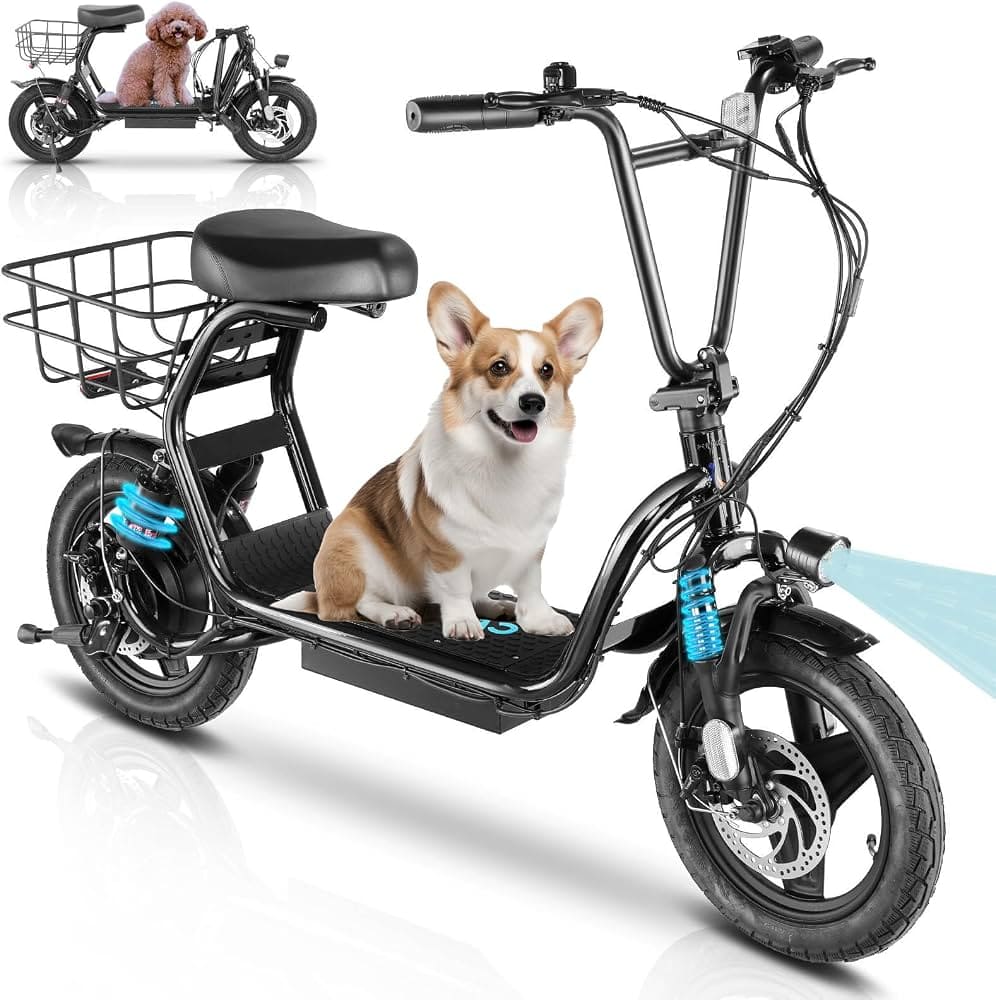
A quick answer: Caroma P1 is a 500W motor with a peak of 800W. It’s not an ongoing 800W model. It’s the most comfortable and easiest-to-license choice, but it’s not the strongest.
Specifications for key components:
- 500W rating (continuous) motor that has an 800-W peak power rating
- Maximum speed: 20 mph. With a rating of around 27% slope hills (about 15 deg)
- 48V batteries (~375Wh) (25-mile range ~5.2-5.5 hour charge
- 14-inch pneumatic fat tires that have rear, front, and seat shock absorption
- With a back basket (30 Lb capacity for cargo)
- Dual brakes (disc or drum ) plus EABS in accordance with the type of version)
- Maximum capacity of the rider: 265 to 300 lbs
- Certified by UL 2272
- Around $300-350
It’s not perfect:
- Its “800W” figure is peak-only; that is, the motor’s continuous power is just 500W, which means it will not out-climb or accelerate a motor that is rated at 800W, as GT1’s.
- The top speed of 20 mph is less powerful than the other three scooters on this list.
- Capacity of battery smaller than GT1, MAX G3, or E10 Pro Max
Recommended for: Passengers on the go and runners who need seats, a luggage basket, and a lower cost, and who’d rather stay within the 20-mph limit that is usually a legal limit rather than pursue speeds that are higher than that.
Segway Ninebot MAX G3 — Best Premium, Long-Range Option
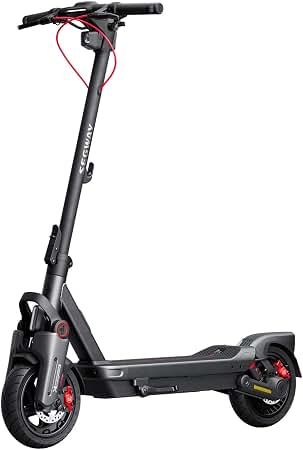
Answer: The MAX G3 delivers the longest distance and smoothest experience of all four; however, its nominal motor of 850W lies just above the 800W range and is priced about twice as much as the other models.
Specifications for key components:
- The nominal power is 850W. (continuous) Motor with 2,000W maximum
- The top speed is 28 mph (app-unlocked, and 20 mph is the default speed limit)
- 597Wh lithium battery (46.8V, 12.75Ah) -Up to 50 miles of range when in Eco mode.
- 3.5-hour recharge (2.5 hours using dual charging)
- Self-sealing tubeless tires of 11 inches equipped with two hydraulic suspensions
- 286 pounds max load. Scooter weighs 54.2 pounds
- Dual disc brakes, plus SegRide stability control as well as Traction control
- IPX6 resistance to water
- Around $899-999
It’s not perfect:
- The most costly bike on this list, almost double the price of the GT1.
- This is the heaviest scooter, at 54.2 pounds. This makes the frequent transport of this scooter less feasible.
- The motor’s 850W rating technically puts it just above the 800W range; thus, those looking to buy “800W” should note this is a lone exception, with its 50-mile distance coming from a bigger (597Wh) battery and not only the motor.
Ideal for serious daily commuters looking for the most realistic range, the finest ride experience, and top safety features who will spend more money to get the best features.
KOWOEE E10 Pro Max — Best Value for Maximum Range
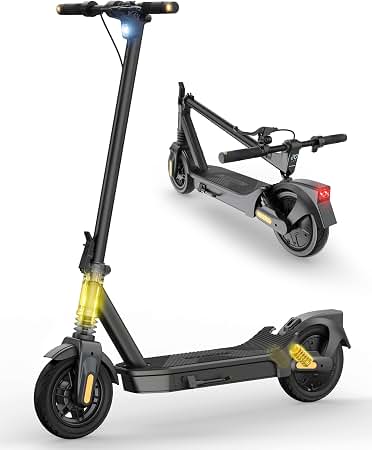
It’s a simple answer: the E10 Pro Max delivers the largest range and the lowest cost of all four models; however, most listings currently indicate its motor as 1000W instead of 800W. It is worth checking prior to buying, unless you’re specifically interested in the class of 800W.
Specifications for key components:
- Rated motor of 1000W (per the latest manufacturer listing; see the note below). Electronically limited to 20 miles per hour.
- 20 mph is the top speed (the cap is determined electronically by the controller and is not a limit on the motor)
- A 40-mile distance
- 10-inch tubeless tire with front suspension as well as rear suspension with dual suspension
- Front drum brake plus rear EABS (no disc brakes)
- Water resistance IPX5, UL2272 certified
- Large 22-inch handlebar, along with a 6.8-inch-wide deck
- Around $400-430
The areas where it fails:
- The majority of listings on retailers for this model state an engine with 1000W, not 800W. If you are looking for a scooter that is in the 800W category, check the latest list prior to purchasing, as the specifications and lineup of KOWOEE changed between models.
- There are no disc brakes; it is based on a front drum brake and rear EABS that provide less stopping power than discs-equipped GT1 as well as MAX G3, even though the limit of 20 mph reduces the risk a bit.
- The maximum speed can be set at 20mph, regardless of a motor’s wattage, which means you’re only paying for the battery’s capacity and range and not the top speed.
Recommended for: Buyers with budget-conscious needs looking for the most possible range and who are happy riding inside the 20-mph limit of the street instead of chasing the top speed.
800W electric scooter Comparison Table
Answer: The GT1 has the edge on capacity for load and hills. The Caroma P1 wins on price as well as comfort. The MAX G3 wins on range as well as build quality. The KOWOEE E10 Pro Max wins the range-per-dollar category — but no single model can win in every specification.
| Feature | isinwheel GT1 | Caroma P1 | Segway Ninebot MAX G3 | KOWOEE E10 Pro Max |
| Motor (rated or maximum) | 800W / — | 500W / 800W peak | 850W / 2,000W peak | 1000W (see the above note) |
| Top Speed | 28 mph | 20 mph | 28 mph (20 mph default) | 20 mph |
| Range | 28 miles | 25 miles | up to 50 miles | up to 40 miles |
| Battery | 48V 10.4Ah (~500Wh) | 48V, ~375Wh | 46.8V 12.75Ah (597Wh) | The manufacturer has not yet published their information. |
| Charge Time | 4-5 hrs | ~5.2-5.5 hrs | 3.5 hrs (2.5 hrs dual) | Manufacturers have not published the information. |
| Tires | 10″ pneumatic, off-road | 14″ pneumatic tire | 11″ tubeless, self-sealing | 10″ tubeless |
| Suspension | Front and rear | Seat, front and rear | Dual hydraulic | Front and rear |
| Brakes | Dual disc + E-ABS | Disc/drum + EABS | Dual disc + traction control | Drum + EABS (no disc) |
| Max Load | 330 lbs | ~265-300 lbs | 286 lbs | The manufacturer has not yet published their information. |
| Water Resistance | IP54 | The article was not published. | IPX6 | IPX5 |
| Price (approx.) | ~$530 | ~$300-350 | ~$899-999 | ~$400-430 |
| Best For | Hilly terrain, more riders off-road | Budget, comfort, casual usage | Long-range, daily commute | Max range per dollar |
The bottom line is that if hill performance and rider capacity matter most, then go for the GT1. If you’re looking for the cheapest cost and also a comfy seat, sit-up ride, opt for the Caroma P1. If quality and range are more important than the price, then the MAX G3 is the strongest overall performer. For those who want the best miles for your dollar and don’t want disc brakes or high speeds, then the E10 Pro Max is hard to beat. Just check the current wattage prior to purchasing if remaining only in the 800W range is important to the buyer.
What Does “800W” Actually Mean?
Answer: “800W” can mean or refer to the motor’s constant (nominal) output, or its brief-burst peak output, and lots of listings that mention “800W” are actually quoting maximum, but with real-time power being closer to 400 or 500W.
An 800W electric scooter is equipped with a motor that’s rated at 800 Watts of power. However, here’s a point that many consumers don’t know: the number may refer to either the nominal (continuous) power, which is the engine’s capacity to sustain without overheating, or maximum power, which is the brief blast it could generate during acceleration or on a long upward climb.
Some scooters that are advertised with the tagline “800W” only deliver that amount at their peak. The average output is 400-500W. This gap can be significant. If a motor isn’t capable of sustaining the wattage it is rated for, it will slow in the hills, get hotter, and reduce battery life more quickly than one that is built using proper thermal management.
A good tip to consider before purchasing: make sure the description mentions peak or nominal Wattage. If not in the listing, take it with caution — and read reviews from users who mention “motor shutdown on hills” or similar issues that are an indication of a poorly constructed thermal system.
How Fast Does an 800w electric scooter Go?
Answer: The vast majority of 800w electric scooter reach speeds of 25-30 mph over flat ground; however, the actual cruising speed tends to be a little slower once headwinds, hilly terrain, and the weight of riders are taken into consideration, as well as many being electronically limited below the speed of their motors to ensure street-legal conformity.
The majority of 800w electric scooter can reach speeds of 25- 30 mph (40-48 km/h) in ideal conditions- smooth pavement with a light rider, as well as a fully charged battery — if unlocked. Most are sold with lower default speeds or a speed limit (often 20 miles per hour) in order to meet the standard street-legal limit.
The real-world cruising speed tends to slow down after you add in headwinds, hills, as well as a rider who is close to the scooter’s maximum weight limit. The speed isn’t just a power feature; it’s an amount of watts relative to terrain, load, and the way that the controller is designed to be able to handle it.
What Actually Affects Top Speed
| Factor | Impact |
| Weight of the rider | Heavier riders decrease speed as well as acceleration. |
| Terrain | Surfaces and hills have a tendency to slow down top speed. |
| The voltage of batteries | Systems with 48V and 52V typically have faster speeds than 36V |
| Tire pressure/type | Underinflated tires will increase the resistance of your wheels and can slow your speed. |
| Riding mode | The Eco/Normal/Sport mode limits speed. |
| The battery’s charge | The speed can decrease in the event that the battery gets low. |
| Software/firmware cap | Certain scooters limit top speeds significantly lower than the power would normally produce, irrespective of power. |
An 800W motor as well as 500W motors may reach the same top speed when riding on a flat surface, particularly if both have been software-capped to the exact maximum. It is more likely to show in the case of an uphill slope or with a heavier rider because the added wattage can keep your speed up instead of slowing down.
How Far Can You Ride on One Charge?
The short answer is 20-30 miles of range from an 800W electric scooter, and select models that are larger capacity (larger batteries and only more wattage) with a range of 40-50 miles in optimal conditions.
It is possible to expect around 20-30 miles of travel under ideal conditions for a normal-battery 800w electric scooter. Some models that have a bigger battery capacity can boast as much as 40-50 miles; the range is measured by the battery’s capacity (Wh) much more clearly than motor power. Similar to speed, real range is highly dependent on the user’s weight, their terrain, and the temperature.
The charging process typically lasts about 4-6 hours to complete a charge, and 3-4 hours with models that have fast charging. The best time to charge is at work instead of hurrying a charge that is only a fraction of the way to going on a trip.
Battery Specs Worth Checking
A motorized scooter that has an 800W motor requires a battery that will actually power it. Mid- and entry-level 800w electric scooters usually come with a battery of 48V somewhere within the range of 8-13AH (roughly 375-600Wh), which is enough to provide the required output needed to run a normal journey.
The larger capacity 48V packs that fall within a range of 15 to 20AH (roughly around 750-960Wh and more) are typically found on higher-end models with longer ranges as well as extend the distance further, yet don’t have to be used in order to run an 800W motor correctly. No matter what size, a unit that’s significantly undersized to draw the motor’s power will exhibit voltage drops when under load, which silently affects acceleration and performance on hills, regardless of whether the motor is properly rated.
Lithium-ion batteries are the norm in the board, and batteries’ chemical composition is more important than many consumers realize. Batteries built to ensure thermal stability are more durable over multiple charges and in hot weather.
Is an 800W Electric Scooter Legal to Ride?
The answer is in your state. The majority of states have a speed limit around 15 to 20 mph regardless of motor power, which means that a motor with a locked speed of 28-30 mph electric scooter isn’t street-legal when 800W is not mentioned in the stipulations.
It’s the one that is a source of confusion for buyers more than any specification sheet. The truth is that it all depends on the location you reside in.
Scooter rules within the U.S. are set mainly on a state and a city scale, rather than unified federal wattage rules, which are a really complex patchwork. The standards are generally based around the speed (commonly 20 mph is the maximum speed limit) instead of motor wattage in particular. As an 800W motor’s output is able to exceed the limit printed on paper, many companies provide these vehicles equipped with a software-delimited “street mode” — usually capped at around 20 mph. This is done to ensure that the scooter is in line with the standard state thresholds.
Some things to consider prior to riding when you are on public roads:
- The state actually sets the speed limit in your state. The majority of states have a practical limit at 15-20 mph, regardless of the horsepower rating of the motor. A scooter that is not locked at 28-30 mph might not be legal to use in the streets, even though 800W motors don’t have a specific designation in the law.
- The rules for wearing helmets. The rules vary significantly by age, beyond the state-specific rules. Helmets are generally compulsory for kids; however, there is no mandated state for adults. It’s just common sense in these conditions.
- The areas where you can cycle. The use of sidewalks is prohibited in many big cities. On the other hand, bicycles are often the only or most preferred route when they exist.
- Licensing. The majority of states do not require a permit for scooters that fall within the low-speed limit, but certain states do require it, especially for scooters that exceed the threshold.
As this is really the case, and it’s sometimes a city-by-city patchwork, you should treat “800W” as a performance specification rather than a legal assurance. Before purchasing or using, make sure you check the state’s latest E-scooter law and the city’s page on transportation. The rules there are frequently updated over the last couple of years. What might have been true in the past isn’t necessarily the case today.
500W vs. 800W vs. 1000W+: What’s the Difference?
A quick answer: 800W is somewhere in between — with more load and hill capacity than scooters with 500W, but without the additional cost in weight and complexity of models with higher horsepower. Be aware that the “typical” top speed by the wattage level is an average design, but not a guarantee that higher wattage scooters have electronic limits that are well below their motor’s maximum.
| Motor Power | Typical Uncapped Top Speed | Best Suited For | Legal Fit (General) |
| 250-350W | 15-18 mph | Low-level urban usage, flat terrain, quick excursions | Usually, it is easy to stay within the legal limit |
| 500-600W | 18-22 mph | All-day commuting, gentle hills | Often, they are close to the typical cap of 20 mph. |
| 800W | 25-30 mph | Heavy riders, hilly commutes and longer journeys | Most often, it exceeds the low-speed limits unless they are limited |
| 1,000-2,000W+ | 30- 40 mph or more (when not capped) | Riding performance, off-road usage | Often edges into moped/motorcycle-adjacent classification when uncapped |
It’s important to note that a 1000W or more scooter may not be more efficient on the road than an 800w electric scooter, as a number of models from the higher range, such as low-cost scooters like the KOWOEE E10 Pro Max above, are electronically capped at 20 mph, despite having a larger motor. This means they trade the top speed in exchange for the range and torque. The above table illustrates the speed that each model could reach when left uncapped, but not the speed that every model of the tier is actually shipped at.
The 800W model is an authentic middle ground with enough power to take on the rigors of a heavier rider without the additional costs, weight, or regulation complexity that is associated with locked 1,000W or more performance scooters. This is the best class for a commuter looking for a bit of performance headroom but without spending more than they’re legally allowed to use.
Who Should Actually Buy an 800W Scooter?
A quick answer: 800W makes sense when you’re on a hill and weigh more than normal or require more headroom. However, it’s too much for those who live in a 15-mph zone, or only have occasional flat, brief journeys.
This is a great choice if you.
- You can commute for miles, with obvious mountains on the way.
- It weighs more than the lightest riders. The extra torque helps keep the speed and range from exploding in the event of a heavy load.
- Are you looking for a power buffer to help with headwinds? Or to carry an item in a backpack or bag.
- Find a place with an official 20-plus mph ceiling or on private trails or private property.
This is probably more than what you’ll need if:
- Living in a strictly 15 mph zone and using public sidewalks and roads
- Want the lightest, cheapest option for occasional short trips — a 250–350W scooter will be lighter and less expensive
- If you need serious off-road capabilities, then a 1000W and dual-motor scooter will be more suitable.
What to Check Before You Buy
Answer: If you are not satisfied with the speeds and distance, make sure to check the material of the frame, brakes, and tires, the suspension, lighting, thermal management, as well as local availability of service. These determine if the scooter will last.
Beyond the speeds and distances, there are a few quality aspects that separate a bike that lasts over the course of an entire season.
- Material for frames. Frames made of aluminum alloy with reinforced welds are able to handle vibrations and strain better than thin-tube steel, especially at greater speed.
- Brakes. Disk brakes, or a combination disc-plus-electronic setup, are significantly safer than drum-only systems in the event that you’re frequently going 25 or more miles per hour.
- Tires. The pneumatic (air-filled) tires run smoother and are more stable. Solid tires exchange the comfort of a tire for less maintenance.
- Suspension. Front suspension, or front and rear on top models, becomes more crucial as the speed increases.
- The management of thermal energy. Be sure to look for indications that the cooling system is active, such as heat sinks as well as temperature gauges. If the listing doesn’t have any information about this, and the reviews refer to the possibility of hill-climbing shutdowns, it’s a red flag.
- Lighting. White light in the front and a rear red light or reflector are typically legally required and not negotiable in the event of night riding.
- Local service and warranty. The motors and controllers that are more powerful experience greater wear. Knowing the possibility of local support — rather than returning the scooter by mail should be considered when you make your purchase.
What Does an 800w electric scooter Cost?
The answer is simple: entry-level 800w electric scooter cost between $300 and $400; mid-range models range from $700-$1,100; and premium models with larger batteries and more powerful brakes range all the way to $1,800plus.
In general, pricing in this area is broken down into three levels:
| Tier | Price Range | What You Typically Get |
| Entry-level 800W-class | ~$300-$700 | One motor, simple or without suspension, 20 to 28 miles area |
| Mid-range 800W-class | ~$700-$1,100 | Greater battery capacity, double suspension, app connection |
| Premium 800W-class | ~$1,100-$1,800+ | A larger battery, disc or hybrid braking, more durable construction, high-end |
In addition to the price on the sticker, include ongoing expenses that include regular maintenance (tires and brake pads occasionally, part replacements) and, if I would like it, optional damage or theft insurance. All of these are not required for a scooter to be owned, though skipping this altogether can frighten owners when something is due for replacement.
Common Mistakes to Avoid
Most frequently made buying mistakes include assuming the street-legal status of a vehicle travels across state lines, mistaking power output for nominal, as well as buying at top speed without even checking the brakes or tires.
- In the event that “street legal” travels with you. A scooter that is legal in one town could not be legal in another state.
- It is important to ignore nominal. Peak wattage while comparing the listings can result in skewing every speed or range comparison you do.
- Buy based on the speed of your car and not taking a look at brakes, tires, or suspension -each of these factors is more important as speeds increase.
- Allowing the battery to become completely depleted for a long time can reduce its usable lifespan.
- Doing without a helmet since it’s not legal for adult drivers.
- Unlocking a speed scooter and riding at full speed on public streets without consulting your local cap first.
800W Scooter and The E-Bike: What Makes More Sense?
The quick answer is to choose an e-bike for your journey if it is long or you need greater stability when you speed. Opt for an 800W bike if portability, cost, and storage are essential. more.
If your commute lasts more than just a couple of miles or if you’re looking for more stability at higher speeds, you should consider having a look at the 800w electric scooter against a class 2 or 3 electric bike prior to making a decision. They generally have a longer distance as well as steadier handling when you’re speeding due to their seated location and more powerful wheels, and scooters are more mobile, along with the price and accessibility of storage even in tiny apartments.
Neither is universally “better” — it comes down to whether portability or comfort-over-distance matters more for your specific route.
FAQ
Is an 800W electric scooter fast?
yes- Most of them do. 25-30 mph with good weather in lock-free mode, and are noticeably more efficient than models with a lower entry level of 250-350W, but still far below fully locked top-of-the-line 1,000W+ scooters.
How far will an 800w electric scooter run with a single charge?
Most likely 20-30 miles with the standard battery model. Some models with higher capacity can go up to 40-50 miles, based on battery capacity, the weight of riders, as well as the terrain and riding mode.
Do you need a license for an 800W electric scooter?
Most likely not; however, it depends on the state in which you reside. The majority of states do not require it for scooters that are within the standard speed limit, but a handful have, especially when it comes to scooters that exceed the threshold.
Can an 800w electric scooter handle hills?
In general, yes, the 800W class of power is often praised as being capable of handling slopes that are roughly 15-20% grade (very approximately 8-11deg), which is better than lesser-wattage scooters. But performance depends on battery performance as well as thermal management.
Is 800W too much for a beginner?
It’s not necessarily so, but first-time riders should begin with a slower speed and increase their confidence before they can use all its power. Higher top speeds mean longer braking distances and smaller margins for error.
What’s the difference between a 500W and an 800w electric scooter?
This gap is evident when you’re under heavy load, such as hill-climbing speed, acceleration, as well as how much top speed is held for a heavier rider. If the ground is flat and empty, particularly in the case of both being software-capped at equal speeds, both can be quite identical.
Are 800w electric scooters street legal?
Most of the time, however, they are only legal when in a speed-limit “street mode” around 20 mph. If you are driving a vehicle that is not locked, the speed could put you over the legal limits of your area. Always verify before you decide.
What electric scooter in the 800W class is the best all-around?
The isinwheel GT1 provides the most balanced combination of 800W true strength, hill-ability, as well as rider capacity. Buyers with limited budgets should think about an option like the Caroma P1 or KOWOEE E10 Pro Max. Riders looking for the most range as well as high-end build quality ought to consider an upgrade to the Segway Ninebot MAX G3 (850W).
Final Thoughts
An 800W electric scooter is an extremely beneficial middle-ground choice that provides sufficient power to handle steep hills, heavy riders, as well as longer rides, but without the expense and legal issues that accompany the fully locked 1,000W-plus high-performance models. The value on the specification sheet doesn’t matter as much as the way it’s used — the low versus high wattage batteries, capacity of the battery, and brakes’ quality can affect the way you ride more than just the headline number.
Before you buy, make sure to check the current state and local regulations on speed and wattage, ensure that your brakes and battery match what you’re going to ride on, and compare real-world models similar to those above instead of just the specs—also, budget for the essential safety equipment along with the bike, the scooter itself. Be sure to do these things correctly. 800W is one of the best classes of power available at present.
About the Author
Huzaifa is the creator of Electric Scooter Analysis, a blog that covers electric scooters of all kinds, including off-road, city, and special circumstances. Data is obtained from manufacturer specs, as well as opinions from riders. Figures are flagged if there’s no proof.
“The information on this website is gathered from industry reports, manufacturer specifications, expert reviews, and trusted sources such as gyroor to provide accurate and valuable insights for our readers