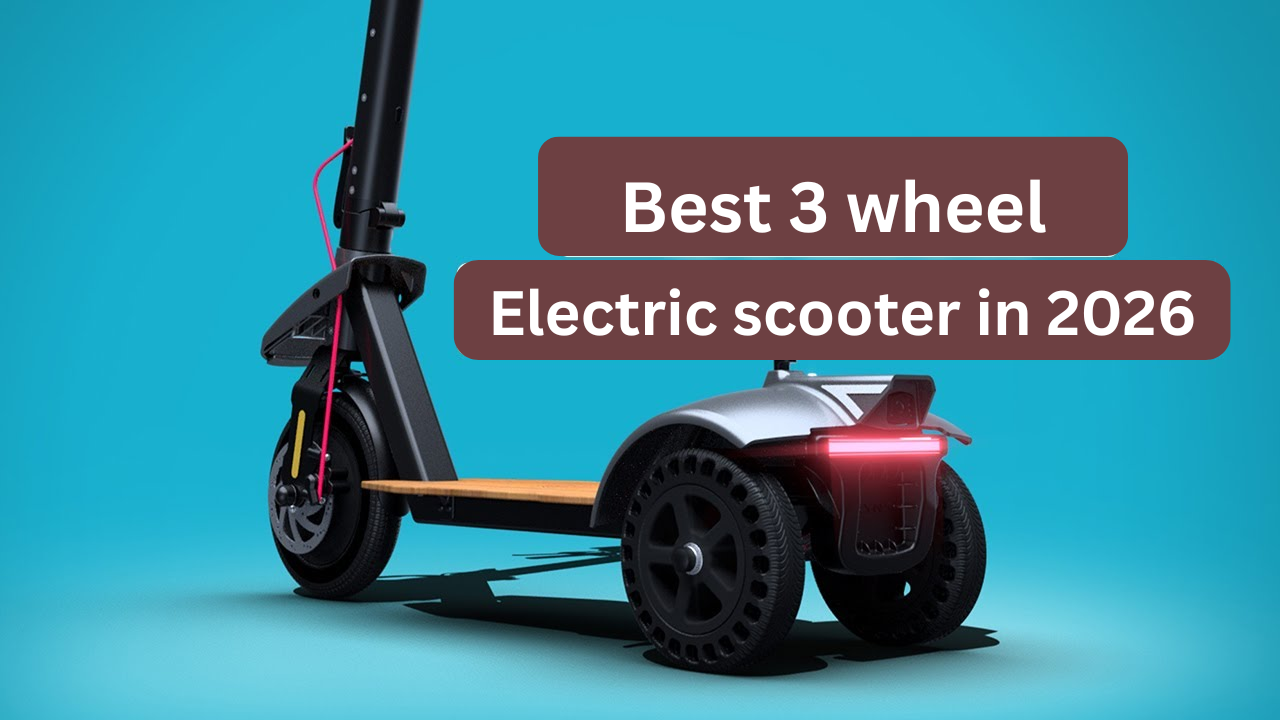
An 3 Wheel Electric Scooter is a self-powered, battery-powered motor vehicle. It features three wheels, typically two at the rear and one in the front. It provides self-supporting stability and doesn’t require the riders to be in the balance. It is used to assist seniors with mobility and urban commutes, as well as for commercial deliveries.
The 42 words of the definition can be enough to allow a virtual assistant to communicate; however, it’s just scratching the surface of the factors that make these vehicles one of the fastest-growing areas of today’s micro-mobility.
The global 3 Wheel Electric Scooter market is estimated at $4.02 billion in 2025. This market will expand to $12.67 billion in 2035. The market is expected to grow at an annual rate of 12.16 percent (Market Research Future 2025). This market’s growth is driven by three concurrent factors: the aging of rapidly growing populations across Asia-Pacific and Europe, and a massive transition away from short-range gasoline-powered transport.
It is possible to purchase an adult who needs mobility, is considering all available delivery options, and is tired of dragging a scooter that isn’t capable of handling the urban environment. This blog provides all details about a 3 wheel electric scooter.
What Is a 3 Wheel Electric Scooter, and How Does It Differ?
2-Wheeled Electric Scooters: The best type for you is the sit-on ones, and push off to where you will not slip when you reach a notch from facing toward that little red sign.
3 Wheel Electric Scooter designs solve that problem by using a single wheel. The triangulated wheel base provides an extremely solid, stable platform that stays straight while the person is sitting in a vehicle, transporting items, or scaling a steep gradient.
There are two major types of wheels:
- Delta configuration: one wheel in front, and two wheels at the rear. It’s the most well-known design of medical-grade mobility scooters made by manufacturers such as Pride Mobility, Invacare, and EWheels. It is a great rear grip and has a compact turning radius, making it ideal for indoor use.
- Tadpole arrangement Tadpole configuration – two wheels on the front, and another on the rear. It is most common in performance models, including commuter and cargo models. It offers greater Speed and stability in cornering because the front wheels can share steering and braking loads.
They’re distinctive from four-wheelers. 3 Wheel Electric Scooter forfeit some of their outside stability to have a significantly shorter turning radius. They are often shorter by less than one foot than comparable four-wheelers. This is crucial when in the middle of a corridor of a hospital or a congested bike track.
The Real Stability Question: 2 Wheels vs 3 Wheels vs 4 Wheels
This is the one question buyers must ask every time they make a purchase. It’s the fact:
| Feature | 2-Wheel Scooter | 3 Wheel Electric Scooter | 4-Wheel Scooter |
| Self-stability at equilibrium | No | Yes | Yes |
| Indoor maneuverability | Excellent | Excellent | Limited |
| Turning radius | Narrow | Tight | Wider |
| Outdoor terrain stability | Moderate | Good | Best |
| Cargo load capacity | Low | Medium-High | High |
| Ideal for balance issues | No | Yes | Yes |
| Portability/foldability | High | Medium | Low |
| The typical weight is around a pound. | 10-20 kg | 20-45 kg | 30-60 kg |
Two-wheeled scooters are best due to their stability. They are also the most effective on terrains that require a lot of effort. 3 Wheel Electric Scooter sit in the middle position and are stable enough to provide the freedom of daily life, mobile enough to work in tight areas, and light enough to move cars in most transport models.
Seniors with balance problems (from vestibular or Parkinson’s conditions), as well as people who frequently need unintentional stops and restarts during transport, may opt for a four-wheeler over a two-wheeler.
Who Actually Uses a 3 Wheel Electric Scooter?
There’s a lot more to this than people believe.
Older adults who want to live independently are the largest customer segment worldwide. A person over the age of 65 who’s not able to ride more comfortably and who doesn’t need a wheelchair can appreciate the huge benefits of a fully-wheeled sit-down motorcycle. There are models from Afikim, EWheels (the EW-36 Elite), and Golden Technologies that are purpose-built for this purpose, featuring step-through frames, cushioned seats, a lower center of gravity, and speeds of less than 15 km/h.
People recovering from injuries or living with chronic illness use 3 Wheel Electric Scooter as active mobility devices rather than assistive devices. Companies like Triad Electric Vehicles have explicitly designed their products for MS Foundation members, Paralympic athletes, and veterans with mobility disabilities.
Urban commuters who want security in their vehicle with the convenience of Speed are a growing segment. For instance, Citycoco 3 Wheel Electric Scooter are powered by 1500W motors capable of speeds up to 45 mph. They’re also fully charged for 50 to 80 kilometers and are great for covering 20km of your daily commute, as well as for storing luggage.
Companies that handle logistics and deliveries often use electric cargo trikes and 3 Wheel Electric Scooter for deliveries in urban areas. In major cities such as London, Amsterdam, Berlin, and Singapore, where motor vehicles aren’t allowed in pedestrian areas, a cargo tricycle can be the ideal choice. Payloads ranging from up to 200 kg are ideal for commercial tricycles. distribution of food items, parcel delivery, and transportation on a smaller scale.
A suspension as fat-tire bikes are intended to wear off pavement on hard-packed dirt or sandy roads will surely appeal to recreational and adventure cyclists who live in rural or coastal regions.
Different Kinds Of 3 Wheel Electric Scooters: Which One Are You?
Mobility and Medical Scooters
The most well-known varieties. The delta configuration prioritizes user-friendliness, convenience, Speed, comfort, and performance above all. Speed limits generally range from 6 to 15 km/h and range from 20 to 50 miles per hour. Medical-grade devices must meet some security requirements. UL 2272 for the US, CE mark and EU declaration of conformity for Europe
The key players operating in the mobility scooter market include Pride Mobility, Invacare, EV Rider, EWheels, Golden Technologies & Afikim.
Commuter Sit-Down Scooters
They are simply handles and seat cars built to endure the morning-gridlock hit of a metropolis. Power: Up to 500 W to 1000 W Range: 40 km to 80 km. Speed range — 25–45 km/h.This complies with the design and the road networks nearby.
Key brands: Citycoco, Razor EcoSmart Metro HD, Triad Electric Vehicles (Triad 750, Quantum).
Stand-Up 3 Wheel Electric Scooter
A less recent, but smaller, category based on the kick scooter’s traditional posture, with a third wheel for added safety. Speed and range aren’t too high (15-35 km/h, or 15-40km). But, they’re more efficient than models that sit down. This is Glion Balto, one of the few tested instances.
Cargo and Commercial 3 Wheel Electric Scooter
This segment is not covered in the buying guides, despite high commercial demand. The vehicles come with a larger rear platform and enclosed cargo containers or panniers that are mounted on the sides. Payloads range from 80 to 200 kilograms. Motor power has a large scale(1000W-2000W) to meet the needs, depending on the load capacity.
However, whenever you have a look at designs that are strictly for commercial use, make sure to consider the load capability of the battery, its capacity by-load (which varies from empty range) in relation to the phase & connectivity of the charger according to local street classifications on your commercial automobiles.
All-Terrain and Off-Road Models
Fat-tires have a rear suspension and hub motors with high torque (750W-2000W), and are suited for gravel trails and moderate trail use. These aren’t as popular yet; however, they are increasing in markets like Australia, Canada, and the US Pacific Northwest, where they are available in a variety of surfaces.
Understanding the Specs That Actually Matter
Most buyers get lost in spec sheets. Here’s what to keep an eye out for:
Motor Wattage — Match It to Your Terrain
This is perhaps the least known description. A motor with 250W of power will suffice to provide a smooth, safe cycle path in Amsterdam. The track will have to contend with the steep 10% hills found in San Francisco, Seattle, and other European cities. Consider this a useful guide:
- Flat urban surfaces: 250W to 500W is sufficient.
- Moderate hill (up 10 percent elevation), A minimum of 500W-750W
- Steep hills (8-15 percent+). The recommended power range is 750W- 1500W.
- The heavy load can be moved on any terrain with 1200W+
Battery Capacity in Watt-Hours (Wh)
Add amp-hours to voltage, then calculate Wh. A 15Ah battery operating at 48V is equal to 780 Wh. A higher power output means a longer distance. Beware: Manufacturers’ claims regarding range are usually tested under ideal conditions: the ground is smooth, there is no wind, and the ride is smooth and calm. The reality is that the distance can vary by 20-30 percent. One final thing to note is size, as you get towards the high-end of things.
Battery science: Li-Ion vs LiFePO4
Most of the premium models are all powered by lithium-ion (Li-ion) batteries. They have the greatest energy density and wt-to-volume ratio, but up to 800 or fewer charge cycles before losing capacity.
All high-end medical-grade models are fitted with lithium iron phosphate (LiFePO4) batteries. They can offer over 1500 charge cycles (nearly double the lifetimes of lithium batteries), far more uniform temperature behavior, and scores to orders of magnitude lower chances of burning.If you’re paying more than $2000, be sure to inquire about the battery’s composition.
IP Rating — Don’t Skip This
IP54 is splashproof and is appropriate for mild rain. IP65 indicates water-jet resistance, making it ideal for regular cycling in rainy conditions. Anything below IP54 is not suitable for use in the rain. The IP rating can be hidden in spec sheets or omitted from low-priced models. If the seller cannot determine whether the model has an IP rating, they must presume it does not.
Turning Radius
In addition, for indoor use, it’s crucial to store your belongings properly for urban mobility. 3 Wheel Electric Scooter with a delta (two front wheels) generally turn faster than scooters with an adpole appearance. These things all need to be present with the licensee. In medicine, the scooter size is generally between 90 and 110 centimeters. The Big and small models to use at dayis between 100 and 150 centimeters.
How to decide: 5-step decision framework
Step 1: Define your use case precisely. “I need something for daily mobility” doesn’t suffice. “I need to travel 8 km round trip to the shops, mostly flat, with one moderate hill, with groceries on the return trip” is an achievable alternative.
Step 2: Set your non-negotiable range requirement. Calculate your actual distance. Add a 20% buffer to account for the real world, and you’ve set the floor for the minimum required to cover the range you want to cover.
Step 3: Locate a motor that is the appropriate power for the terrain. Utilize the gradient guide from the earlier step. Don’t think that cars equipped with flat specs are able to navigate the rough streets in your area.
Step 4: Confirm your legal standing in your state of residence. Take a look at the compliance table below. No scooter, not even an excellent one, which isn’t allowed in the local area, is useless.
step 5: Review the overall cost to own your home, and not only the initial cost. Think about the cost of replacing batteries (every 3 years, between $150 and $500) and annual maintenance ($50 between $200 and $50), along with registration and insurance, when needed locally.
Legal Status by Region: The Global Compliance Table
It’s also often skipped by customers and is one of the main reasons for customer frustration.
| Region | Road Legal Threshold | License Required? | Registration? | Key Authority |
| USA (federal) | 20 mph equals 775W (varies in accordance with the state) | There’s usually no restrictions to classes that have low speed | The state-specific variation varies. | Local ordinances/State DMV |
| European Union | <=25 km/h (L1e-A class) | There is none (within the boundaries of the class) | Mandated in the vast majority of EU members. | The National Transport Authority |
| United Kingdom | <=15.5 mph (EAPC rules) | Models that don’t meet the specifications aren’t deemed to be compliant. | Not necessary | DVLA |
| Australia | 25 km/h or more (varies in accordance with the specific state) | This is not the case for models that have low power. | The state-specific distinctions vary (NSW, VIC, QLD are different) | State road authority |
| India | 25 km/h =250W (exempt from registration) | No | You do not need to fall below a certain threshold | Ministry of Road Transport |
| Canada | The speed varies depending upon the region (typically 32 km/h) | Varies | Variable is determined by province | Minister of Provincial Transport |
A word of caution: city-level rules may be stricter than national laws. These laws can change constantly. As ever, confirm the local transport authority’s rates options that are offered on purchase. The quickest motorcycles (or above the cap velocity) are commonly known as mopeds or motorbikes. Registered, insured, and licensed
Within the US, Medicare may partially cover a medically prescribed power-operated car (POV) or mobility scooter if a registered doctor certifies medical necessity. The same applies to models for mobility, but not commuters or cargo electric scooters.
Pricing: What Your Budget Actually Buys
| Budget Tier | Price Range (USD) | What You Get |
| Entry Level | $300-$800 | Motors 250 to 500W, with a 15-30 km range. basic features, and three years of warranty |
| Mid-Range | $800-$2,000 | 500-1200W, with 30 to 65 km range, a better built and a electronic display. Warranty |
| Premium / Medical | $2,000-$5,000+ | 700W+.50 – 100 kilometers distance, LiFePO4 choice, medical safety certifications, long warranty |
| Commercial Cargo | $1,500-$8,000+ | Payloads that are large and durable of the commercial warranty of the fleet |
operating costs during the period (mid-range model):
- Electricity: $20-$50
- Tire replacement: $40-$120
- Battery maintenance/replacement (amortised): $80-$160
- Routine maintenance costs $50 to $150.
- Registration/insurance (region-dependent): $0-$300
What CES 2026 Signals About Where This Market Is Going
At CES 2026, three major changes reshaped the future of personal mobility and the e-scooter concept. One is the transition towards high-end products, such as the Dashmoto Dash 3, an electric scooter. Dashmoto Dash 3, a 3-wheeled carbon-fiber-seated commuter that reflects the trend towards high-end products. Another aspect is the integration of AI and intelligent connectivity into the vehicle that is personal to you. This can be found in autonomous driving devices, voice-trading partners, vulnerability assessment, augmented reality-controlled gadgets, smart homes, and IoT-enabled security gadgets. The third is the obvious spectrum of Speed from roomy “super scooter” variants to low-speed medical features all spec’d for a very specific customer.
The future for customers also comes in two flavors: a range of options for every budget over the period spanning 12 to 24 months and a fleet subscription intended for cities without plans to invest.
Safety Checklist Before You Ride
It certainly would be best to confirm without a doubt that you are serious as to whether or not the IP rating you have chosen is applicable according to your environment.
- On your end, verify that the working certificate is valid: UL 2272 (USA), CE Mark (EU), or superior.
- Check the brakes. Avoid excessive Speed through the first tours
- [ ] Set tire pressure to manufacturer-recommended specifications
- Before heading off earlier into the night, make sure all lights are operational.
- (*) Please verify that the way is legal in your destination.
- Wear the compulsory helmet at all times, no matter what classes.
- Never overload beyond the maximum load carried by the manufacturer
Locate a distributor or a dealer somewhere close to you
If you’re interested in mobility or medical scooters, call a DME (durable medical equipment) supplier or a list of assistive centers. Usually, they provide free home evaluations with a trial (including some service providers: free 7-day trial) in addition to on-site repair services. Showrooms have trial periods for cargo and commuter models with special mobility options before you start to make that investment, starting at 1500.
Online buyers must find out if the seller has a warranty of substance in place in the country from which they are buying (not just manufacturer-direct warranties – third-party ones as well). Ensure that spare parts are available locally within the country they live in, and that they buy the same SKU for that country. Internationally, there are versions of a few models that do not comply with local regulations.
FAQ
Street legal status of 3 Wheel Electric Scooter.
That will largely depend upon what part of the state or province you happen to live in, along with the power and speed specs. The surroundings with either a power output below 750W or a speed less than 25 km/h are legal to ride in Australia, as well as the EU and some US states. There is no license required. Higher horsepower models may require registration. Contact the local council prior to using the public roads.
What is the highest power of a 3 Wheel Electric Scooter that is suitable for older people?
They’re the top-rated elderly scooters out there —the EWheels EW-36 Elite and the Afikim Afiscooter S3. Both have relatively comfortable, but upright seating positions in lower speeds, greater distances (40–50 km), and frames that allow walking through. The Razor EcoSmart Metro HD is a cost-effective seating alternative that promises to be an incredible opening gambit in the business for budget-conscious products.
The 3 Wheel Electric Scooter that may travel up hilltops.
Yes. The slope will be determined by the horsepower of the motor. The 500W motor is suitable for more moderate steepness (near 8 percent). If you have the steeper slope (10-15 %+), then at least 750W should be looked for & check the minimum quality standards laid down by the manufacturer, which are usually represented as a percentage in the specs.
Better than the other for mobility scooters with 3 and 4 wheels.
3 Wheel Electric Scooter are best in mobility and versatility if you want to go inside, and have accurate navigation in the urban area. There is more protection from four-wheel-drive models when you are in rugged or uneven terrain. 3 Wheel Electric Scooter are typically better for someone who is indoors the majority of their time or out shopping.
The cost of a good 3 Wheel Electric Scooter affects your pocket by how much?
800–2000 USD — midrange and budget range. LiFePO4 Batteries, medical-grade models: $2500 — $55,000 warranty. That said, it is possible to buy more affordable configurations for under 800 dollars. They offer durability and performance.
Is there any chance that Medicare will pay for a 3 Wheel Electric Scooter?
The patient meets particular conditions, and the Department of Health barely covers a powered-operated car (POV) or maybe a mobility scooter, provided that two main facets are reliable: If the degree serves to resolve a useful obstacle due to confinement exercise trouble. The doctor will be in attendance as the clinical submits! Models that have a mobility feature are also provided with insurance coverage. It is not available for commuter or cargo electric scooters, which must typically have a prescription prior to being operated.
How is it different from a scooter and an electronic trike (3 here in our case)?
3 Wheel Electric Scooter usually run completely off throttle and do not have pedals.They are like motorised scooters. If you consider it as a road e-tricycle, which, with pedal assist, works and functions like a bike, which is great if you are someone who wants to exercise with pedal assistance from the motor. Most 3 Wheel Electric Scooter have legal rights and road-use advantages.
What is the battery life like?
High-end Li-ion batteries will perform for 500–800 recharges at 100% capacity quality, dropping off after 2 years of daily use. Using a LiFePO4 battery comes with several advantages: Long life cycle: LiFePO4 battery can be fully discharged and charged for 1500 times,(up to 4-7 years Charging legislation (do not discharge the battery completely and be on average 40-60% at idle) will improve the lifetime of both chemicals.
Conclusion
You can’t compromise if you want an 3 Wheel Electric Scooter. Only that is the right fit to use the vehicle. This may be an older adult wanting more independence, someone seeking the measure of security that city living provides, or a business hoping to improve its final-mile delivery. This is the fake-it-til-you-make-it car of personal mobility vehicles. You can even customize the make, design, model, and even size of battery to fit your own custom needs before you spend a dime on a vehicle.
When you’re near a dealership, test drive them if you have the opportunity. If you order online, then make sure to choose the one with a warranty valid for home use, along with a support program. The scooter market is only going to see better, higher-quality options than ever before by 2026. Selecting the category you want to buy from is easy.
Market trends information is obtained from Market Research Future (2025) and WiseGuyReports (2026). Though this information is just intended for reference purposes only. All information may also change or become out of date at any time. Verify the new guidelines by calling over to the local transport authority.
The information on this website is gathered from industry reports, manufacturer specifications, expert reviews, and trusted sources such as Electroheads to provide accurate and valuable insights for our readers