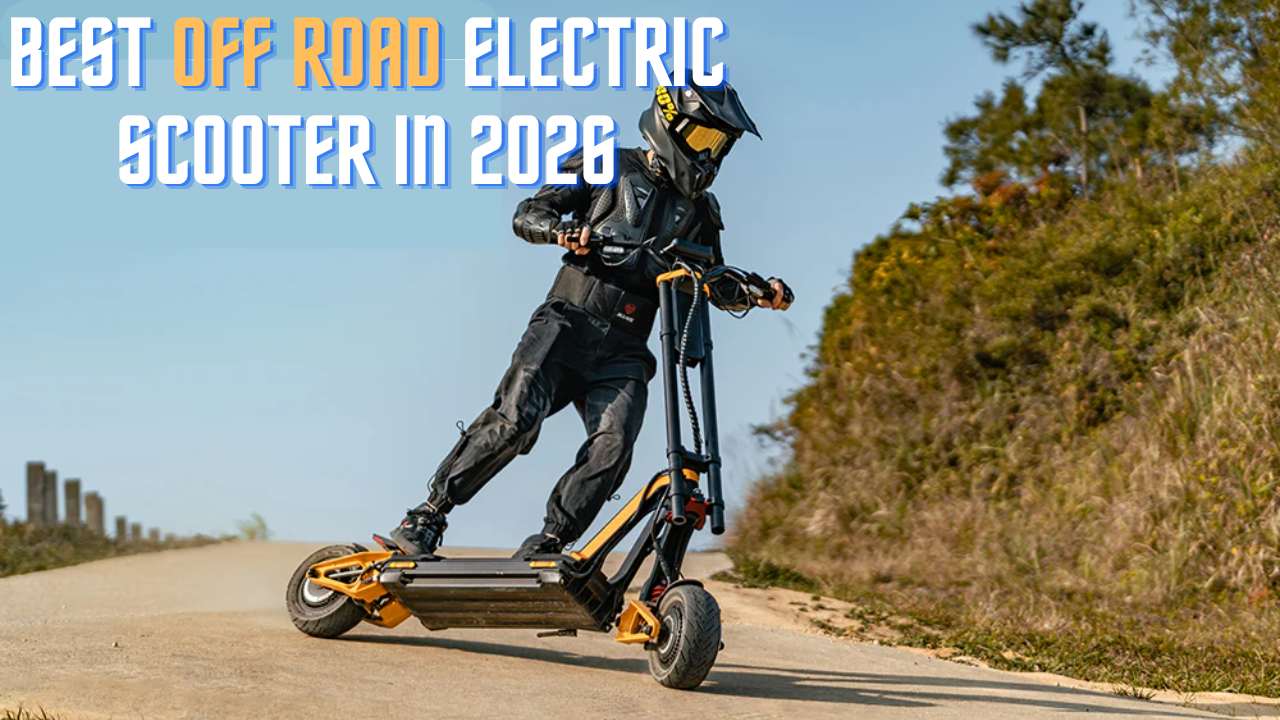
The quick answer is that an off road electric scooter is an electric personal vehicle that is built using pneumatic knobby tires with dual motors that are high-torque (2,000W-13,440W in total) with full suspension as well as high-capacity batteries to ride through dirt trails and gravel roads, as well as sand, hilly, mud, and uneven terrain — not confined to paved roads.
The majority of electric scooters that are sold “off road” are not true off road electric scooter. They sport aggressively styled tires and an imposing frame. And this is where the story of off-road ends. You can take one of them on an unpaved forest service road, an unpaved trail, or an arid hillside, and you’ll see the truth after the first fifty meters as the suspension begins to sink and the brakes are a bit tinny as well as the engine begins crying for help at the very first decent hill.
In 2026, the first off road electric scooter is expected to be created and entirely unique. Models like the Kaabo Wolf King GTR Segway ZT3 Pro, and Apollo Phantom Stellar draw inspiration from mountain bikes and motocross.
They’re created from scratch to be used on surfaces that could ruin a scooter for commuters. The gap between authentic fake off road electric scooter and real is never wider. Recognizing it is the first step; this guide will help you with that.
What Actually Makes an Electric Scooter Off-Road Capable
The distinction isn’t about looks. The difference lies in five physical realities: suspension performance and tire setup; torque delivery and braking efficiency on loose surfaces; and the frame’s rigidity under load.
The most common commuter scooter is equipped with a single motor running 250W-500W and thin or solid tires with no suspension. They also have brakes designed specifically for asphalt. The combination works fine for smooth surfaces. If the surface gets rougher, the specs will not be yours to play with.
A truly rugged off road electric scooter has two brushless DC hub motors with max outputs of more than 13,000W.It is mounted on large pneumatic knobby tires, usually 10 to 11 inches in diameter, that are filled with air to handle uneven terrain.
The off road electric scooter has full suspension on the front and rear, usually mechanical, and with a suspension range of up to 100mm on each side. Hydraulic disc brakes give constant stopping power, regardless of whether the surface is moist or dry, or gravelly or wet and muddy. Frames are reinforced with an aircraft-grade aluminum alloy for the highest-quality models. The entire unit has an IP54 rating, which is sufficient to withstand water and mud.
The myths vs. factual reality:
| What does the marketing say? | What does it really mean? |
| “Off road capable” | It could be nothing more than that Check suspension specifications |
| “Dual motor” | Make sure both motors are on Not just listed. |
| “40 mile range” | The trail was tested on a flat surface Expect 25 to 32 miles on trails |
| “Knobby tires” | The tread pattern is important and you should verify that the tread is pneumatic and of a size 10″+ |
| “Full suspension” | It could refer to two springs — request the distance of travel in millimeters |
The 5-Step Buying Framework
A decision based solely on the quality or the brand’s name is the most expensive error in this class. Make use of this method instead.
Step 1: Decide on your first terrain, not the budget. Sand and snow require huge tires with low pressure and powerful motors. The technical trails on rocky terrain require long suspension travel and hydraulic brakes. Combining commuting and gravel requires a completely different balance. All other decisions are based on the terrain.
Step 2: Determine the specific requirements of the particular range. Determine the distance you can cover, then multiply it by 1.4 to illustrate your energy usage while driving. Also, add a twenty percent buffer. long drive for 20 miles, the off road electric scooter needs to travel 34 to 35 miles on a full charge. The manufacturer’s range figures are based on flat surfaces at moderate speed. Off-road travel can reduce these numbers by 20-40 .
Step 3: Make sure your budget is in line with your objectives. An investment of $900 will be used to purchase an entry level off road electric scooter for park trails or gravel. However, they’re not suited for long-term use. In the $1,500 to $2,800 range, truly powerful off road electric scooter High-end models equipped with hydraulic suspension and 50+ miles of real-world driving can be found between $2,800 and $4,500. Beyond that, you’re entering hyper-scooter mode — vehicles capable of speeds up to 60 mph specifically designed for enthusiasts of performance rather than trail-commuters.
Step 4: Go over your rider’s profile using the specification sheet. If you weigh more than 220 pounds, you are likely to weigh between 265 and 325 pounds.
It is vital that motorists be sure the motor’s power is controlled properly when hauling a greater weight, and also that the frame is of sufficient capacity.
If you’re only beginning, it is recommended to restrict the number of trips you make to bicycles that are equipped with a minimum speed of 30 mph until you’ve mastered how to navigate routes. In addition, you must consider the load of your cargo when transporting it. A motorbike that weighs over 90 pounds may be possible, but imagine the weight of it dragging it up a set of steps, or of getting the vehicle with it
Step 5: Check to see if you’re legally able to purchase and ride an off road electric scooter within the country in which you’re buying. Three-quarters of a million dollars for a scooter you are not legally able to ride isn’t a bargain. Legally, the landscape varies widely by country and will be covered in full in the following.
Top off road electric scooter in 2026
These are the ones that are always present in actual circumstances, not just on specifications sheets.
| Model | Combined Motor | Real Range | Top Speed | Suspension | IP Rating | Weight | Price (USD) |
| Kaabo Wolf Warrior X GT | 4,000W | Tested at 44 miles | 45.3 mph | Full hydraulic | IP54 | 84 lbs | ~$2,599 |
| Kaabo Wolf King GTR | 13.440W peak | ~55 mi | 65.8 mph | Full hydraulic | IP54 | 137 lbs | ~$4,800 |
| Segway ZT3 Pro | 1600W peak | ~43 mi | 34 mph | Full dual spring | IP55 | 66 lbs | ~$1,299 |
| Apollo Phantom Stellar | 2,400W peak | ~50 mi | 38 mph | Full hydraulic | IP56 | 77 lbs | ~$2,299 |
| Ausom Gosoul 2 Pro | 1200W peak | ~28 mi | 28 mph | Dual springs | IP54 | 57 lbs | ~$849 |
| Inokim OXO | 2,000W | ~62 mi | 34 mph | Full hydraulic | IP54 | 79 lbs | ~$2,500 |
| Dualtron Thunder 3 | 6,640W peak | ~75 mi | 50 mph | Full hydraulic | IP54 | 95 lbs | ~$3,800 |
| MetaMoov ZU06 | 1,200W | ~35 mi | 28 mph | Dual springs | IP54 | 71 lbs | ~$1,099 |
The range figures are based on real-world conditions off-road, not the manufacturer’s claims.
Best for Most Riders
It’s the Kaabo Wolf Warrior X GT
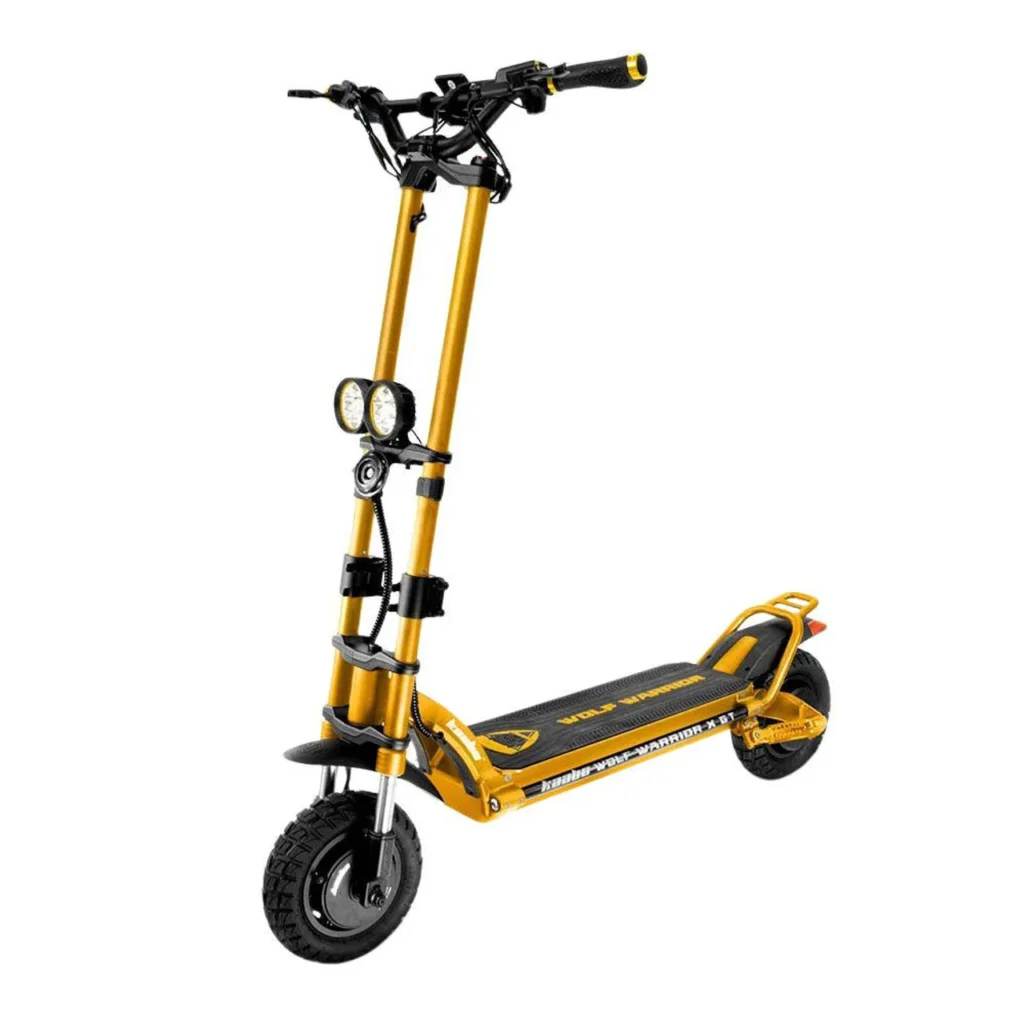
priced at $2,599, which makes it the most well-balanced machine available at this price — real dual-motor power, tested to provide a range of 44 miles, and a suspension with hydraulics that can handle challenging terrain without hurting the user. It’s the solution for those who want the most powerful off road electric scooter , but without edge-case requirements.
Best Budget Pick
Its Ausom Gosoul 2 Pro
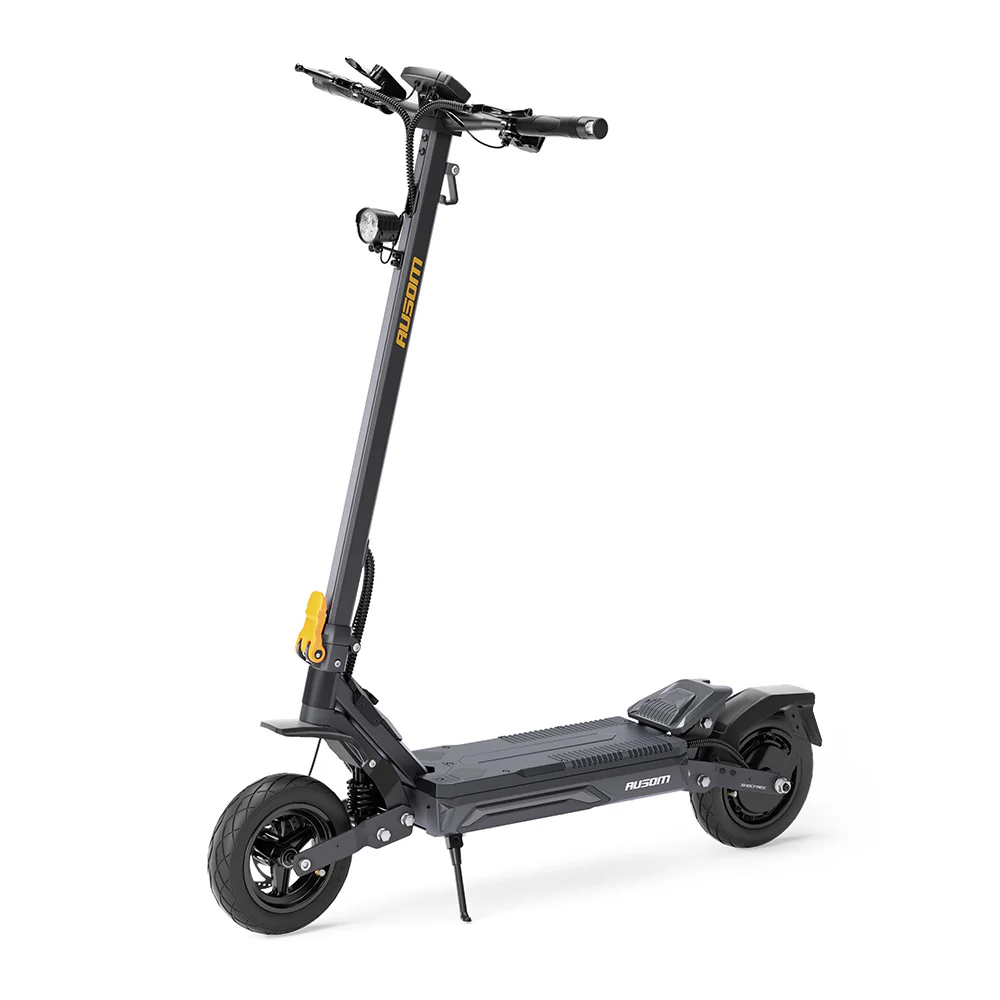
consistently delights at less than $900. It’s not designed to handle rough and rocky terrain. However, for gravel roads, dirt-packed roads, and occasional trail use, it is significantly better than its “budget” label suggests.
Best for Heavy Riders
The MetaMoov ZU06
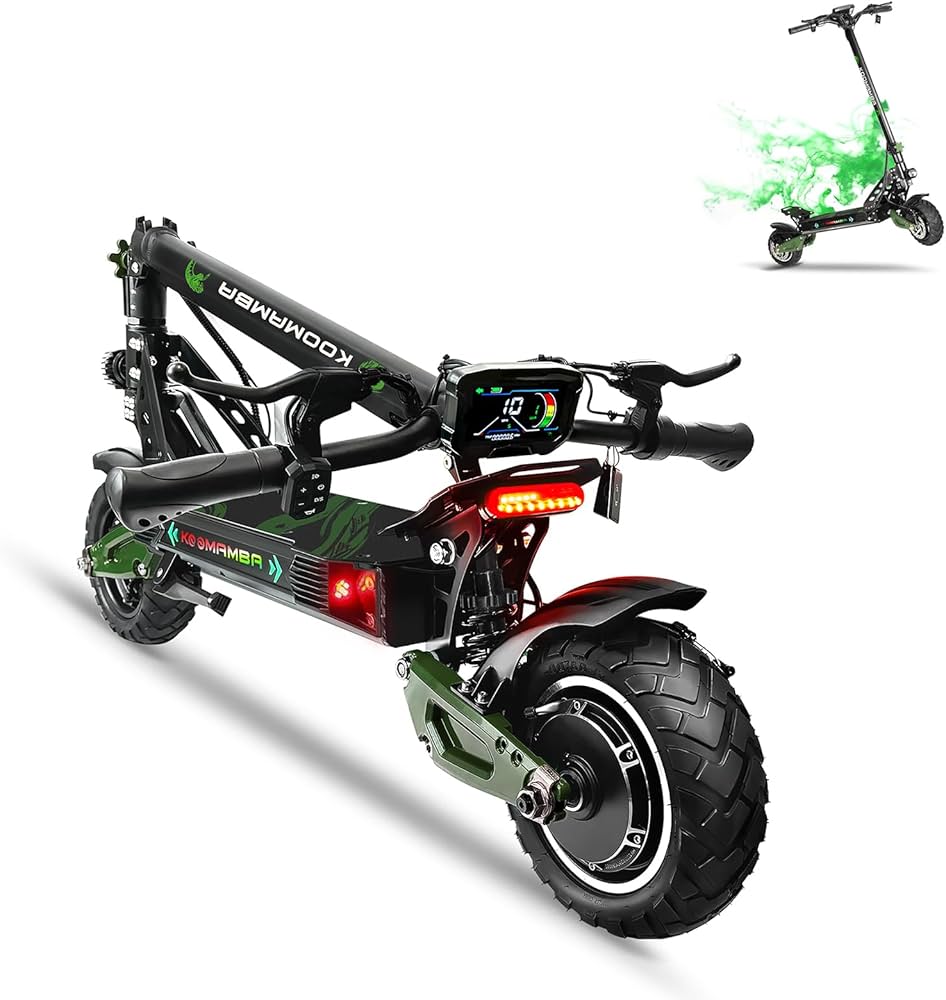
has the capacity of 390 pounds -it is the largest that is currently in production, together with fat tires of 10 inches that effectively distribute weight over a loose surface.
Hyper-Scooter Category
Kaabo Wolf King GTR
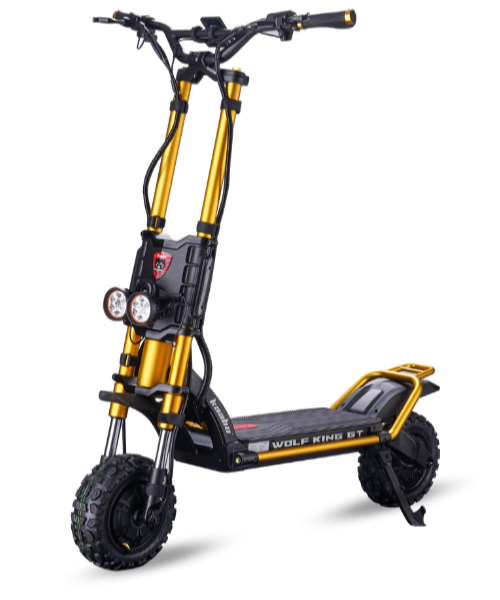
has an output of 13,440W, and a predicted highest speed of 65.8 miles per hour. It’s the first category of hyper-scooters and is predicted to debut in 2026. It’s not designed for riding trails — it’s designed for enthusiasts who want to race, who live on private property or hyper-speed tracks. With 137 pounds, it takes two individuals.
Terrain-by-Terrain Guide
Dirt Trails and Forest Paths
Priority specifications: Full suspension, 150mm+ front travel, two motors with 2,000W+ or more, combined with the knobby 10-11″ pneumatic tires, minimum IP54.
Rocks embedded in roots and in the soil are the main dangers. The suspension travel is more important than peak wattage in this. There are two models: the Wolf Warrior X GT and the Apollo Phantom Stellar, which serve as the basis for this terrain type.
Gravel Roads and Unpaved Rural Routes
Priority specification are pneumatic tires, at least 10″ front suspensions, a minimum of 10 with disc brakes with hydraulic discs.
A loose gravel surface significantly increases braking distance compared to a mechanical brake surface. If you travel on gravel every day, hydraulic brakes are not an option. Segway’s ZT3 Pro’s traction controls — among the few available in this class to be released in 2026 — offer substantial stability on gravel when you’re moving.
Sand and Beach Terrain
Priority specifications: Wide tires, deflated to 20-25 PSI to ensure surface flotation, a high-torque motor (sand drag is significant), and thorough cleaning after the ride.
Salty air damages the bearings and connectors more quickly than in any other setting. Wash the entire undercarriage following every trip to the beach. It is recommended that the Wolf King GTR and Dualtron Thunder 3 handle sand very well, thanks to their raw torque; however, their weight can be an issue in soft sand.
Mud and Wet Trails
Priority specifications include a strong, knobby tread pattern and dual motors with high torque, both rated IP55 or higher.
The mud builds up in the motor vents and wheel wells. Make sure to clean the motor vents right away after any muddy ride -do not let it dry within the housing. IP55 provides directional spray protection; IP67 provides submersion protection. A majority of high-quality off road electric scooter models are IP54-IP56 rated. It can handle splashing and rain; however, it does not cover deep-water crossings.
Snow and Winter Conditions
Requirements for superiority include big requirements for tires. They also include LiFePO4 Chemical batteries (when needed) and a cold-weather warming-up protocol.
The lithium-ion battery’s performance can be reduced by 20 to 40 percent at temperatures that are below 32°F (0 to 0 Celsius). LiFePO4 chemically degrades more slowly when temperatures are lower and is much heavier. If you’re a frequent winter cyclist, make sure you keep your bike in a cool place and allow 20 minutes for warming the battery before charging with a battery that isn’t heated.
Steep Hills and Mountain Terrain
Priority specifications: two motors required, hill-hold function, and hydraulic brakes. Thermal security.
Motorized scooters with single motors aren’t capable of rising at a rate of 15 degrees while someone sits inside the car. Two motors with over 2000W of power can manage gradients up to 30. Make sure your car has cutting-off thermal protection. A continuous climb can generate heat. Motors without thermal protection may stop mid-climb.
Battery Chemistry: The Conversation Nobody Else Is Having
Most buying guides ignore battery chemistry entirely. The issue is far more significant than most people realize.
Lithium-ion (Li-ion) is the ideal alternative for off road electric scooter . It’s the one with the highest energy density, that is, more power per gram. However, it’s less effective at higher temperatures.It also poses a greater risk of temperature runaway if damaged.
LiFePO4 (Lithium Iron Phosphate) gives you a more extended time between cycles (1,500-3,000 cycles, vs. 500-1,000 cycles for the standard Li-ion) and better performance in cold weather, and greatly improved security. However, the tradeoff is that the LiFePO4 packs weigh more in Wh. If you are a rider in colder environments or concerned about endurance, LiFePO4 is the superior choice.
UL2272 certification is the standard for battery safety you should look for in any marketplace. It is a way to ensure that all electrical components, such as battery management, comply with the minimum requirements for shock and fire safety. When it comes to off-road applications (where water, vibration, and impact are typical), used batteries are far more valuable than road-use batteries. Get the electric scooter.
Who Should Buy an Off Road Electric Scooter
This is a sensible category for a range of different buyers.
People who enjoy trail riding can be ideal buyers: those looking to unwind from their hectic schedules and discover natural areas, forests, or gravel trails without needing an ATV or even a big electric bike.
Rural commuters who drive daily on roads that are not paved will benefit from the mix of range, torque, and suspension that off road electric scooter are able to provide. Estate groundskeepers, farm workers, or rural commuters who have to endure conditions that could ruin commuter scooters in just the course of a few months.
B2B fleet operators are an untapped but growing segment. Resorts, golf courses, camping facilities, security firms, and large property owners have increasingly been using fleets of electric scooters that can cover all terrains, providing a low-cost, emission-free alternative to gasoline-powered utility vehicles. The cost of ownership in three years is considerably less than that of similar gas-powered alternatives, and the fuel management system is not required.
Travelers who are looking for an option that is portable and packable to hire ATVs and hire guided trails at places like New Zealand, the Swiss Alps, or the coast of Australia provide another exciting application.
Global Legality in 2026: Know Before You Buy
In this section, the vast majority of purchasing guides fall short for international buyers.
United States: Regulation is state-by-state. A majority of states consider e-scooters with more than 1000W of continuous power or speeds of 28mph to be motor vehicles that require registration, insurance, or a permit to be used on public roads. off road electric scooter models with high-performance generally are not restricted to private land and are identified as areas of OHV (Off-Highway Vehicle) regions. Before riding on public trails, check the specific land management agency’s guidelines — many states and national parks ban electric scooters on non-motorized trails.
United Kingdom:As of the middle of 2026, privately-owned electric scooters are within the legal gray area for public roads in accordance with the Road Traffic Act 1988. These are technically classified as Powered Light Vehicles and require insurance, tax, and a road-use license. Government-sanctioned rental trials operate under different rules. Private land riding is free of restrictions. The United Kingdom’s Transport Bill is expected to define the legality of private scooters; however, as of the time of writing, it is unclear whether there are any updates before purchasing an expensive model designed for public use.
European Union: There is a uniform body of EU law. The maximum speed allowed for off road electric scooter on the highway is 25 km/h. 250W continuous . Anything over that amount requires insurance in many countries, and it is considered a motor vehicle. The EU Directive affecting vehicles exceeding 25km/h or 25kg requires insurance coverage in the member states. Use of off road electric scooter on private property is typically free of restrictions. Germany, France, and the Netherlands. Each of them has the choice to follow the law of their country.
Australia: Make sure you are aware of local laws prior to purchasing the product in Australia. Every state in Australia has its own rules. The maximum speed for road use is 200W/25km/h. off road electric scooter with powerful engines are permitted only in designated zones and on private property. Make sure to check with the state road authorities before buying, as enforcement is on the rise in Victoria and New South Wales.
Canada: Province-by-province variation. Ontario, along with British Columbia, has the most advanced e-scooter frameworks. The use of private land is usually not restricted, regardless of output.
What It Really Costs
The purchase price is just one aspect.
The total cost of the first year for an off road electric scooter of mid-range (~$2,200 cost of purchase):
| Item | Estimated Cost |
| Purchase of a Scooter | $2,200 |
| Full-face helmet (ASTM certified) | $80-$220 |
| Protects wrists and knees with elbow pads | $60-$150 |
| Riding gloves | $30-$80 |
| The first replacing tires (knobby tires wear out faster off roads) | $80-$120 |
| Fast charger upgrade | $60-$150 |
| Shipping (heavy models, 75-100 lbs) | $100-$250 |
| Year 1 of total | ~$2,610-$3,170 |
Ongoing maintenance costs are typically between $200 and $400 and cover tire replacements, brake services, and basic maintenance supplies. For B2B fleet managers, all top brands offer warranty extensions and service agreements, which should be considered when making procurement decisions.
Common Mistakes That Cost Riders Real Money
The choice of top speed is the main measure. The speed is not the most useful measure of performance off road electric scooter performance. The suspension travel, torque, and tire condition determine the experience on trails.
Rely on the manufacturer’s range of claims to the extent that they can be believed: Each major brand has a range test on flat surfaces at moderate speeds, with an average weight of 165 pounds. In reality, the range for trails could be 20% to 40 percentage smaller. Use test results from independent reviewers when available.
Underestimating weight: A motorcycle that weighs about 90 pounds is manageable when you view an instructional film. There’s something different as you take the scooter up two flights of steps. You can also place it inside a vehicle each day, or get it out of the pond.
Purchase a single suspension for actual trails: Front-only suspensions can be used to make gravel commutes. If you’re looking for technical trails, dirt terrain, or any activities that require root or rock, rear suspension isn’t something you’ll be able to afford not doing, as it’s an essential safeguard for your safety.
Do not ignore the IP rating in wet conditions: IP54 is able to handle splashing and rain. IP67 handles brief submersion. If you regularly ride throughout the UK as well as the Pacific Northwest, or coastal Australia, the difference is very much.
Doing away with the break-in phase: The majority of manufacturers recommend 30-50 miles of moderate usage prior to full-power rides. The accuracy of battery calibration and motor life is determined by how first-ride sessions are conducted.
The trail is not always open to inspection: Purchasing a $ 3,000 scooter and later finding that your local trail system does not allow motorized vehicles for personal use is costly and a completely preventable scenario. Make sure you know the local laws of the land management authority, and not only the general laws of the state or national level.
Maintenance: What the Schedule Actually Looks Like
Before every ride: make sure you examine tire pressure (knobby tires usually require greater pressure than regular tires). Make sure the handle on the brakes is in good condition. Examine the latch that folds (if it’s there) to verify that the light is working.
After any off-road excursion: you should wash the motor’s vents, frame, and connectors. Remove the mud and dirt that are accumulating in the wheel wells before they dry on the floor. Inspect the tire’s sidewalls for any damage or embedded particles.
Every month: Oil the joints that fold, as well as axle points. Examine the torque of every bolt that is on the frame. Road vibrations continuously loosen bolts. Take a look at the brake pad dimensions. Look over the suspension for leaks or play.
Every 3 to 6 months: Full brake bleeds to the hydraulic system. Testing battery capacity using the manufacturer’s app when available. Test of the tire’s rotation. Checking the wheels for bearings and the headset.
Each year: motor inspection. Checking the electrical connections. Suspension maintenance, which includes replacing fork oil in hydraulic systems.
off road electric scooter . The Alternatives
| Alternative | Pick it out when | Do not do it. |
| Electric mountain bicycle (e-MTB) | The rules for trail access allow bicycles, but not scooters. the pedal backup is a matter of concern | It is essential to have a compact, portable solution |
| Electric ATV / UTV | Extreme terrain, high capacity of hauling and no need for portability | Budget is below $8,000; storage capacity is restricted |
| Unicycle electric (EUC) | Single-person-friendly, ultra-portable and a little off-road | A steep learning curve can be a hurdle in the technical world. |
| Electric dirt bike | Professional motorcycle rider, licensed | License is required. Cannot fold/carry, higher price |
| Scooter powered by gas | Unlimited range, remote areas and no charge access | Emissions matter; noise restrictions apply |
The off road electric scooter provides the ability to move around, with no emissions, a better performance-to-cost ratio, and the capacity to fold up and move. The terrain requires extreme capability or rules explicitly banning motorized vehicles on the trail.
FAQ
Do electric scooters have the ability to take off-road?
It is true that any scooter can be used while parked. But true off road electric scooter capabilities, such as dirt trails, high hills, mud, dirt, and sand, are a requirement for a custom-built vehicle with dual motors, a full suspension, and pneumatic knobby tires, as well as hydraulic brakes. Motorized electric scooters that are used for daily commutes in realistic conditions can lead to the engine failing or losing control.
What’s the most off road electric scooter you could invest in until 2026?
Kaabo Wolf Warrior X GT is the best combination of speed and versatility. It has been tested and is priced at $2,599 . The affordable Ausom Gosoul 2 Pro delivers true trail-like performance for just $900.For maximum efficacy, make sure you purchase the highest high-end equipment. Two models have been bought Two models have been purchased: The Kaabo Wolf King GTR and the Dualtron Thunder 3. Dualtron Thunder 3 is one of the best models in the market.
What is the longest range that the off road electric scooter are able to cover in a single charge?
The distances that are traveled off the highway are predicted to vary between 20 and 40 percent lower than what is stated by the manufacturer. Scooters capable of a maximum velocity of sixty miles an hour generally cover 35 to 48 miles over rough terrain. A majority of the top models come with an off-road option.
Are electric scooters able to be driven off-road?
Most countries possess off road electric scooter (over 1000W or capable of driving over 28+ miles in one charge) and aren’t permitted on public roads. It is possible to use them in private areas and in designated off-road zones, including those of the US, UK, EU, and Australia. There are different laws in place; check with the authorities in your area before buying.
What is the bare minimum horsepower of a motor needed for off-road usage?
A minimum of 1200W (dual motors) can be used on light or moderately difficult trails. If you plan to climb over a steep grade, or through mud, or with a group of powerful runners, or in a group with strong runners, a motor that is 2500W or more is recommended. Single-motor configurations aren’t suitable for off-road conditions, regardless of the claimed power rating.
Do I require authorization to ride on off road electric scooter ?
If you live on private land or within designated OHV areas, a license is usually not required to operate electric scooters in Australia, the US, or the UK, regardless of power source. If you’re on an open road or trail, your licensing rules are based on the vehicle’s engine power and the highest speed class in your area.
What’s the most significant problem that can arise from the use of electric scooters that have batteries that are off-road?
The lifespan of the average ranges from 500 to 1000 fully-powered cycles. Their abilities decrease by about 20%. This is approximately the same as the typical 2-5 year use. LiFePO4 batteries can be used for 1,500 to 3,500 cycles. Proper storage at 40 to 80 percent when at room temperature greatly extends the battery’s life.
What’s the best off road electric scooter that you can use for people who are just beginning to discover the world of electric scooters?
The Segway ZT3 Pro is an electric scooter, and the Ausom Gosoul 2 Pro is the ideal starting point. They both have off-road capability, with no hefty high speeds or the weight of premium models. Begin by narrowing your list to bikes with a speed under 30 miles per hour.
Glossary of Key Terms
Battery Management System (BMS): Computerized controller that manages the cell’s balance along with charging regulations and the thermal protection of batteries.
It is a Brushless DC (BLDC) motor located in the wheel hub. The brushes that cause friction are eliminated. This results in longer life and greater efficiency compared to other alternatives.
Ground Clearance: The distance between the bottom of the structural scooter and the ground. Clearer ground allows dirt and roots to be removed more efficiently.
Hydraulic Disc Brake: A fluid-line-controlled braking system, which provides consistent and high-force stopping even in dry as well as wet conditions.
Hyper-Scooter is thought of as the most innovative invention that was invented in 2026. Electric scooters can reach speeds as high as 60 miles per hour. Motors are able to provide as much as 8000W.
IP rating (Ingress Protection) is an internationally recognized standard (IEC 60529) that determines a device’s resistance to water and dust. IP54 indicates IP65 waterproof resistance. It refers to low-pressure jet resistance. IP67 is the term used to describe temporary submersion resistance.
LiFePO4 (Lithium Iron Phosphate): is a battery chemistry with a longer lifespan, greater weather stability, and a stronger security profile than lithium-ion batteries. Heavier per Wh.
OOH (Off-Highway Vehicle): A classification of the regulatory system that covers the vehicles that are designed specifically for off-road usage. These designated areas offer accessible trails suitable for high-powered electric scooters and off road electric scooter.
Peak Wattage as compared to. Continuous Wattage: The Peak represents maximal output in short bursts, and continuous provides long-term, safe power. The real-world experience is closer to constant wattage — make sure to verify both numbers.
A pneumatic tire: or air-filled tire, is vital for controlling off-road and bump absorption. An ad pattern helps increase the traction on loose surfaces.
Suspension Travel: The maximum Distance of Compression in the suspension system. 150mm more front travel is an acceptable minimum requirement for technical trail riding.
ULC2272: North American safety certification for the battery and electrical system of personal electronic mobility devices that covers shock, fire, and overload dangers.
The information on this website is gathered from industry reports, manufacturer specifications, expert reviews, and trusted sources such as Electroheads to provide accurate and valuable insights for our readers