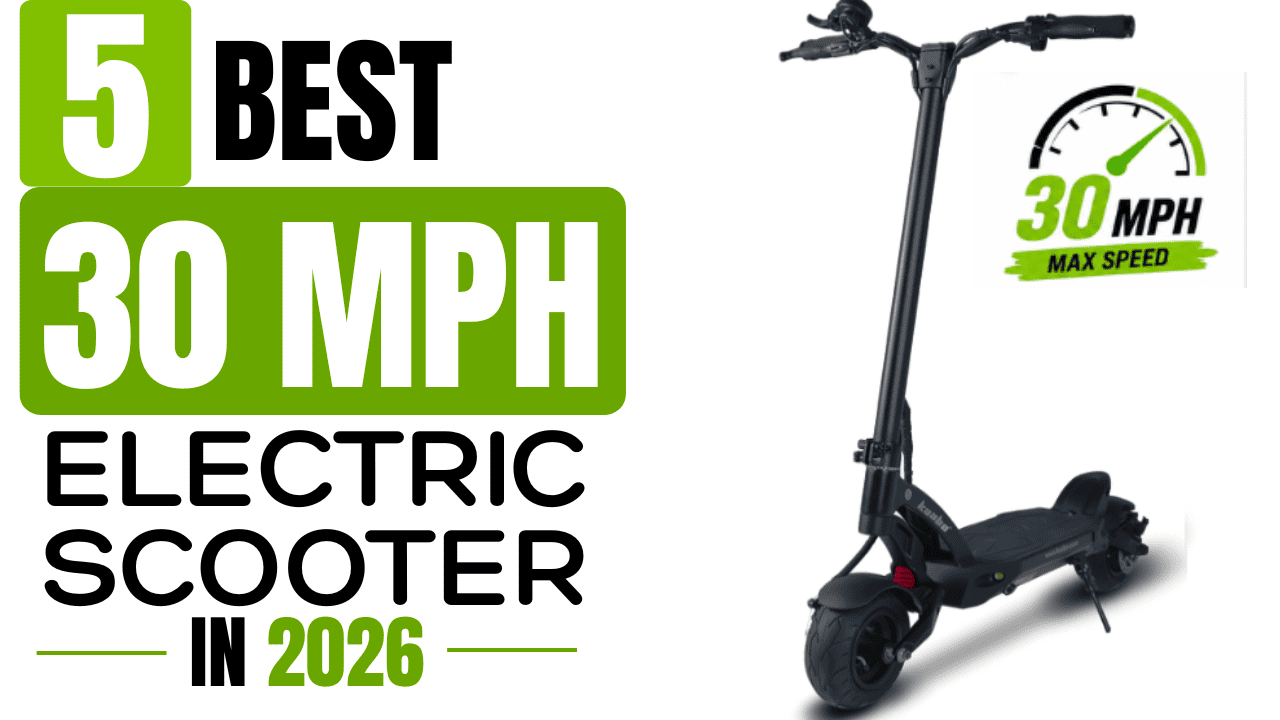
Quick Verdict: The best overall choice is the OOTD T10 (up to 34 mph manufacturer-listed, real-world closer to 30-31 mph). The best premium/high-performance pick is the Hiboy Titan Pro (33 mph, 80-mile range). The best value/off-road pick is the KuKirin G2 Max.
Answer: The 30 mph electric scooter is a powerful personal vehicle (1,000W-3,000W motor with a battery of 48V-60V+, dual hydraulic brakes) that is able to mechanically reach speeds between 28 and 35 mph. It’s not legal to travel at that speed on public roads in most jurisdictions worldwide. The typical limits are 15 to 20 miles per hour in the US, as well as 20-25 km/h (12.4-15.5 miles per hour) across the majority of Europe, but 30 mph Electric Scooter owned by private owners within the UK. The possession of a scooter is permissible almost everywhere in the world, but riding at full throttle on public roads typically isn’t.
A 30 mph Electric Scooter can be a seated or stand-up private electric vehicle (PEV) that is built with a motor strong enough to achieve between 28 and 35 mph on flat ground. It typically runs on 1,000W to 3,000W of motor power, as well as a 48V-60V+ battery with disc brakes and dual hydraulics. Whether you can legally ride at this speed depends on where you live — which is the thing most people get wrong.
This isn’t a niche issue. Search interest in this speed level has grown alongside a flurry of dual-motor, high-voltage electric scooters hitting the market, but much of the material addressing it only covers a small part of the picture — the legal reality in one country, or an overview of scooters with no regulatory context at all. This guide aims to be international, transparent about trade-offs, and useful for deciding which speed tier actually suits your needs.
5 Scooters for 30 MPH-Class Performance (2026)
Answer: The most effective all-around choice for a genuine 30+ mph ride is the OOTD T10, the Hiboy Titan Pro is the pick for riders who want maximum range and hill-climbing torque, and the KuKirin G2 Max delivers the strongest value-for-power combination with a real 30+ mph top speed. Two additional models — the iSinwheel GT2 and the Circooter Raptor Pro — round out the list for budget and off-road value, though according to their manufacturers’ own published specs, neither one actually reaches 30 mph; both top out at 28 mph.
The five scooters listed here cover the 30 mph-class category, ranging from value-focused off-road commuters to high-end long-range performance scooters. Three genuinely clear 30 mph according to manufacturer specifications; the other two are marked clearly below for falling just short of the mark — included for their budget and off-road strengths, not top speed. Treat manufacturers’ claimed top speeds as an indication of speed, not a guarantee.
1. OOTD T10 — Best Overall 30 MPH Electric Scooter
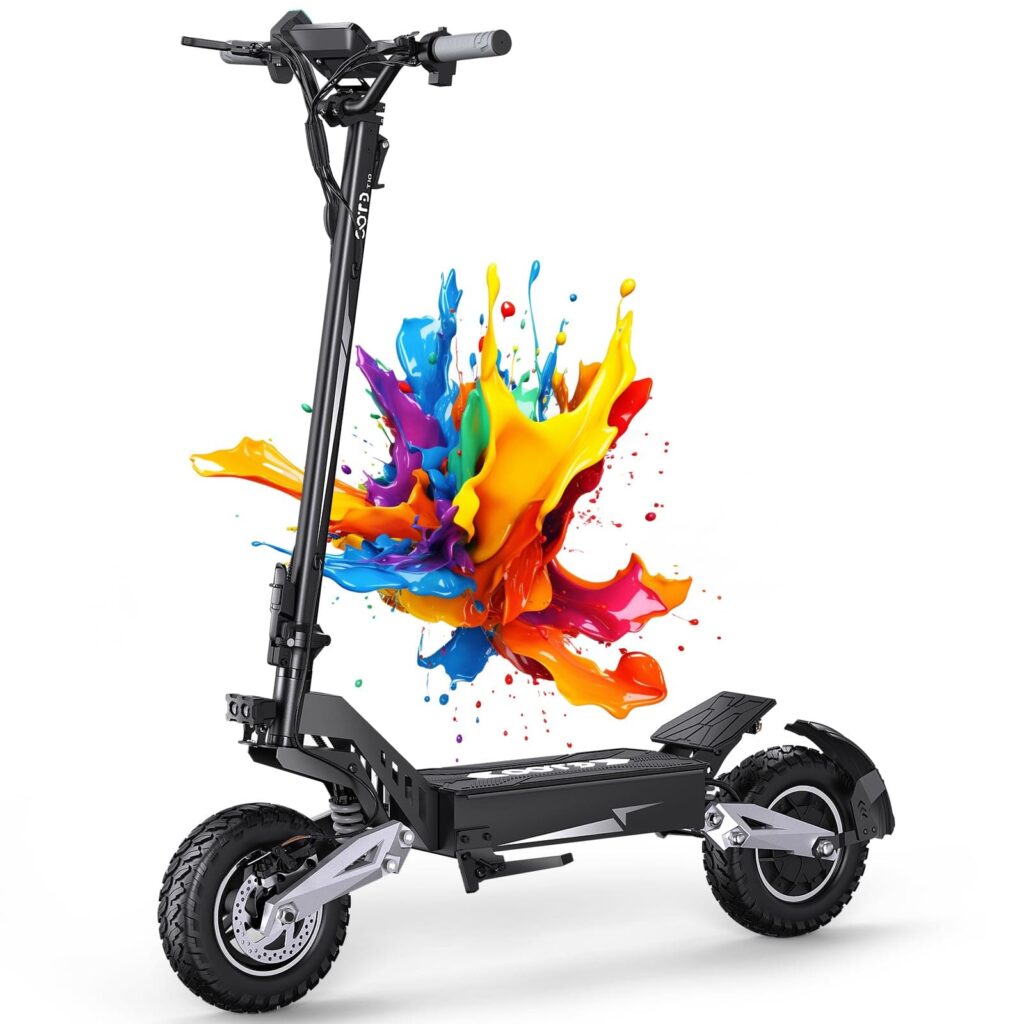
Answer: The OOTD T10 is the most well-rounded choice for riders who want a genuinely fast commuter scooter with real-world speed near 30 mph, a comfortable ride, and a manageable price point, without stepping up to flagship pricing.
The T10 is built around a 48V rear hub motor rated at 500W with up to 900W peak output. According to OOTD’s own published data, the factory-unlocked version is capable of up to 55 km/h (about 34 mph) with no rider load as a reference figure, dropping to roughly 49 km/h (about 30 mph) once a rider’s weight is factored in — a useful reminder that the headline number and the real-world number aren’t the same thing. The design pairs 11-inch semi-pneumatic all-terrain tires with front-and-rear spring suspension and mechanical disc brakes, aimed at everyday comfort and durability rather than chasing the highest number on the box.
Specs:
- Top speed: Manufacturer-listed up to 34 mph (no-load reference); brand’s own rider-load reference figure is closer to 30 mph
- Motor: 500W rated, 900W peak, rear hub
- Battery/range: 48V 18Ah, up to 46 miles claimed range (brand’s own tested range: ~37 miles at 85 kg rider weight, 25 km/h)
- Weight: ~62 lbs (28.1 kg); maximum load: 264 lbs (120 kg)
- Brakes: Front and rear 140mm mechanical disc brakes
- Suspension: Dual (front and rear spring)
- Tires: 11-inch semi-pneumatic all-terrain
- Charging time: 6-7 hours
- Display: HD LCD display
Cons:
- Advertised top speed depends heavily on rider weight and terrain — expect the lower end of the range in everyday riding
- Mechanical disc brakes rather than hydraulic, meaning slightly more hand effort at speed
- Water resistance is not clearly specified by the manufacturer
Recommended for: Riders who want a genuinely quick daily-driver scooter with solid range and comfort features, without paying flagship prices, and who understand that real-world speed will land closer to 30 mph than the headline 34 mph figure.
2. Hiboy Titan Pro — Best Premium / High-Performance Option
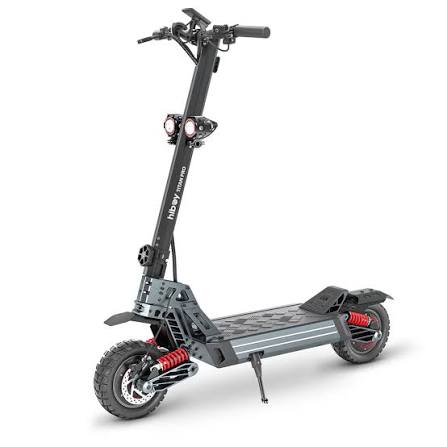
Answer: The Hiboy Titan Pro is the pick for riders who want maximum range and confident hill-climbing torque alongside a genuine 30+ mph top speed, backed by a well-documented manufacturer spec sheet.
The Titan Pro is built around dual Bosch hub motors delivering up to 2,400W combined peak output, paired with a substantial 48V 36Ah (1,728Wh) UL 2272-certified battery. Hiboy’s own testing puts the top speed at 33 mph and the maximum range at up to 80 miles — among the longest of any scooter in this class. The reinforced 6061 aluminum frame, 10-inch gel-filled tubeless tires, dual hydraulic disc brakes, and full front-and-rear suspension system are built for stability at speed rather than pure portability.
Specs:
- Top speed: 33 mph (manufacturer-tested)
- Motor: Dual 750W rated (2,400W combined peak), Bosch hub motors
- Battery/range: 48V 36Ah (1,728Wh), up to 80 miles claimed range
- Weight: 103.6 lbs; maximum load: 330 lbs (150 kg)
- Brakes: Front and rear hydraulic disc brakes
- Suspension: Dual (front and rear)
- Tires: 10-inch gel-filled tubeless
- Charging time: 12.5-13.5 hours
- Water resistance: IPX4 (scooter body), IPX5 (battery)
- Display: 3.5-inch LED display
- Hill climb: Up to 35% grade
Cons:
- At over 100 lbs, this is not a scooter you carry up stairs — portability is a real trade-off
- Long charge time (12.5-13.5 hours) means this isn’t a same-day top-off scooter
- Premium pricing reflects the flagship-tier components
Recommended for: Riders who prioritize range, hill-climbing power, and stability over portability, and who don’t mind a larger, heavier machine in exchange for genuine 30+ mph performance and all-day range.
3. KuKirin G2 Max — Best Value / Off-Road Option
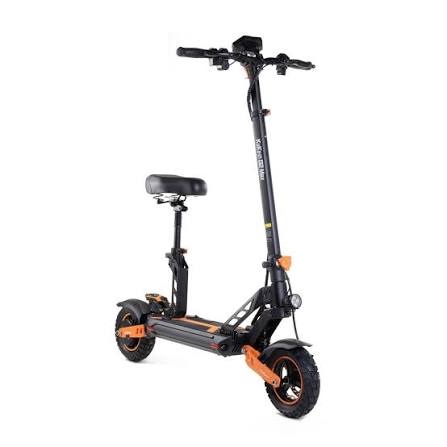
Answer: The KuKirin G2 Max pairs a genuine 30+ mph top speed with strong off-road capability and a detachable seat option, at a price point below most dual-motor flagships.
Powered by a single 1,000W-rated Hall brushless hub motor and a 48V 20.8Ah (998Wh) battery, the G2 Max is manufacturer-rated for a top speed of 55 km/h (about 34 mph) and a range of up to 70 km (about 43 miles). It rides on 10-inch pneumatic off-road tires with front-and-rear spring shock absorption, and includes front-and-rear disc brakes plus an electronic brake as backup. A detachable, padded leather seat is available for riders who want the option of sitting rather than standing.
Specs:
- Top speed: 55 km/h (about 34 mph)
- Motor: 1,000W rated, rear hub, single motor
- Battery/range: 48V 20.8Ah (998Wh), up to 70 km (about 43 miles) claimed range
- Weight: ~70 lbs (31.72 kg); maximum load: 264 lbs (120 kg)
- Brakes: Front and rear disc brakes, plus electronic brake
- Suspension: Dual (front and rear spring, four-arm design)
- Tires: 10-inch pneumatic off-road
- Charging time: 10-11 hours
- Water resistance: IP54
- Display: Smart LCD display
- Hill climb: Up to 22° slope
Cons:
- Single motor means less aggressive acceleration than the dual-motor Titan Pro
- IP54 is a lighter water-resistance rating than the IPX4/IPX5 combination on some rivals
- Long full-charge time relative to its battery capacity
Recommended for: Riders who want genuine 30+ mph performance, off-road-capable tires and suspension, and the flexibility of an optional seat, without paying dual-motor flagship prices.
4. iSinwheel GT2 — Best Budget Option (Falls Just Short of 30 MPH)
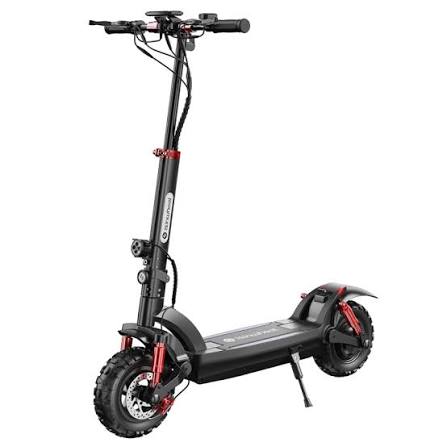
Answer: The iSinwheel GT2 is the most affordable scooter on this list and a capable off-road commuter, but according to iSinwheel’s own published specifications, it tops out at 28 mph — it does not actually reach the 30 mph mark covered by the rest of this guide.
The GT2 uses a 1,000W-rated brushless motor and a 48V 15Ah lithium battery with a built-in Battery Management System. iSinwheel’s own spec sheet lists a top speed of 28 mph and a maximum range of up to 37 miles. It rides on 11-inch pneumatic off-road tires with dual/independent suspension, and includes front-and-rear disc brakes with an electronic anti-lock braking system (EABS). It’s UL 2272 certified and includes NFC unlocking and companion app connectivity.
Specs:
- Top speed: 28 mph (manufacturer-listed) — does not reach 30 mph
- Motor: 1,000W rated, brushless
- Battery/range: 48V 15Ah, up to 37 miles claimed range
- Weight: 53 lbs
- Brakes: Front and rear disc brakes with EABS
- Suspension: Dual/independent front-and-rear
- Tires: 11-inch pneumatic off-road
- Charging time: 5-7 hours
- Water resistance: IP54
- Hill climb: Up to 35% grade
- Certification: UL 2272
Cons:
- Does not actually hit 30 mph like the top three scooters on this list
- Single motor means slower acceleration than dual-motor rivals
- Maximum rider weight capacity is not clearly specified in the manufacturer’s official listing
Recommended for: Budget-conscious riders who want a well-equipped, UL-certified off-road commuter with app connectivity, and who can live with a top speed just under the 30 mph mark in exchange for a lower price.
5. Circooter Raptor Pro: Best Off-Road Pick
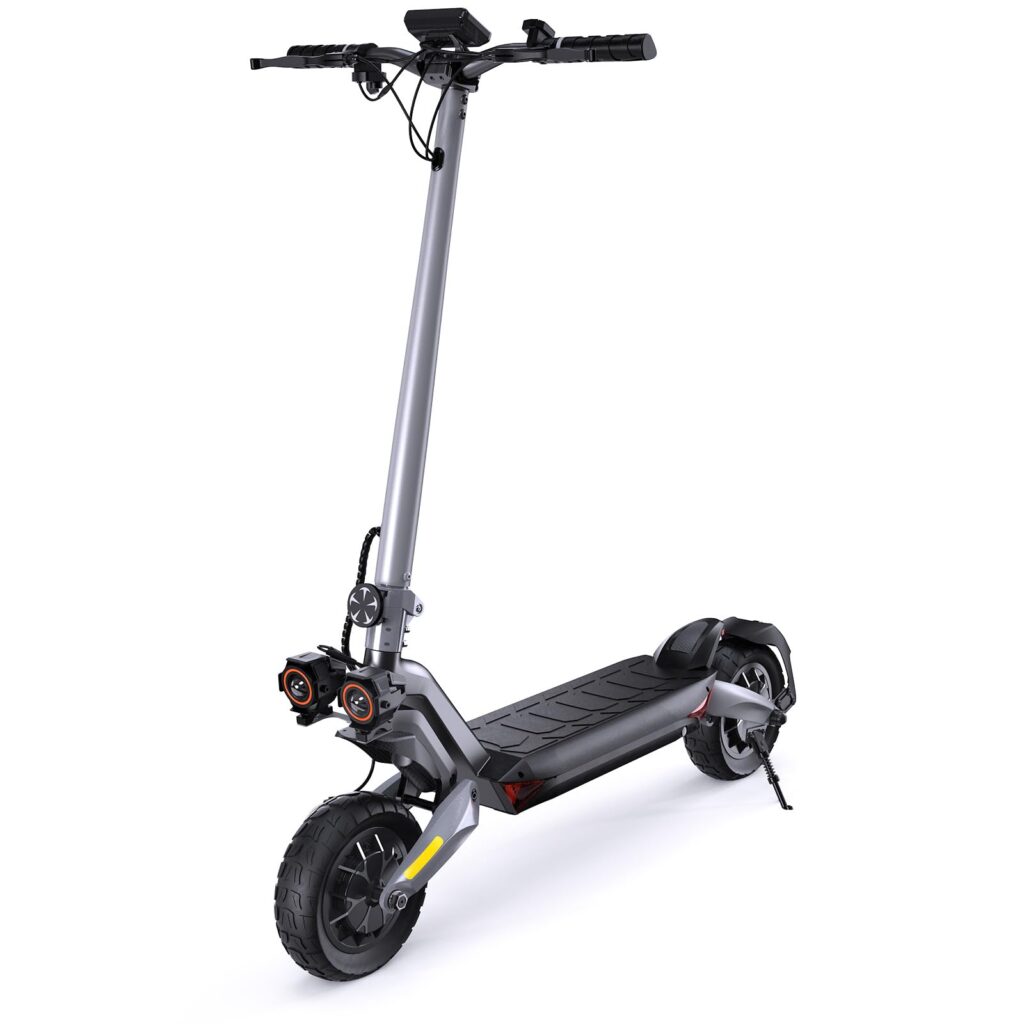
Answer: The Circooter Raptor Pro brings a dual 1,600W-combined motor setup and strong off-road hill-climbing to this list, but its manufacturer-listed top speed is 28 mph — like the GT2, it doesn’t quite reach the 30 mph threshold.
The Raptor Pro pairs dual motors (800W x 2, 1,600W combined) with a 48V 20Ah (960Wh) battery. Circooter’s own specification page lists a top speed of 28 mph, a range of up to 31 miles, and hill-climbing capability up to a 30% grade — among the strongest climbing figures on this list. It rides on 11-inch pneumatic off-road tires with a multi-point shock absorption system, and offers dual charging ports that cut charge time to as little as 3-5 hours. A companion smartphone app adds ride tracking and customizable settings.
Specs:
- Top speed: 28 mph (manufacturer-listed) — does not reach 30 mph
- Motor: Dual 800W (1,600W combined peak)
- Battery/range: 48V 20Ah (960Wh), up to 31 miles claimed range
- Weight: ~66 lbs (about 30 kg, per retailer listings)
- Brakes: Front and rear disc brakes
- Suspension: Multi-point shock absorption (front and rear)
- Tires: 11-inch pneumatic off-road
- Charging time: 3-5 hours (dual-port charging)
- Water resistance: IPX4
- Hill climb: Up to 30% grade
- Smart features: Companion app with lock/unlock, lighting, and ride-mode control
Cons:
- Does not actually hit 30 mph — its strength is torque and hill-climbing, not top speed
- Shorter claimed range than most other scooters on this list
- Some owner reports describe mechanical rather than hydraulic brakes on certain production runs, so confirm the exact spec on the listing before buying
Recommended for: Riders who want strong low-end torque and hill-climbing power for off-road use and fast dual-port charging, and who are more focused on acceleration and terrain capability than outright top speed.
Comparison Table: 5 Scooters in the 30 MPH-Class Tier
| Model | Top Speed | Can you reach 30 mph? | Motor | Range | Weight | Best For |
| OOTD T10 | Up to 34 mph (no-load reference); ~30 mph with rider load | Yes | 500W rated / 900W peak, single | Up to 46 mi | ~62 lbs | Best overall daily-driver value |
| Hiboy Titan Pro | 33 mph | Yes | Dual 750W (2,400W peak) | Up to 80 mi | 103.6 lbs | Maximum range and hill-climbing |
| KuKirin G2 Max | 55 km/h (~34 mph) | Yes | 1,000W rated, single | Up to 43 mi | ~70 lbs | Best value / off-road capability |
| iSinwheel GT2 | 28 mph | No | 1,000W rated, single | Up to 37 mi | 53 lbs | Budget-friendly off-road commuting |
| Circooter Raptor Pro | 28 mph | No | Dual 800W (1,600W combined) | Up to 31 mi | ~66 lbs | Off-road torque and hill-climbing |
Treat every figure on this table as a manufacturer’s claim under near-ideal conditions. Actual performance depends on rider weight, terrain, and the level of caution you exercise.
What Makes a Scooter Capable of 30 MPH
The answer is four things working together: 1,000W+ motor power (often split between two motors), a 48V+ battery, 10-11 inch pneumatic tires, real suspension, and dual hydraulic disc brakes. Remove any one of these and the scooter either won’t sustain 30 mph or won’t stop safely once it gets there.
Many scooters say “high speed” on the box without being able to sustain 30 mph in practice. Reaching and holding that speed safely is the result of a specific combination of components and software — not just a big motor.
Battery and motor. Reaching and holding 30 mph Electric Scooter usually requires around 1,000W or more, often split between two motors for better torque distribution. This typically runs on a 48V, 52V, or 60V+ lithium-ion battery — notably higher than the 36V systems used in standard commuter scooters.
Suspension and tires. Larger 10- to 11-inch pneumatic or tubeless tires reduce vibration and improve grip. Suspension isn’t optional here — without it, road imperfections that are merely annoying at 15 mph become genuinely dangerous past 30.
Braking. This is the area budget models tend to skimp on. At this speed tier, hydraulic dual disc brakes (ideally paired with regenerative braking) aren’t a luxury feature — they’re the difference between a controlled stop and a long, uncontrolled slide.
Weight. All of this adds up. Most 30 MPH Electric Scooters weigh between 45 and 105 lbs — significantly heavier than a standard commuter — which matters if you’re carrying it upstairs or onto a bus.
Real-World Speed vs. Advertised Speed
Quick answer: Expect 3 to 6 mph lower than what’s advertised. Manufacturer top speeds are typically measured with a lighter rider (150-165 lbs) on dry, flat pavement at full charge — a scenario most riders won’t match day-to-day.
Here’s something most product pages don’t spell out: the “30 mph” on a spec sheet is usually measured with a lighter rider (150-165 lbs) on smooth, dry, flat pavement, with a fully charged battery. Add 40-50 lbs of rider weight, a slight incline, or a partially depleted battery, and the real number can drop by 3-6 mph. The OOTD T10 illustrates this gap well: the brand’s own unlocked-mode reference figures show roughly 34 mph with no rider load versus roughly 30 mph once rider weight is factored in.
If your purchase decision hinges on hitting a specific speed or keeping pace with a particular traffic flow, plan around the realistic, lower number — not the one printed on the box.
Is a 30 MPH Electric Scooter Actually Legal?
Quick answer: Almost never at full speed. Owning one is legal almost everywhere; riding at 30 mph Electric Scooter on a public road generally isn’t, since most jurisdictions cap operating speed at 15-20 mph.
This is the question that determines everything else, and the honest answer is: probably not at full speed, regardless of where you live. There’s no single global standard — regulation happens at the local and sometimes national level, and most jurisdictions cap legal operating speed well below what these scooters can mechanically achieve.
United States
Short answer: No federal speed cap exists. States and cities set their own limits, typically between 15 and 20 mph, regardless of what a scooter can mechanically do.
There are no national scooter speed laws. Federal product classifications generally limit low-speed electric bicycles to 20 mph and 750W — a category riders often see referenced alongside scooters, though its direct applicability to stand-up scooters varies and is worth confirming locally. Actual road-use rules are set state by state, and sometimes city by city on top of that.
| State | Typical Legal Operating Cap | Notes |
| California | 15 mph | Posted road speed limit must be 25 mph or under; sidewalks prohibited; recent changes limit peak motor power at 750W |
| Colorado | 20 mph | Permitted on streets with posted limits up to 30 mph, though the scooter’s own operating speed is capped at 20 mph — one of the more permissive states overall |
| New York (NYC) | 15 mph | Citywide cap regardless of state-level allowance |
| Texas | No statewide cap | Cities such as Austin, Dallas, and Houston set their own local restrictions, especially downtown |
| Washington | 15 mph operating | 20 mph maximum design speed permitted |
The pattern across all states: mechanical top speed and legal operating speed are two different numbers. A 30 mph Electric Scooter is legal to own almost everywhere in the US — it’s not legal to ride at 30 mph Electric Scooter on a public road anywhere in the country.
Europe
Short answer: Most EU countries cap unlicensed electric scooters at 25 km/h (about 15.5 mph) as of 2026. Exceeding that speed or weight threshold increasingly triggers registration and insurance requirements.
Europe is more consistent than the US overall, though not fully uniform. Most EU countries set 25 km/h (about 15.5 mph) as the threshold above which a scooter requires registration. Germany, Denmark, Sweden, Norway, and Ireland apply a stricter 20 km/h (about 12.4 mph) cap instead.
The biggest change for 2026 is regulatory tightening around anything faster or heavier than that baseline. Under the 2024 EU directive, personal electric vehicles exceeding 25 km/h (15.5 mph) or 25 kg increasingly require liability insurance across member states. Spain has gone further, introducing a national VMP (personal mobility vehicle) registration and identification system under Royal Decree 52/2026, alongside mandatory insurance. Italy has introduced similar identification and insurance requirements as part of ongoing amendments to its scooter regulations.
In practice, a 30 mph Electric Scooter bought in Europe faces two separate hurdles: it almost certainly exceeds the speed threshold that keeps it registration-free, and depending on the country, it may now require formal registration and insurance to be ridden on public roads at all.
United Kingdom
Short answer: Privately owned electric scooters aren’t permitted on UK roads or pavements at any speed — only rental scooters within official trial zones are legal.
The UK remains the strictest market covered here. Privately owned e-scooters, regardless of top speed, cannot legally be used on roads or pavements. Only rental scooters operating within official government trial zones are permitted, and those are speed-limited and geofenced by the operator. A privately owned 30 mph Electric Scooter in the UK is, for practical purposes, a private-property-only vehicle.
Australia
Rules vary significantly by state. Queensland takes a relatively permissive approach; New South Wales largely restricts private e-scooter use to private property.
Australia’s rules are state-by-state. Queensland is more open toward personal electric scooters, while New South Wales remains far stricter, with private scooters mostly confined to private property. As with the US, checking your state transportation authority directly — rather than assuming a spec sheet number equals legal speed — is essential.
The Global Pattern
Everywhere, mechanical top speed and legal operating speed are two different numbers, and the legal one is almost always lower. Rental operators like Lime and Bird manage this gap with geofencing and built-in speed limiters. If you own the scooter outright, that responsibility falls entirely on you.
Who a 30 mph Electric Scooter Actually Makes Sense For
Quick answer: Off-road riders with access to private property, and commuters in the relatively few jurisdictions with higher road speed limits. It’s a poor fit for short-distance urban commuters, new riders, and delivery riders bound by city speed caps.
Given how restrictive most legal limits are, the extra speed only pays off for specific riders.
Good fit:
- Riders on private or off-road trails, where street speed limits don’t apply
- Riders with legal access to private land or closed courses
- Suburban commuters in the smaller number of areas with higher legal speed limits, where the extra margin still matters within the legal cap
Poor fit:
- Urban commuters on short trips — most cities cap operating speed at 15 mph or below, so the extra power goes unused
- First-time riders — stopping and controlling a scooter safely at 30 mph Electric Scooter requires experience most beginners haven’t built up
- Delivery riders bound by platform or city rules requiring lower speed caps
If licensed, fully legal street use at full speed is the goal, a moped may be a more suitable vehicle than a stand-up scooter.
Buying Decision Framework
Quick answer: Check your local speed limits first. Then match the scooter to your actual use case, check brakes and battery certification, and only then compare top-speed figures.
Work through this in order — not by top speed alone.
- Check your legal operating cap first. Look up your country’s (and city’s) specific e-scooter laws before comparing models. If your local cap is 15-20 mph, a 30 mph Electric Scooter mainly pays off for off-road or private-property use.
- Match the scooter to your actual use case. Commuters should prioritize portability, range, and braking over raw top speed. Off-road use justifies higher motor wattage, suspension travel, and tire tread.
- Check suspension and brakes, not just speed. A 30+ mph rating paired with only a drum brake and no real suspension is a red flag, regardless of price.
- Check rider weight capacity. Most models cap out around 220-330 lbs; exceeding this affects real-world acceleration and braking performance.
- Check battery certification. Look for UL 2272 (US and global) or EN 17128 (Europe) certification — these verify fire and electrical safety, which matters more as battery voltage increases.
- Factor in insurance and registration where applicable. In parts of Europe, this is now a real cost and regulatory step, not an afterthought.
Price Ranges
Answer: Entry-level 30 mph-class scooters typically start around $500-800, mid-range single- or dual-motor models run $700-1,600, and premium high-range or heavy-duty off-road flagships run roughly $1,600-2,000+.
| Category | Typical Price Range | What You Get |
| Entry-level (28-31 mph, single motor) | $500-800 | Basic suspension, dual brakes, no seat |
| Mid-range single/dual-motor | $700-1,600 | Better suspension, higher range, stronger braking |
| Off-road / heavy-duty flagship | $1,600-2,000+ | High-end suspension, off-road tires, most powerful motors |
Entry-level and flagship off-road categories can overlap in price, since they’re differentiated by features (single vs. dual motor, battery size, hydraulic vs. mechanical brakes) rather than budget alone — a scooter’s class is determined by its intended purpose, not price alone. Prices reflect general market trends and vary by retailer, region, and promotions; always confirm current pricing directly before purchasing.
Safety Gear and Riding Practices
Answer: At 30 mph, an approved helmet, wrist guards, knee and elbow pads, and reflective clothing aren’t optional — treat them as part of the purchase.
At this speed tier, protective gear is a requirement, not a nice-to-have. A full-face approved helmet (especially if you regularly ride near top speed), plus wrist, knee, and elbow guards and reflective clothing, should be budgeted as part of the purchase cost.
- Build up speed gradually across multiple rides rather than going full throttle immediately
- Test your brakes at low speed before every ride — disc pads wear faster under high-speed use
- Avoid wet roads — stopping distance increases significantly, and most scooter tires aren’t designed for wet-weather grip
- Don’t carry passengers — tandem riding is prohibited in nearly every jurisdiction covered here and significantly affects handling
As micromobility adoption grows and average scooter speeds rise industry-wide, riders moving from a 15 mph commuter scooter to a 30 mph Electric Scooter model should treat it as learning a new vehicle, not a minor upgrade. For hard injury-rate data specific to your area, check your city’s public health or transportation department’s latest micromobility safety reports rather than relying on general industry commentary.
30 MPH Electric Scooters and Alternatives
Answer: If legal, high-speed road use is your goal, a Class 3 electric bike (capped at 28 mph) generally has clearer legal status in more jurisdictions than a stand-up 30 MPH Electric Scooter.
| Vehicle | Typical Legal Top Speed | License/Registration | Best For |
| Standard e-scooter | 15-20 mph | Usually none | Short urban commutes |
| 30 mph e-scooter | 15-20 mph in the US; 25 km/h across most of the EU | Increasingly required in parts of Europe | Off-road, private-property use |
| Class 3 e-bike | Up to 28 mph (pedal-assist) | Varies, often none | Longer commutes with clearer legal status |
| Moped/50cc scooter | 30-35 mph | Registration and license almost always required | Riders who want full legal street use at this speed |
If legally compliant, high-speed public road use is the priority, a Class 3 e-bike generally offers clearer legal standing across jurisdictions than a stand-up scooter at the same speed — worth comparing before you commit.
For Fleet Operators and Retailers
Answer: Rental companies bridge the gap between mechanical and legal speed using geofencing and physical speed limiters. Retailers selling into Europe should expect increasing paperwork and insurance requirements at point of sale.
For B2B buyers — retailers, rental fleet operators, and insurers — this speed tier creates liability considerations that don’t apply to standard commuter fleets. Rental operators typically manage this through geofencing and speed limiters rather than relying on rider compliance; this should be built into fleet deployment plans from the start. Retailers selling into Europe should also prepare for growing requirements to document UL 2272/EN 17128 certification and to flag insurance obligations at the point of sale, particularly given how quickly the regulatory landscape is shifting heading into 2026.
FAQ
Is a 30 mph Electric Scooter safe to use on roads?
In most jurisdictions, not at full speed. Legal operating limits are typically 15-20 mph in the US and 20-25 km/h (about 12-15.5 mph) across most of Europe. Private ownership isn’t permitted on UK roads at all.
Do you need a license to operate a 30 mph Electric Scooter?
In most US states, no registration is required regardless of speed. In parts of Europe, exceeding 25 km/h (15.5 mph) can trigger registration and insurance requirements.
What does a 30 mph electric scooter cost?
Entry-level models start around $500-800; mid-range or longer-range dual-motor models run $700-1,600; premium off-road flagships reach $1,600-2,000+.
Is 30 mph actually fast for an electric scooter?
Yes — roughly double the legal operating limit in most jurisdictions, and it meaningfully changes braking distance and the level of skill needed to ride safely.
What’s the difference between a 30 mph Electric Scooter and a moped?
Mopeds require registration and a license in nearly every jurisdiction. A 30 MPH Electric Scooter usually doesn’t require registration, but its legal operating speed on public roads is typically far below its mechanical top speed — usually well below a moped’s legal speed too.
Do I need insurance for a high-speed electric scooter?
Increasingly, yes, in parts of Europe. Under 2024 EU rules, private electric scooters exceeding 25 km/h (15.5 mph) or 25 kg require liability insurance in a growing number of member states, including Spain and Italy, both of which have introduced formal registration systems as of 2026.
Which is the best overall 30 mph electric scooter?
The OOTD T10 offers the strongest combination of real-world speed, comfort, and value for everyday commuting. The KuKirin G2 Max is the best value pick for a genuine 30+ mph single-motor scooter with off-road capability at a reasonable price.
Is there a better alternative for legal high-speed street riding?
A Class 3 electric bike, capped at 28 mph, typically has clearer and more consistent legal status across countries than an equally fast stand-up scooter.
The Bottom Line
A 30 mph Electric Scooter is a genuinely capable piece of hardware — strong motors, real brakes, and batteries built for sustained high-speed use. But the number on the box and the number you’re legally allowed to use are usually two different figures. Confirm your actual legal operating limit before buying, prioritize braking and certification over advertised top speed, and budget for safety gear as part of the purchase. If legal, full-speed street use matters more than off-road capability, it’s worth comparing a Class 3 e-bike before committing to a scooter.
About the Author
Huzaifa is the creator of Electric Scooter Analysis, a blog that covers electric scooters of all kinds, including off-road, city, and special circumstances. Data is obtained from manufacturer specs, as well as opinions from riders. Figures are flagged if there’s no proof.
“The information on this website is gathered from industry reports, manufacturer specifications, expert reviews, and trusted sources such as gyroor to provide accurate and valuable insights for our readers