Before buying, confirm two things: (1) whether the “750W” figure is continuous or peak power, since these ride very differently, and (2) whether a 750W-class scooter is street legal where you live, since this varies by country, state, and city.
This guide’s core rule, applied consistently throughout: a published continuous wattage rating tells you more about real-world hill climbing and payload capacity than any peak or unverified “750W” headline number. Every recommendation below follows this rule — models with a verified continuous rating are ranked ahead of models that only advertise an unverified peak figure, even if the unverified model has a higher top speed.
4 Scooters in the 750W Class (2026)
All four scooters below are marketed in the 750W class, but they are not equally verified. Two of them (GOTRAX Eclipse Ultra, EILLEO 48V) publish a confirmed continuous rating of 500W with 750W as the peak figure. The other two (escoone W6, Jasion JS2 PRO) advertise only a flat “750W” or “750W peak” figure with no published continuous rating — meaning their real sustained output is unverified and, based on typical peak-to-continuous ratios in this class, likely lower than the headline number.
Because of this, the two models with published continuous ratings (GOTRAX Eclipse Ultra and EILLEO 48V) are the more reliable picks for anyone who needs guaranteed sustained power — for hills, heavier riders, or daily commuting. The escoone W6 and Jasion JS2 PRO are reasonable choices only if you value top speed or features over a verified power rating, and you should treat their “750W” claim as a ceiling, not a guarantee.
GOTRAX Eclipse Ultra — 500W Continuous / 750W Peak
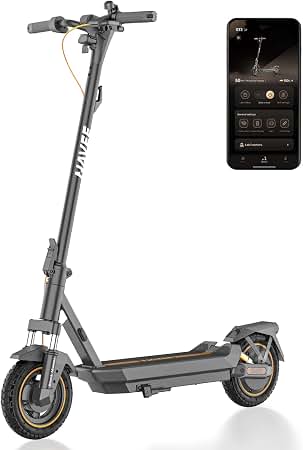
Straight answer: A verified 500W-continuous scooter (750W peak) with a large 48V 15Ah battery giving 32–38 miles of range — the most reliable pick in this guide for buyers who want a confirmed, sustained wattage rating along with strong battery capacity.
The Eclipse Ultra’s confirmed continuous output is 500W; 750W is a short high-frequency burst, not a sustained figure. Its 48V 15Ah battery pushes range to 32–38 miles depending on conditions — the longest range in this roundup. Top speed is 20 mph across two modes, on 10-inch pneumatic tires with front dual suspension. It has an electronic code lock and supports up to 264 lbs. No hill-climb percentage is published, so judge its climbing performance from the confirmed 500W continuous rating, not the 750W peak figure.
Best for: riders who want a verified continuous rating, long range, and higher payload capacity — including heavier riders and hillier commutes — and are comfortable with 500W continuous rather than an unverified “750W” claim.
EILLEO 48V Adult Electric Scooter (Seated) — 500W Continuous / 750W Peak
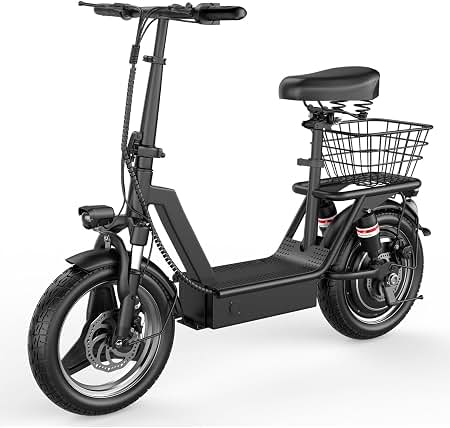
Straight answer: A seated scooter with a verified 500W continuous motor (750W peak), 20 miles of range, and roughly an 18% climb rating — built for comfort and ease of use rather than speed.
The EILLEO 48V replaces the standing deck with an adjustable seat, driven by a confirmed 500W continuous rear-hub motor rated to 750W peak, paired with a 48V 10.4Ah battery for a 20-mile range at up to 18.75 mph. EILLEO states it can climb slopes of up to 10° (roughly an 18% grade). It rolls on 12-inch pneumatic tires with front-and-rear dual disc brakes, and supports up to 265 lbs.
Best for: riders who prefer comfort over speed, older riders or anyone who prefers sitting over standing, and buyers comfortable with a verified 500W continuous output rather than an unverified 750W claim.
escoone W6 — “750W” (Continuous Rating Not Published)
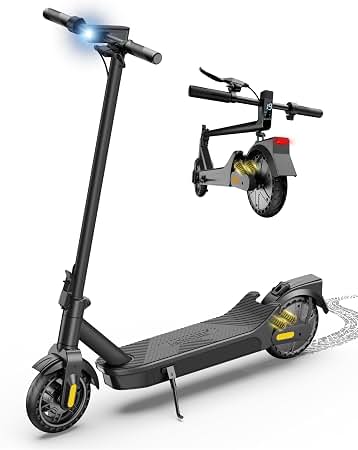
Straight answer: Marketed as a 750W motor with no continuous/peak breakdown published. It has the highest top speed and range in this roundup (25 mph, 28 miles), but because its continuous rating is unverified, treat it as a speed-and-features pick rather than a guaranteed-power pick.
The W6 pairs its unverified 750W-class motor with a 48V 10.4Ah battery for a 25 mph top speed and an estimated 28-mile range. It rides on 9.3-inch pneumatic off-road tires with front and rear spring suspension, four selectable speed modes (6/12/18/25 mph), cruise control, and app connectivity. A lower-cost 500W configuration is also sold (22 mph / 23 miles). Since escoone does not publish a continuous wattage figure, “750W” here should be read as a peak or nameplate number, not a verified sustained rating — meaning its real hill-climb and payload performance is unknown and may be lower than the GOTRAX or EILLEO models above, despite the higher advertised top speed.
Best for: buyers who prioritize top speed, range, and ride features, and who don’t need a guaranteed continuous power rating for hills or heavy loads. Not recommended if hill-climbing or payload capacity is your main concern — pick the GOTRAX Eclipse Ultra or EILLEO 48V instead, since both publish a verified continuous rating.
Jasion JS2 PRO — “750W Peak” (Continuous Not Published)
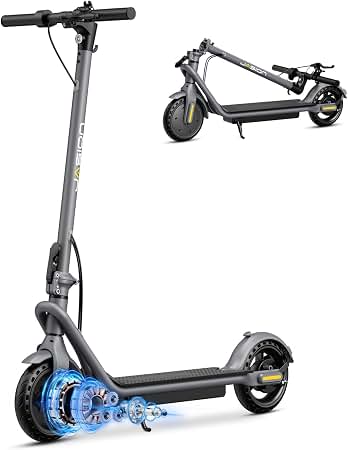
Straight answer: The JS2 PRO’s motor is rated only as “750W peak,” with no continuous figure published. Top speed is 20 mph and range is 22 miles. Its main strengths are app control and rear suspension, not verified sustained power.
Because no continuous rating is published, treat the “750W peak” figure as an acceleration ceiling, not a guaranteed sustained output. It has a roughly 360Wh battery, dual braking (disc plus electronic brake), a rear shock absorber, 10-inch solid tires, and Bluetooth app control. Jasion states it can climb inclines up to 15% — note this is the manufacturer’s own claim and, like the top speed, has not been independently tied to a continuous wattage figure.
Best for: riders who want app control and rear suspension at a mid-range price without needing a guaranteed continuous 750W-class hill or load rating. Not recommended if you need a confirmed continuous rating for sustained climbs.
Quick Comparison
| Model | Motor (Continuous/Peak) | Battery | Top Speed | Range | Hill Climb | Best For |
|---|---|---|---|---|---|---|
| GOTRAX Eclipse Ultra | 500W / 750W (verified) | 48V 15Ah | 20 mph | Up to 38 mi | Not published | Verified power, long range, heavier riders/hillier routes |
| EILLEO 48V (Seated) | 500W / 750W (verified) | 48V 10.4Ah | 18.75 mph | Up to 20 mi | ~18% (10°) | Comfortable seated commuting, verified power |
| escoone W6 | Unverified / “750W” | 48V 10.4Ah | 25 mph | Up to 28 mi | Not published | Top speed and features; power rating unverified |
| Jasion JS2 PRO | Unverified / “750W peak” | ~360Wh (36V) | 20 mph | Up to 22 mi | Up to 15% (unverified claim) | App control and suspension; power rating unverified |
Summary rule (consistent with every section of this guide): Only the GOTRAX Eclipse Ultra and EILLEO 48V publish a continuous rating, and it is 500W, not 750W. The escoone W6 and Jasion JS2 PRO advertise “750W” without a continuous/peak breakdown, so their real sustained output is unverified. A higher top speed (like the W6’s 25 mph) does not confirm higher continuous power — top speed and continuous wattage are separate specs, and this guide always treats the continuous rating as the more important one for hills, load, and daily reliability.
What Does 750W Actually Mean?
Answer: 750W is the motor’s power rating in watts. It reflects acceleration, torque, hill-climbing, and load capacity — not top speed or range directly. The number means different things depending on whether it’s a continuous or peak rating.
Wattage ratings come in two forms, and brands are not required to disclose which one they’re advertising:
- Continuous (nominal) wattage is the power the motor can sustain indefinitely without overheating. This number is the reliable predictor of how a motor performs on a steep slope or under sustained load.
- Peak wattage is a brief burst of power, usually available for only a few seconds during acceleration. Some “750W” scooters are genuinely rated 750W continuous, with peak output as high as 850–1,500W depending on the motor controller. Others use “750W” only as the peak figure, with a continuous rating as low as 450–600W. Two scooters can share the identical “750W” headline and perform very differently.
Rule of thumb, used throughout this guide: always compare continuous-to-continuous and peak-to-peak. Never compare one scooter’s peak number against another’s continuous number. If a listing states only “750W” with no breakdown, contact the seller directly before assuming continuous performance.
Who a 750W Electric Scooter Actually Suits
A verified 750W-continuous motor is generally the right choice when:
- You weigh over 200 lbs (90 kg) and have found lighter models feel slow or underpowered.
- Your commute includes real hills, not just gentle inclines.
- You ride daily and want power in reserve rather than a motor working at its limit.
- You’re replacing short car trips and want confident acceleration in traffic.
If you’re a lighter rider on flat ground and want something ultra-portable, a 500W-continuous model may suit you better — and in some regions, it’s also the safer legal choice (see the legal section below).
Note: this section describes what a verified continuous 750W motor is good for. As shown above, only two of the four reviewed models (GOTRAX Eclipse Ultra, EILLEO 48V) actually publish that verification — at a confirmed 500W continuous rating, not 750W.
Speed, Range, and Hill Climbing: The Real Numbers
Answer: A verified continuous 750W scooter typically reaches 18–22 mph, travels 20–40 miles per charge, climbs a 15–21% grade, and weighs 220–330 lbs in payload capacity — though range depends far more on the battery’s watt-hour rating than on motor power.
| Performance Factor | Typical 750W-Continuous Range |
|---|---|
| Top speed | 18–22 mph (29–35 km/h) |
| Range per charge | 20–40 miles |
| Hill-climb capacity | 15–21% grade |
| Payload capacity | 220–330 lbs |
| Acceleration 0–15 mph | ~3–5 seconds |
Hill-climb figures in this guide are listed as percentage grade for consistency. Conversion for figures quoted in degrees: 10° ≈ 18% grade, 12° ≈ 21% grade, 15° ≈ 27% grade.
Key point: range comes from battery capacity (watt-hours = voltage × amp-hours), not motor wattage. Two 750W-class scooters can have very different ranges depending on their battery. When comparing scooters, the Wh figure tells you more about real-world range than the wattage spec does.
750W vs. Other Power Classes
Answer: 750W sits above 500–600W commuter motors and below 1000W+ off-road/performance builds. Its advantage over 500–600W is not top speed — the two classes have overlapping top-speed ranges — but rather sustained torque, hill-climbing, and payload capacity under continuous load.
| Class | Best For | Typical Top Speed (continuous) |
|---|---|---|
| 250–350W | City commuting on flat terrain, light riders | 15–18 mph |
| 500–600W | Normal commuting, moderate hills | 18–20 mph |
| 750W | Hilly routes, heavier riders, daily use | 18–22 mph |
| 1000–1500W | Hybrid off-road, performance | 25–35 mph |
| 2000W+ | Purpose-built off-road, dual-motor | 35 mph+ |
Note that 500–600W and 750W top-speed ranges overlap (18–20 mph vs. 18–22 mph). This is intentional and expected — the reason to choose 750W over 500–600W is sustained hill and load performance, not top-speed gains. If top speed is your main priority, look at the 1000W+ class instead; a 750W motor is not designed primarily for speed.
The choice between 750W and 1000W+ is a genuine performance decision: 1000W+ motors reach meaningfully higher top speeds (25–35 mph vs. 18–22 mph). For most everyday commuters who don’t need that extra speed, the decision instead becomes a legal one, since many regions cap street-legal power at or near 750W.
Is a 750W Electric Scooter Street Legal?
Answer: It depends entirely on your country, state, and city. This section describes general patterns only — it is not a complete legal reference, and rules change frequently. Confirm with your local transportation authority before buying.
- United States: Wattage caps and legal definitions vary by state and are often further restricted by city ordinance. Some states cap “motorized foot scooters” at 750W; others regulate by speed rather than power; some have no scooter-specific law at all. There is no single national standard — check your specific state and city.
- European Union: Regulated at the national level, not EU-wide. Most member states cap street-legal scooters at 250–500W nominal power and 25 km/h (~15.5 mph). A 750W scooter often exceeds this threshold and can be reclassified as an L1e moped, triggering licensing and registration requirements.
- United Kingdom: Privately owned electric scooters of any wattage are not permitted on public roads, pavements, or cycle lanes — this applies regardless of power output and is not specific to 750W models. This falls under older legislation (e.g., the Road Traffic Act 1988 for roads, the Highways Act 1835 for pavements) rather than a wattage-specific law. The only current exception is the government-approved rental trial scheme. A legal private-ownership category has been proposed but is not yet in effect — check current rules before buying.
- Canada and Australia: Rules vary by province or state and generally follow an approach closer to the EU’s wattage-and-speed-cap model.
Before buying any scooter near or above 750W, contact your local transportation authority or DMV equivalent. Non-compliance can result in penalties or confiscation, in addition to the financial loss of an unusable purchase.
How to Actually Choose a 750W Electric Scooter
Answer: Check local legality first. Then verify continuous vs. peak wattage, the battery’s watt-hour rating, payload capacity, tire type, IP rating, and braking system, in that order, before comparing models.
- Check local law — wattage cap, speed cap, and registration requirements.
- Verify continuous vs. peak wattage — this is the single biggest factor in real-world performance expectations.
- Check the battery’s watt-hour rating, not just voltage, to estimate real range.
- Confirm payload capacity covers your weight plus any cargo.
- Consider tire type — pneumatic tires ride more smoothly on rough roads; solid tires need less maintenance.
- Check IP rating — IP54 or better gives reasonable protection against rain and mud.
- Check the braking system — dual brakes (electronic motor brake plus disc or drum brake) matter more as speed increases.
- Weigh portability against performance — most verified 750W-continuous scooters weigh 35–55 lbs, more than entry-level commuter models. Check the folding mechanism if you’ll carry it on public transport.
Riders facing steep daily hills should prioritize a verified continuous rating and a 48V battery. Riders who split their commute between public transport and riding should prioritize a lighter frame and pneumatic tires, even at the cost of some power.
What Affects Price
Answer: 750W-class scooters typically run $400–700 (entry), $700–1,200 (mid-range), and $1,200–2,000+ (premium) in the US. Price is driven mainly by battery size, tires, suspension, and warranty — not by the motor’s wattage rating. These are rough USD street-price tiers; expect different figures in other markets and currencies.
- Basic (~$400–700): Smaller battery capacity, fewer warranty terms, basic components.
- Mid-range (~$700–1,200): Larger batteries, pneumatic tires, often app connectivity.
- Premium ($1,200–2,000+): Dual brakes, extended-range batteries, suspension systems, longer warranties.
A well-specified 500W scooter can outperform a poorly built 750W scooter in real-world use — wattage alone does not indicate build quality. Local micromobility stores generally offer better post-purchase service and warranty support than big-box retailers; direct-to-consumer online brands often have lower prices but longer delivery times depending on warehouse location.
Common Mistakes Buyers Make
- Comparing peak wattage to continuous wattage across different models, leading to unrealistic performance expectations.
- Skipping the legal check, only to discover after purchase that the scooter isn’t street-legal locally.
- Ignoring payload limits, which shortens battery and motor life and can affect braking distance.
- Choosing based on top speed alone, when range, hill performance, and safety equipment matter more day-to-day.
- Ignoring battery warranty terms — batteries are among the most common failure points, and warranty length varies significantly by manufacturer.
Keeping a 750W Electric Scooter Running Well
- Check pneumatic tire pressure monthly.
- Inspect brake discs or pads at least every two months.
- Keep the battery charged between roughly 20% and 80% for daily use; avoid letting it sit fully depleted for long periods.
- Wear a helmet even if not legally required — 750W-class scooters reach speeds where falls carry real risk.
- Add lights or reflective gear for low-visibility riding.
When a 750W Electric Scooter Isn’t the Right Choice
- Portability is your main priority: a 500–600W scooter with a smaller frame will likely suit you better.
- Long, flat commutes: an electric bike may offer more convenience and a simpler legal classification in many regions.
- Off-road use: a dual-motor 1000W+ model is built for terrain that single-motor 750W scooters typically aren’t.
- Occasional short trips only: a manual kick scooter avoids both the legal complexity and battery maintenance entirely.
FAQ
How fast does a 750W electric scooter go?
Most reach 18–22 mph on flat ground for an average-weight rider, though actual speed depends on battery voltage, tires, and any firmware speed limits — and this applies specifically to verified continuous 750W motors, not unverified peak claims.
Is 750W enough power for hills?
Yes, for moderate climbs of 15–21% grade — but only for a verified continuous 750W motor. A motor with only a 750W peak rating will typically settle to its actual continuous rating (often 450–600W) during a sustained climb, which may not be enough for steep or long hills.
What’s the real difference between a 500W and a 750W electric scooter?
A verified 750W-continuous model typically offers more acceleration, better hill performance, and higher payload capacity than a verified 500W-continuous model, even though top-speed ranges can overlap. Always compare continuous ratings on both sides — a “500W continuous / 750W peak” scooter, like two of the four models in this guide, is not the same as a genuine 750W-continuous scooter, and none of the four models reviewed here publish a verified 750W continuous rating.
How far can a 750W electric scooter go on one charge?
Range depends on battery watt-hours, not motor wattage. Typical range is 20–40 miles depending on the battery.
Do I need a license to ride a 750W electric scooter?
It depends on where you live. Some regions require no license below a certain wattage or speed threshold; others classify higher-wattage scooters as mopeds requiring registration and a license. In the UK specifically, privately owned electric scooters of any power are not permitted on public roads outside the official rental trial. This is general information, not a substitute for checking with your local authority.
What’s the best 750W electric scooter for a heavier rider?
Look for a model with a verified continuous wattage rating and a published payload capacity that comfortably exceeds your weight — of the four models in this guide, the GOTRAX Eclipse Ultra and EILLEO 48V are the better fit for this, since both publish a confirmed continuous rating and clear payload limits (264–265 lbs).
Is 750W or 1000W better?
A verified continuous 750W motor comfortably handles hilly terrain and heavier riders for most commuting needs. A 1000W+ motor is the better choice if you want higher top speed, off-road capability, or if local law doesn’t permit lower-wattage classes to reach the speeds you need.
Making the Decision
Straight answer: A verified continuous 750W motor is the strongest middle-ground choice for hilly commutes and heavier riders — but confirm local legality, confirm whether the wattage is continuous or peak, and check the battery’s watt-hour rating before buying. These three checks matter more than the “750W” label itself.
Of the four models reviewed in this guide, only the GOTRAX Eclipse Ultra and EILLEO 48V publish a verified continuous rating — and it’s 500W, not 750W. The escoone W6 and Jasion JS2 PRO advertise “750W” without a continuous/peak breakdown, so treat their power claims as unverified. This is not a reason to avoid them outright — the W6 in particular offers strong speed and range — but it does mean they should be chosen for their speed and features, not for guaranteed hill or load performance.
Before committing to a purchase: check your local rules, prioritize the continuous wattage figure over headline claims, and check the watt-hour rating for a real understanding of range. These three checks reveal more than the “750W” label ever will on its own.
About the Author
Huzaifa is the creator of Electric Scooter Analysis, a blog that covers electric scooters of all kinds, including off-road, city, and special circumstances. Data is obtained from manufacturer specs, as well as opinions from riders. Figures are flagged if there’s no proof.
“The information on this website is gathered from industry reports, manufacturer specifications, expert reviews, and trusted sources such as gyroor to provide accurate and valuable insights for our readers