Written by Huzaifa, co-founder of Electric Scooter Analysis
If you’ve been searching for an electric scooter with a built-in Bluetooth speaker, you’ve probably run into the same problem everyone does: most guides are product listings disguised as information. They tell you what’s trendy, not what actually matters when you’re riding to work and back in the rain.
An electric scooter with a Bluetooth speaker is exactly what it sounds like — a standard electric scooter with an audio system, built in or attached, that lets you listen to music, take calls, or hear podcasts without headphones. It sounds like a small feature on paper, but it changes how the scooter is built, how it performs, and what you need to check before spending your money.
This guide explains how the audio system works, what separates a well-built model from a gimmicky one, the general cost range you can expect, and the safety and legal issues riders commonly run into.
Top 5 Electric Scooters with Bluetooth Speakers in 2026
Naming actual models helps ground this in reality rather than vague generalities. Below are five scooters covering different use cases — everyday adult commuting, performance riding, and kids’ models at different budgets and sizes. Specs can change with regional availability and firmware/hardware revisions, so always confirm current specifications directly with the seller before buying.
ONECNA T4: Best Music & Off-Road Performance
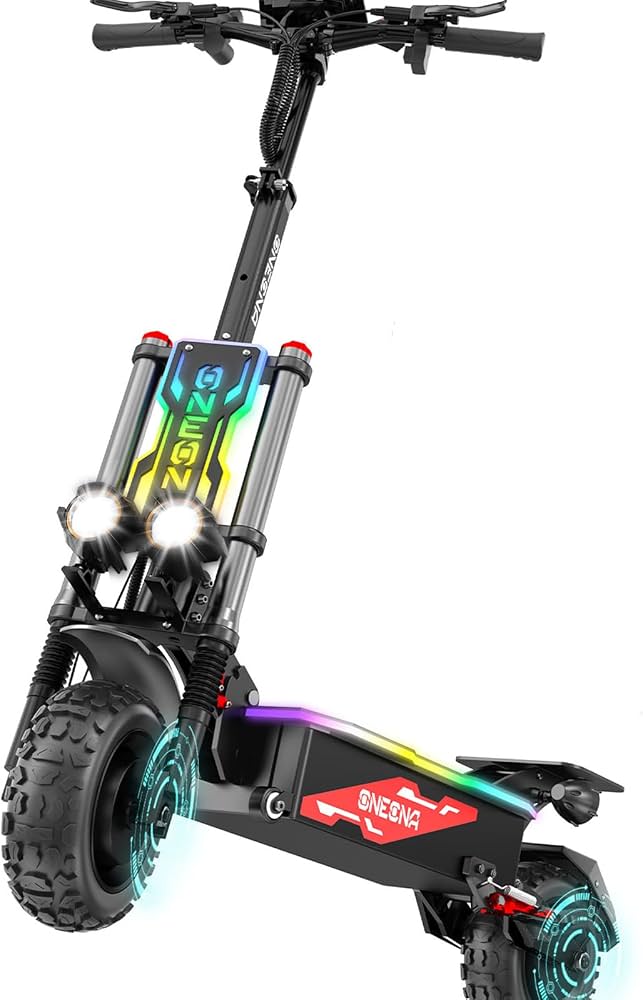
The ONECNA T4 earns its place because it doesn’t treat audio as an afterthought. The Bluetooth speaker is integrated directly into the front of the cockpit rather than bolted onto the frame, and it’s backed by genuine performance: a top speed of around 25–30 mph in road-legal configurations (higher-speed unlocked modes exist but are intended for private or off-road use only, since most regions cap street-legal e-scooters at 15–20 mph — see the Safety & Legal section below), roughly 45–50 miles of range, and dual hydraulic suspension for a smoother ride over rough pavement.
It has a maximum rider weight of 265 lbs, dual hydraulic braking, and ambient lighting synced to the front speaker. This is geared toward adult riders who want a serious commuter scooter that also sounds good — not a speaker bolted onto a weak platform.
FanttikRide C9 Apex: Kids’ Everyday Fun
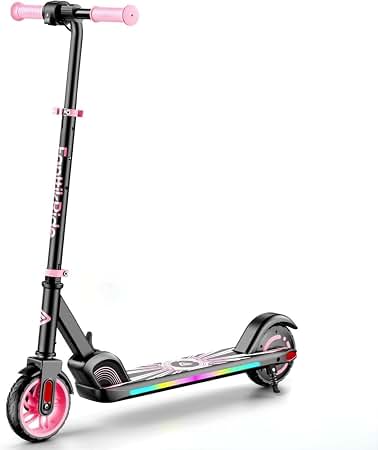
Built for kids ages 8–12 (up to 132 lbs) who want a scooter that grows with them while keeping the music going. The handlebar adjusts across three heights (31.7″, 34.1″, and 36.5″), and three selectable speed modes (5/8/10 mph) let parents control how fast a beginner can go before working up to the top speed.
The built-in Bluetooth speaker plays from the deck, paired with rainbow lights that cycle through six modes in sync with the music, while a rear fender brake and a G-sensor that only engages the motor once the rider is already moving keep things safer for first-timers. Range tops out around 5 miles and roughly 40 minutes of continuous riding — plenty for neighborhood loops, though not for longer trips.
Sonic Glow Electric Scooter (Best for Kids & Teens)
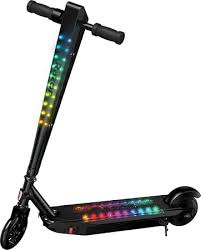
Designed for riders ages 8 and up (up to 120 lbs), the Sonic Glow uses a quiet brushless rear-hub motor good for up to 10 mph. Rated ride time is roughly 55 minutes of continuous use per charge, which works out to approximately 8–9 miles of range at its top speed (actual distance will vary with rider weight, terrain, and how much of that time is spent at lower speeds). Its built-in, auto-reconnecting Bluetooth speaker pairs once and connects automatically every time the scooter powers on, while multicolor LEDs on the deck and steering tube pulse in time with the music.
Gyroor H30 Max (Best Compact Kids’ Scooter)
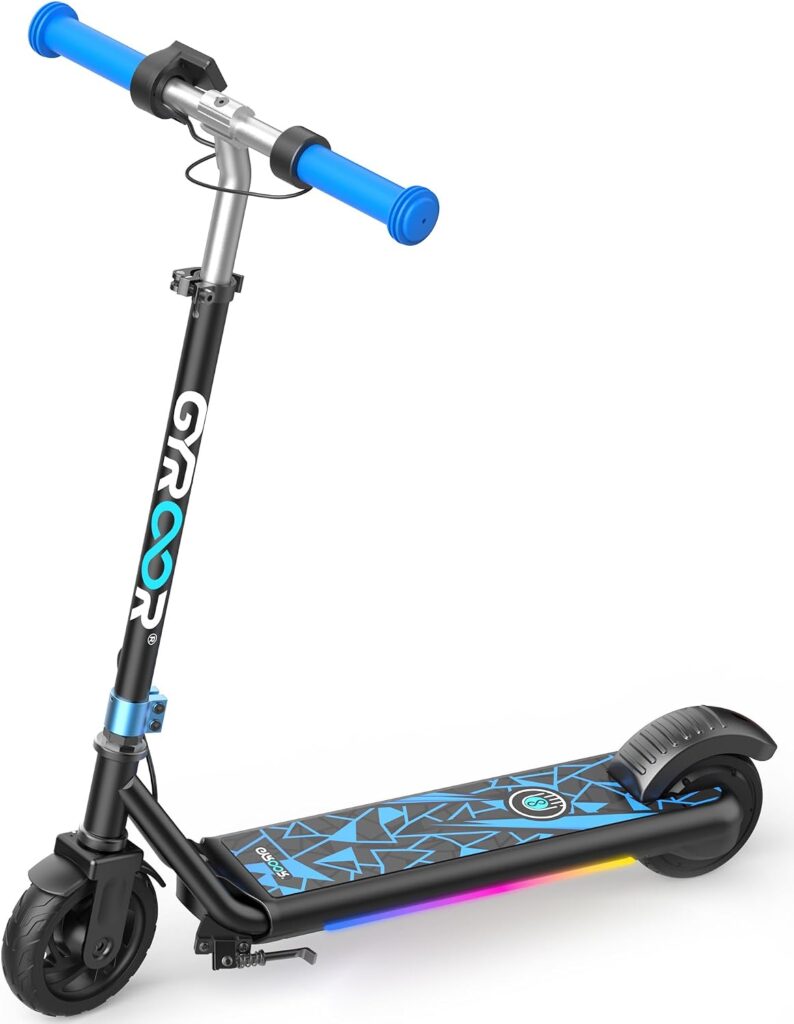
A compact, adjustable electric scooter built for kids aged 6–12. A 150W motor delivers speeds up to 10 mph with roughly 10 miles of range, and the handlebar height adjusts across three positions (34″, 36″, 38″) to grow with the child. A Bluetooth speaker built into the base of the deck lets kids stream music on the go, paired with bright LED lights on the deck and front tire for extra visibility, plus a dual brake system (electronic and foot brake) for reliable stopping power.
isinwheel S4 (Best Portable Kids’ Scooter)
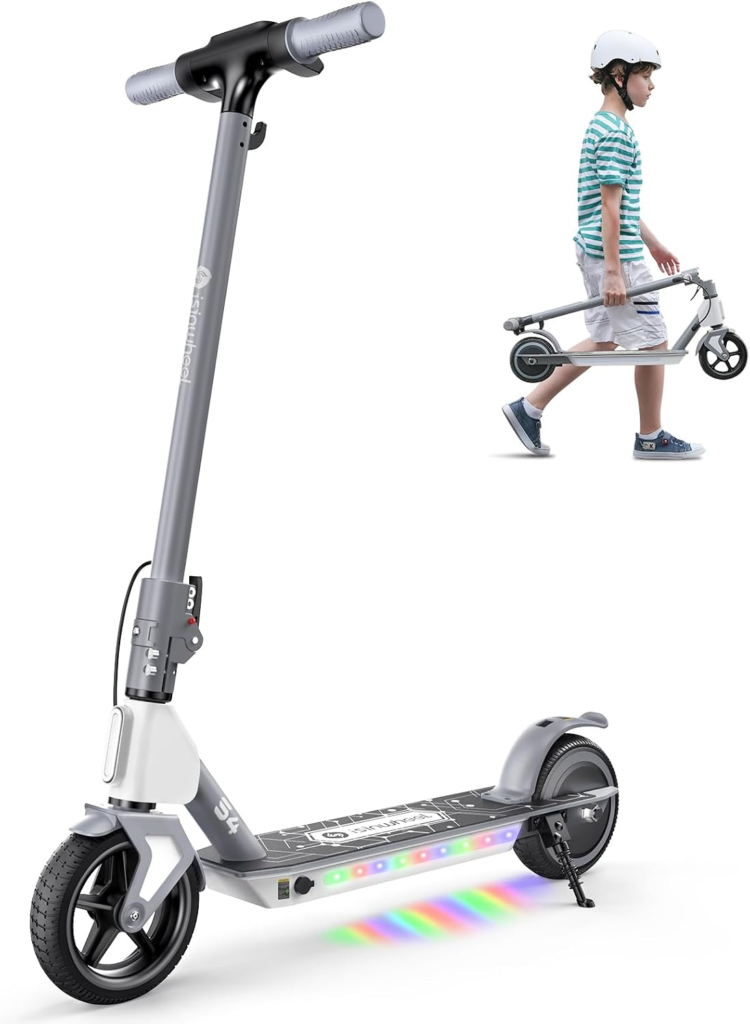
The pick for families who need a scooter that’s genuinely easy to carry. At just 15.2 lbs, it’s one of the lightest Bluetooth speaker scooters built for kids ages 6–14, and it folds down in around three seconds. A 200W motor offers three speed settings (5/8/12 mph), with a smart LED dashboard that riders double-tap to shift gears and check battery status. Range runs roughly 5–9 miles depending on rider weight, up to a 154-lb max load, and the built-in Bluetooth speaker pairs with rainbow deck lighting. Dual braking (electronic plus foot brake) and an IPX4 splash-resistant build round out a scooter designed to travel with the family.
Comparison Table: Top 5 Models at a Glance
| Model | Best For | Top Speed | Range | Speaker Highlight |
| ONECNA T4 | Performance & music (adults) | ~25–30 mph (road-legal config) | ~45–50 miles | Front-facing integrated speaker with high-quality audio |
| FanttikRide C9 Apex | Adjustable, all-round fun (kids 8–12) | 10 mph | ~5 miles | Deck-mounted speaker + 6 music-synced LED light modes |
| Sonic Glow Electric Scooter | Kids & teens (8+) | 10 mph | ~8–9 miles (~55 min ride time) | Auto-connect Bluetooth speaker + beat-synced LEDs |
| Gyroor H30 Max | Compact kids’ scooter (6–12) | 10 mph | ~10 miles | Deck-mounted Bluetooth speaker + LED lights |
| isinwheel S4 | Portability (kids 6–14) | 12 mph | ~5–9 miles | Built-in Bluetooth speaker + smart LED dashboard, folds in 3 sec |
What Exactly Is an Electric Scooter with a Bluetooth Speaker?
At its core, this is a personal electric vehicle — in the same category as a kick scooter or e-bike — with a Bluetooth audio component wired into the battery and motor system. Instead of connecting your phone to a separate speaker or earbuds, the phone connects directly to the scooter itself.
The audio component typically includes a small amplifier, one or two speaker drivers, and a Bluetooth receiver — usually running Bluetooth 5.0 or later, which offers better connection stability and battery efficiency than older 4.0/4.2 versions. Higher-end models may add hands-free calling or beat-synced LED lighting, though that’s more about aesthetics than function.
Built-In vs. Clip-On Speakers: The Comparison Most Guides Skip
This is the main decision point, and most buying guides skip it entirely. There are two distinct ways to add audio to a scooter, suited to different users.
A built-in speaker system is integrated into the deck or stem during initial assembly. It usually draws power from the main battery, which generally means better bass and no separate charging step — at the cost of a modest reduction in overall range.
A clip-on Bluetooth speaker attaches to the handlebars and runs on its own independent battery, so it doesn’t affect the scooter’s performance at all. It can also be moved between almost any scooter or bicycle you own.
| Feature | Built-In Speaker | Clip-On Speaker |
| Power source | Shares main battery | Independent battery |
| Impact on range | Minor reduction (roughly 5–15%) | None |
| Sound quality | Often better integration and bass | Varies by brand |
| Flexibility | Locked to one scooter | Works across multiple scooters/bikes |
| Best for | Buyers purchasing a new scooter | Buyers upgrading an existing scooter |
If you already own a scooter you’re happy with, a clip-on is usually the lower-risk option. If you’re buying from scratch, an integrated speaker tends to look and sound better — but only if the scooter’s other fundamentals (range, motor, brakes) hold up on their own merit.
How the Bluetooth Pairing Actually Works
Pairing is simple, but understanding what happens behind the scenes helps explain why it sometimes fails.
- Turn on the scooter and locate the Bluetooth button — usually on the display panel or stem.
- Hold it until you see a flashing light or hear a pairing tone.
- Open your phone’s Bluetooth settings and select the scooter from the list.
- Confirm the connection — some models ask for a simple PIN, such as 1234 or 0000.
- Open your music or podcast app; audio should route to the scooter automatically.
- Adjust volume using the scooter’s buttons or your phone.
If pairing fails on the first try, the fix is almost always the same: forget the device on your phone and repeat the process. Most “broken speaker” complaints online turn out to be outdated Bluetooth pairings, not hardware failures.
Does the Speaker Really Drain the Battery Faster?
This is one of the most common — and valid — concerns. If the speaker shares power with the main battery, running audio for extended periods can reduce your range, generally by 5–15%, depending on volume and battery size.
If the scooter uses an independently powered speaker (common on clip-ons and some higher-end built-in models), scooter range isn’t affected at all — only the speaker’s own runtime matters, which can last several hours per charge.
If range anxiety is a real concern for your commute, check the spec sheet to confirm whether the audio system is battery-independent before buying.
Is It Actually Safe (and Legal) to Ride with Music Playing?
The honest answer: it depends on your location and how you use it.
Compared to headphones or earbuds, a scooter speaker has one clear safety advantage — it doesn’t block ambient sound the way something in your ears does, so you can still hear horns, traffic, and pedestrians. That’s a meaningful benefit over riding with earbuds in, something many safety professionals flag as a hazard to situational awareness.
That advantage disappears, however, if the volume is turned up loud enough to drown out traffic noise. A speaker at low-to-moderate volume is safer than earbuds; a speaker cranked up to full volume can undermine the same safety benefit it’s supposed to provide. Keeping volume at a level where you can still clearly hear your surroundings is what actually makes the speaker safer, not the speaker itself.
Before riding, a few things worth checking:
- Helmet laws vary by state, country, and sometimes age group — check with your local transport authority.
- Speed and power limits vary by location; many regions treat e-scooters similarly to bicycles, with typical legal limits around 15–20 mph and 250–750W. Scooters capable of higher speeds (like unlocked performance modes) may exceed what’s legal to ride on public roads in many areas.
- Some zones have noise ordinances that can apply to loud music on scooters in residential or public spaces.
- Where you’re allowed to ride (bike lanes, streets, sidewalks) is regulated differently around the world.
This isn’t legal advice, and rules change often — check with your local authority before assuming anything is allowed by default.
What Should You Actually Look for When Buying One?
It’s tempting to focus only on speaker volume, but that’s how people end up with a scooter that sounds great and performs badly. It helps to break the decision into four categories:
Audio quality — Volume (5W is standard; 15–20W can be loud enough for group listening), Bluetooth version (5.0+ is current), and whether the speaker shares power with the main battery.
Scooter performance — Motor power ranges from 250W for flat, casual rides up to 800W for heavier riders or hill climbs. Range typically runs 10–15 miles on basic commuter models and 25–40 miles on higher-end ones. Dual braking (mechanical plus electronic) should be a higher priority than anything else on this list.
Build quality — Better tires mean lower maintenance; pneumatic tires generally ride more smoothly. Water resistance matters more than people expect — IPX4 handles light splashes, while IPX5 and above is safer for riding in real rain.
Battery behavior — Confirm whether the speaker shares the main battery or runs independently, and check the manufacturer’s stated playback time.
Quick guide:
- Want the best audio? Prioritize built-in systems with 10W+ drivers.
- Own a scooter already? Consider a clip-on instead.
- Commuting daily? Prioritize brakes and range over speaker wattage.
- Buying for a teen? Prioritize durability and speed limits over audio quality.
Common Mistakes Buyers Make
A few patterns show up repeatedly in forums and reviews — most are easy to avoid:
- Choosing a scooter based on speaker power while ignoring motor performance and range.
- Assuming “water-resistant” means fully waterproof (most models are IPX4–IPX5, not submersible).
- Playing music loud enough to block out traffic sound — which cancels out the safety advantage a speaker is supposed to offer.
- Skipping the return policy or a test ride before buying online.
- Overlooking the battery warranty, since the battery is by far the most expensive component to replace.
- Ignoring local speed or power regulations, which can result in fines in some cities.
Maintaining the Scooter and Its Speaker
- Fully charge the battery before the first ride.
- Check tire pressure regularly if you have pneumatic tires.
- Clean the speaker vents after riding in wet weather.
- Re-pair Bluetooth if the sound starts cutting out repeatedly.
- Update firmware through the companion app, if available.
- Check brake pads every few months.
- Avoid letting the battery fully drain during long storage periods.
Alternatives Worth Considering
A scooter with a built-in speaker isn’t the only way to get hands-free audio on two wheels:
- Standard scooter + clip-on speaker — cheaper and upgradeable, but needs its own charging.
- Bone-conduction headphones — keep your ears open to traffic sounds, though best used solo rather than for shared listening.
- E-bike with a built-in speaker — better range and stability, at the cost of size and complexity.
FAQ
Are electric scooters with Bluetooth speakers safe to ride?
Generally yes, since they don’t block ambient sound the way earbuds do — as long as volume stays moderate enough that you can still hear your surroundings.
Do Bluetooth speaker scooters drain the battery faster?
If the speaker shares the main battery, expect a roughly 5–15% reduction in range. Independently powered speakers don’t affect scooter range at all.
Can I add a Bluetooth speaker to a scooter I already own?
Yes — clip-on Bluetooth speaker mounts are widely available and fit most standard handlebars.
Can you legally ride with music playing in public?
Riding itself is generally legal, but noise levels and where you’re allowed to ride vary by city, so check local regulations.
How long does the speaker’s battery last?
Depends on whether it shares the main battery or runs independently. Independent units often last several hours of continuous playback — check the specific model’s rating.
What’s the difference between built-in and clip-on speakers?
Built-in speakers are integrated into the scooter’s design and battery system. Clip-on speakers are removable accessories with their own battery that can be used on nearly any scooter or bike.
Final Thoughts
The best Electric Scooter with Bluetooth Speakers in this category treat audio as a genuine feature, not a marketing gimmick covering for a weak motor or short range. Decide first whether a built-in system or a clip-on device fits your needs, then evaluate the scooter itself — motor performance, range, brakes, water resistance — exactly as you would without the speaker in the picture.
Check your scooter’s actual speed rating against local legal limits before riding, compare specs across at least two sellers, and test the Bluetooth connection early so you’re not troubleshooting it after the return window closes.
About the Author
Huzaifa is the creator of Electric Scooter Analysis, a blog that covers electric scooters of all kinds, including off-road, city, and special circumstances. Data is obtained from manufacturer specs, as well as opinions from riders. Figures are flagged if there’s no proof.
“The information on this website is gathered from industry reports, manufacturer specifications, expert reviews, and trusted sources such as gyroor to provide accurate and valuable insights for our readers