A 40 MPH Electric Scooter is a personal electric vehicle (PEV) built with high-performance features — dual motors, a 48V–60V+ battery, hydraulic disc brakes, and real suspension — engineered to make speeds in this range manageable, not just reachable on paper. Expect real-world speeds a couple of miles below the advertised number, and no legal right to ride at full speed on public streets in most of the U.S. or EU without registering the vehicle as a motorcycle or moped.
The four models in this guide
all sit in the 38–43.5 mph range and are grouped together here as the “40 MPH-Class.” A scooter built for 40 mph isn’t a commuter model with a bigger battery bolted on; it’s a distinct category built around dual motors, high-voltage electronics, and suspension components that entry-level scooters simply don’t need. Whether this class is right for you comes down less to the exact number on the spec sheet and more to where you’ll ride, how experienced you are, and how much you’re willing to invest in doing it safely.
This article covers what defines a 40 MPH-Class electric scooter, how that speed is actually engineered, where it’s legal to use, and what to weigh when picking a model — whether you’re buying for yourself or building out a fleet.
A quick note on terminology used throughout: scooter listings often mix “rated power” (the combined nominal output of the motors — e.g., two 1,000W motors = 2,000W rated) with “peak power” (the short-burst ceiling the controller can hit, usually higher). These are different numbers, and not every manufacturer publishes both, so treat any unlabeled power figure with a bit of caution.
The 4 Best 40 MPH-Class Electric Scooters
1. Nanrobot N6 (52V): Best 40 MPH Scooter
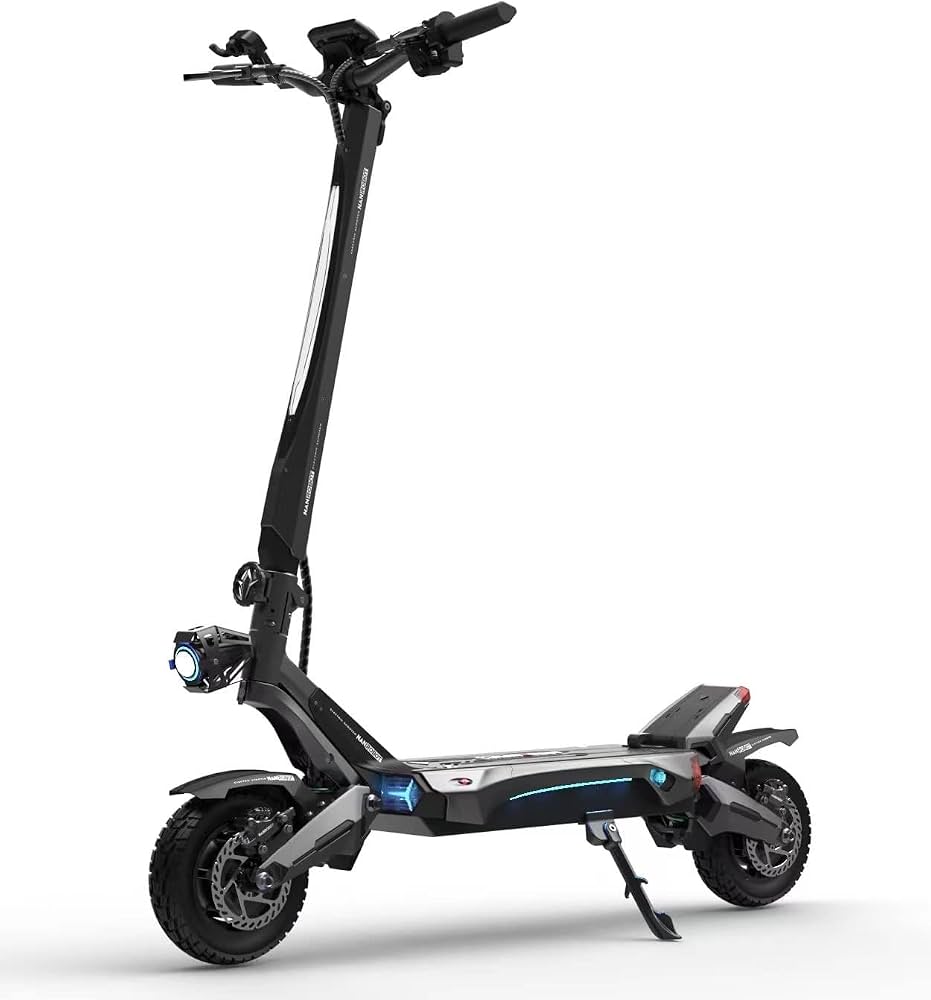
The 52V Nanrobot N6 holds a flat, steady 40 mph top speed and is one of the best-known names built specifically around this speed bracket. It runs dual 1,000W hub motors (2,000W combined rated output) paired with a 52V 26Ah battery, plus front- and rear-mounted hydraulic suspension and dual hydraulic disc brakes. It’s not the lightest scooter in its class at roughly 85–88 lbs, but the suspension and braking hardware give the rider solid control at speed.
- Top speed: 40 mph (manufacturer-rated)
- Brakes: Hydraulic disc, front and rear
- Best for: Riders who want a scooter engineered specifically around the 40 mph mark, without paying for headroom they won’t use
2. isinwheel H7Pro: Best Lightweight Pick
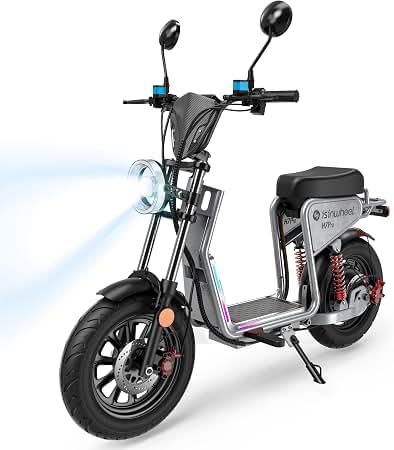
The isinwheel H7Pro is the most accessible model in this class, powered by a single 1,200W motor across four speed modes topping out at 38 mph, paired with a 48V 18.2Ah battery. It trades the dual-motor, hydraulic-brake setup of the other three models for a simpler single-motor layout with disc brakes, but makes up ground with a seat, 16-inch pneumatic fat tires, front fork suspension plus rear spring shock absorption, and a rated 43-mile range that beats several heavier dual-motor rivals.
- Top speed: 38 mph (manufacturer-rated)
- Brakes: Front and rear disc with electric cutoff brake — not hydraulic, so factor that into stopping-distance expectations at speed
- Water resistance: IPX4
- Net weight: Around 62 lbs — the lightest model in this lineup, reflecting its single-motor build
- Best for: Riders who want most of the range and speed of the 40-mph class, plus a seat, in the lightest and simplest package here
3. YUME X11 — Best Long-Range Pick
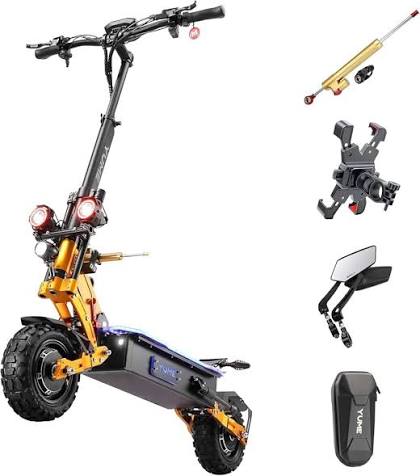
The YUME X11 is built for riders who want real distance alongside speed at the top of this class, running dual 3,000W motors (roughly 6,000W combined peak output) off a 60V 27Ah battery (a 60V 30Ah Samsung-cell pack is also offered) for a manufacturer-rated range of 56 to 60 miles.
- Top speed: 50 mph (manufacturer-rated; varies with rider weight, charge state, and terrain)
- Brakes: Dual hydraulic disc with electronic braking support
- Suspension: C-shaped hydraulic front suspension plus dual rear shocks, paired with 11-inch tubeless all-terrain tires
- Net weight: Around 98 lbs
- Best for: Riders who want the longest range in this lineup and plenty of power headroom
4. Segway GT2: Best Premium Pick
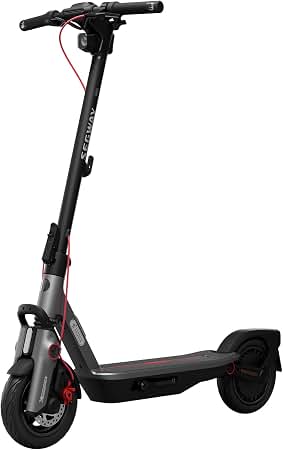
The Segway Ninebot GT2 is the most feature-loaded option in this lineup, pairing dual 3,000W motors (roughly 6,000W combined peak, 88Nm peak torque) with a 50.4V 30Ah (1,512Wh) battery that Segway rates for a 37.3-mile typical range and up to 55.9 miles in ideal conditions. It adds features the other three models don’t offer: a supercar-style double-wishbone front suspension, a Dynamic Traction Control system for slippery or gravel surfaces, a Boost Mode for short bursts of extra power, and a transparent display.
- Top speed: 43.5 mph (manufacturer-rated), with a claimed 0–30 mph time of 3.9 seconds
- Brakes: Front and rear hydraulic disc
- Tires: 11-inch tubeless, self-sealing/anti-puncture
- Net weight: About 116 lbs — the heaviest model here
- Max payload: 331 lbs
- IP rating: IPX4
- Charge time: About 16 hours on a single charger, or 8 hours with the dual-charger setup
- Best for: Riders who want the most engineered, tech-loaded scooter in the class and don’t mind the extra weight
None of these four should be read as “the” answer on its own — the right pick depends on what you want out of a 40 MPH-Class scooter: the lightest build, the longest range, the most tech, or the most tightly tuned to the 40 mph mark itself. Always confirm current specs and brake type directly with the manufacturer before buying, since firmware-limited options and configurations change often.
Quick Comparison Table
| Model | Top Speed | Motor Setup | Brakes | Net Weight | Standout Strength | Best For |
|---|---|---|---|---|---|---|
| isinwheel H7Pro | 38 mph | Single 1,200W motor | Disc (not hydraulic) | ~62 lbs | Lightest build, plus a seat | Riders who want range and comfort in the lightest package |
| Nanrobot N6 (52V) | 40 mph | Dual 1,000W motors (2,000W combined) | Hydraulic disc | ~85–88 lbs | Tuned precisely to the 40 mph mark | Riders who want a scooter built around exactly 40 mph |
| YUME X11 | 50 mph | Dual 3,000W motors (6,000W combined peak) | Hydraulic disc with EBS | ~98 lbs | Longest range in this lineup | Riders prioritizing distance and power headroom |
| Segway Ninebot GT2 | 43.5 mph | Dual 3,000W motors (6,000W combined peak) | Hydraulic disc | ~116 lbs | Premium build, tech features, traction control | Riders who want the most engineered, feature-loaded scooter |
What Is a 40 MPH-Class Electric Scooter?
A 40 MPH-Class electric scooter is a PEV built to reach speeds around 40 mph (roughly 64 km/h), using dual motors, a high-voltage battery, real suspension, and disc brakes strong enough to control that speed. Standard commuter scooters top out around 15–20 mph, so this is a genuine technical step up, not just a speed-limited commuter model.
What sets it apart from a commuter scooter:
- Dual motors in place of a single hub motor (though some models in this class, including budget ones, still use a single motor). Combined output varies widely by tier — entry-level dual-motor setups typically land around 1,600–3,200W, while top-tier setups can exceed 5,000W.
- High-voltage battery systems, typically 48V–60V on lower- and mid-tier models, with some at 72V+ for more efficient power delivery at speed.
- Steering dampers and hydraulic suspension to control the handlebar “wobble” that shows up on unstable scooters past 25–30 mph.
- Larger pneumatic tires (10–13 inches) for stability and grip.
- Disc brakes for real stopping power at speed — many top models use hydraulic discs, sometimes paired with regenerative braking, but this isn’t universal. Some models marketed in the 40 mph class use mechanical or electric-cutoff disc brakes instead. Don’t assume hydraulic brakes are standard — confirm the brake type on the specific model you’re buying.
In short, 40 mph isn’t just a number on a spec sheet — it’s a full frame and power system built to make that speed usable, and the voltage, brake type, and build quality behind it vary meaningfully between models.
How These Scooters Actually Reach 40 MPH
A 40 MPH-Class scooter reaches that speed through several components working together, not one powerful motor:
- Dual hub motors replace the single motor in commuter models, roughly doubling available torque (a handful of models, including some budget ones, use a single motor instead).
- A higher-voltage battery supplies the motors with enough energy without generating the excess heat a low-voltage system would under the same load.
- The motor controller is tuned for a higher RPM ceiling, often split between a faster “sport” mode and a slower, street-safe “eco” mode.
- Larger-diameter tires increase top speed at the same motor RPM while also adding stability.
- Suspension and steering dampers control the high-speed wobble that becomes a real safety risk above 30 mph.
- Disc brakes — hydraulic where fitted, mechanical or electric-cutoff on other models — provide stopping power a basic cable-and-caliper commuter setup can’t match. Hydraulic brakes generally offer better stopping power and less finger fatigue on long descents, so it’s worth checking which type your model uses.
That last point matters more than it seems: braking distance grows roughly with the square of speed, so a scooter that’s twice as fast needs more than double the stopping power to be safe.
How Fast Is 40 MPH, Really?
Actual top speeds on a 40 MPH-Class scooter typically run a bit below the advertised figure, since manufacturer specs are usually tested by a rider around 150 lbs, on flat terrain, on a full charge, in ideal weather — conditions most riders won’t consistently match.
On a typical ride, expect:
- A top speed slightly below the advertised number, especially for heavier riders or on hilly terrain. Independent testing has consistently found results one or two mph below the stated figure under good conditions.
- Real-world performance 25–40% below the claimed figure once hard acceleration, stop-and-go riding, or hills are factored in.
- Headwinds reducing both range and top speed further.
This gap isn’t specific to one brand — it’s common across the whole 40 MPH-Class category, since advertised numbers reflect best-case lab conditions. Set expectations around real-world testing, not the number on the box.
Is a 40 MPH-Class Electric Scooter Legal?
Riding at full speed on public roads is not possible almost anywhere. A scooter capable of 38–50 mph typically exceeds local low-speed vehicle limits and can legally be classified as a motorcycle or moped — which usually means registration, insurance, and sometimes a license are required. Being legal to buy is not the same as being legal to ride at full speed on public roads, and that’s the most common mistake buyers make.
Rules vary by country and, in the U.S., by state — treat the following as a starting point, not a final answer for your specific area, and check current regulations with your local DMV or equivalent authority before riding on public roads.
- United States: Most states define “low-speed” or “motor-assisted” scooters as capped around 15 mph (occasionally up to 25 mph), with power limits that vary by state, typically in the 750W–1,500W range. Scooters capable of 38–50 mph almost always exceed these limits and can be classified as a motor vehicle or moped, requiring registration, plates, insurance, and sometimes a motorcycle endorsement. Some states restrict scooters in this class from public roads entirely, regardless of speed.
- European Union: Classification varies by member state, but many countries cap unregistered PLEVs (Personal Light Electric Vehicles) at 20–25 km/h (roughly 12–15.5 mph). A scooter near or above 40 mph is well outside that range in almost all EU countries and will generally need to be classified as a motorcycle or moped for legal road use.
- Everywhere else: Rules vary significantly and change often. Outside the U.S. or EU, confirm your country’s vehicle classification before assuming a high-speed scooter is road-legal.
In practice, most scooters in this class ship with a speed-limited “legal mode” for street use, reserving full power for private property or closed courses. Riding unregistered at full speed on public roads risks penalties, confiscation, and — in the event of a crash — the strong likelihood that insurance won’t cover an unregistered high-speed vehicle.
Who Actually Needs a Scooter This Fast?
A scooter in the 38–50 mph range suits riders with legal access to higher speeds — on private property, a closed course, or in an area that permits it — but it’s a poor fit for first-time buyers or commuters riding daily in zones with lower speed caps.
Good fit for:
- Experienced riders stepping up from a mid-tier scooter
- Riders using private land, campus grounds, or closed courses
- Long-distance riders who need extra power for hills
- Anyone riding in an area where higher speeds are legally permitted
Not a good fit for:
- First-time scooter buyers
- Riders whose main use is daily public-road commuting in a lower-speed zone
- Riders unwilling to invest in real protective gear
- Anyone without secure, dry storage — these machines typically weigh 60 to 116 lbs
30 MPH vs. 40 MPH: Which Do You Actually Need?
Pick a 30 mph-class scooter for short city rides where portability matters most. Pick a 40 MPH-Class model for hills, longer commutes, or riding where the extra weight and charge time pay for themselves in range and power.
If you’re unsure, starting with a 30 mph scooter is the safer call — it’s easier to move up to more speed later than to walk back overconfident riding habits.
Safety Gear and Riding Requirements
Riding at 40 mph and above safely requires a certified DOT/ECE full-face helmet, protective gloves, knee and elbow pads, and abrasion-resistant clothing — a standard bicycle helmet isn’t adequate at this speed.
Before riding at full speed, make sure you have:
- A full-face, DOT/ECE-certified helmet
- Protective riding gloves
- Elbow and knee pads
- Abrasion-resistant pants and jacket
- Sturdy, closed-toe shoes
- Lighting or reflective elements for low-visibility riding
Common mistakes to avoid:
- Riding at full throttle before learning how the scooter handles at lower speeds
- Substituting a bicycle helmet for a proper full-face helmet
- Ignoring tire pressure, which is a major contributor to high-speed wobble
- Skipping brake and suspension maintenance, which sees more strain in this class than on a commuter scooter
- Assuming a model has hydraulic brakes without checking — as noted above, it’s not universal in this class and directly affects stopping distance
For Fleet Operators, Retailers, and Importers
Buying into this category from a business angle is a different equation than a private purchase:
- Import/compliance: Many high-speed scooters fall outside standard low-speed vehicle import categories, which can affect certification requirements, duties, and resale classification.
- Rental and fleet use: Public liability risk rises with each speed tier. Most rental and shared-scooter programs deliberately cap fleet vehicles below 40 mph for this reason.
- Retail positioning should be based on tested performance — top speed, suspension quality, brake components — rather than spec-sheet numbers alone.
- Service and warranty: Dual-motor, high-voltage systems require more service expertise than standard commuter units, which is worth factoring into after-sales planning.
Alternatives Worth Considering
A 40 MPH-Class scooter isn’t the only route to higher performance than a basic commuter model:
- 30 mph-class scooters offer a meaningful step up without the legal and insurance complexity of the 40-mph tier
- E-motorcycles are the better option when full-speed, legal public-road use is the goal
- E-bikes often fit more easily into bike lane and pedal-assist regulations in many regions
- Standard 15 mph scooters remain the right call for everyday city commuting
FAQ
Can electric scooters actually reach 40 mph?
Yes. The Nanrobot N6 (52V) is manufacturer-rated at exactly 40 mph, with dual motors and hydraulic disc brakes. The isinwheel H7Pro, YUME X11, and Segway Ninebot GT2 round out the 40 MPH-Class at 38, 50, and 43.5 mph respectively. Always check a model’s actual rated speed and brake type before assuming — hydraulic brakes aren’t guaranteed across every model in this class.
Is a 40 MPH-Class electric scooter legal to ride on public roads?
Most likely not at full speed. Most U.S. states and EU countries cap unregistered scooters well below 40 mph, which can classify a faster scooter as a moped or motorcycle requiring registration.
Can I ride a 40 mph scooter on public roads at all?
Generally only in “legal mode,” speed-limited to your local cap (usually 15–25 mph). Riding at full speed on public roads without registering the scooter as a moped or motorcycle is restricted in many U.S. states and EU countries.
Do I need a license for a 40 MPH-Class scooter?
In many places, yes — if the scooter exceeds your area’s low-speed vehicle limit, registration, insurance, or a driver’s or motorcycle license may be required depending on local law.
How does real-world performance compare to the advertised speed?
Usually 25–40% lower once hills, stop-and-go riding, and full-speed use are factored in.
Are 40 mph-class scooters safe for beginners?
Not recommended. This tier calls for real riding experience, proper protective gear, and comfort handling higher speeds before using full power.
Who actually needs a scooter this fast?
Mostly riders who want hill-climbing power, confidence over longer distances, and off-road capability — not riders trying to hit top speed on public roads.
Is a 30 mph or 40 MPH-Class scooter better?
Neither is universally better. 30 mph suits shorter city trips and easier portability; the 40-mph tier suits hills, longer distances, and riders who want more performance headroom.
40 MPH Electric Scooter Buyer’s Guide
Once you’ve decided this class is right for you, the model that fits comes down to practical factors, not just the biggest number on the spec sheet.
Step 1: Confirm where you’ll actually ride. Before comparing models, know where full-speed riding will happen — private property, a closed course, or an area that permits it. If most of your riding happens on public roads with a lower speed cap, prioritize convenience and portability over outright top speed.
Step 2: Decide what you’re optimizing for. All four models in this guide sit in the 40 MPH-Class, but each is built around a different priority — exact speed tuning, low weight, long range, or premium tech. Know which one matters most to you before comparing specs line by line.
Step 3: Match the motor setup to your priorities.
- Lightest, most accessible build: isinwheel H7Pro — single motor, seat, lowest weight in this lineup
- Tuned precisely to 40 mph: Nanrobot N6 (52V) — dual motors, hydraulic suspension and brakes
- Maximum range and power headroom: YUME X11 — dual motors, hydraulic brakes, longest range here
- Premium build and tech: Segway Ninebot GT2 — dual motors, double-wishbone suspension, traction control, Boost Mode
Step 4: Budget for proper safety gear, not just the scooter. A full-face helmet, riding gloves, and abrasion-resistant clothing are part of riding this class safely — skipping them undercuts the point of buying a well-built machine in the first place.
Step 5: Compare tested performance, not just advertised specs. Where possible, compare models using independently tested range and top speed rather than manufacturer claims alone. The gap between advertised and real-world figures varies by brand, and testing data gives a more reliable basis for comparison.
Step 6: Buy from a brand with real support. A dual-motor, high-voltage scooter is harder to service than a commuter model. A brand with responsive warranty support and available spare parts will pay off over the life of the scooter.
Quick Decision Checklist
- [ ] I know where I’ll ride at full speed, and it’s legal there
- [ ] I’ve decided what matters most: exact 40 mph tuning, low weight, range, or tech features
- [ ] I’ve matched the motor setup (single vs. dual) to my priorities for range, weight, and capability
- [ ] I’ve confirmed the brake type (hydraulic vs. mechanical/electric-cutoff) on my chosen model, rather than assuming
- [ ] My plan includes proper safety gear, not just the scooter itself
- [ ] I’ve compared at least two or three models against tested performance, not just advertised specs
- [ ] The brand I’m considering has real warranty support and service availability
A 40 MPH-Class electric scooter can be an excellent tool for the right rider in the right setting. It isn’t a good first scooter, and it isn’t a shortcut around local vehicle regulations — but paired with the right environment, experience, and gear, it’s one of the most capable tools in personal electric mobility today.
About the Author
Huzaifa is the creator of Electric Scooter Analysis, a blog that covers electric scooters of all kinds, including off-road, city, and special circumstances. Data is obtained from manufacturer specs, as well as opinions from riders. Figures are flagged if there’s no proof.
“The information on this website is gathered from industry reports, manufacturer specifications, expert reviews, and trusted sources such as gyroor to provide accurate and valuable insights for our readers