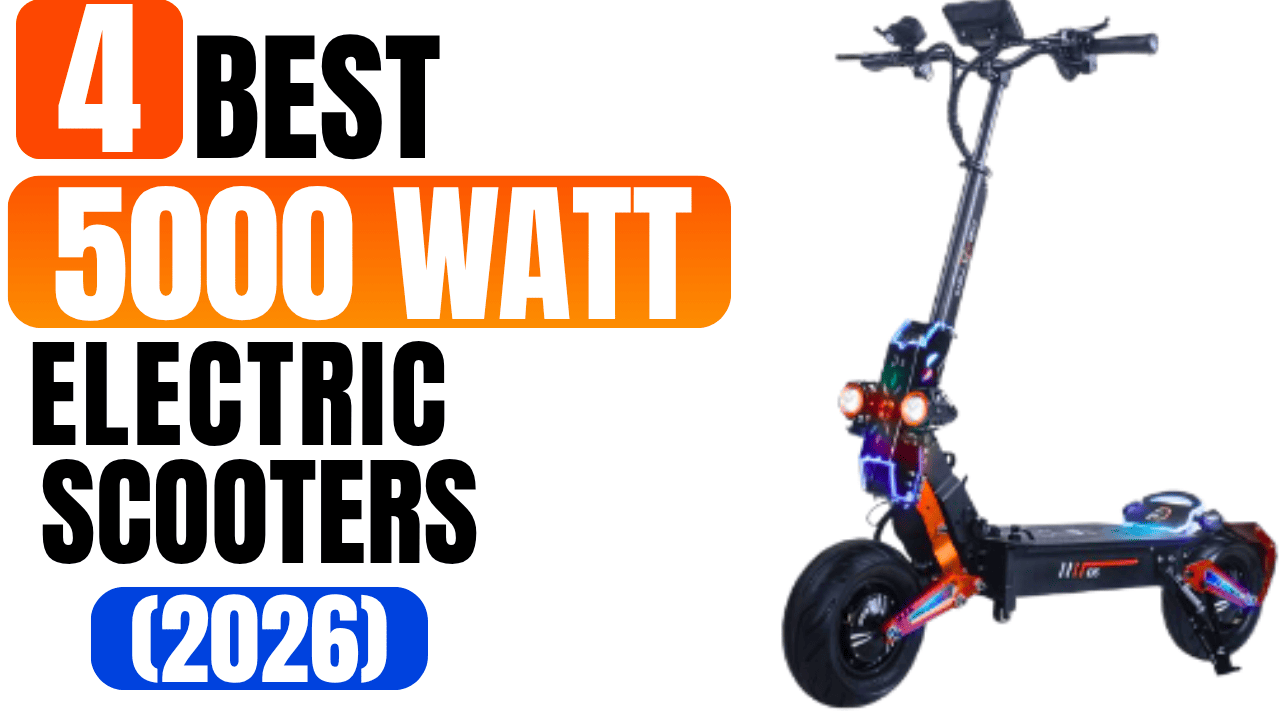
If you’ve ever looked into the latest electric scooter that has high power, you’ve noticed “5000 watt” gets thrown around all the time — usually without any explanation of what it means for the way it rides, what it actually costs, or whether you’re even allowed to ride it on the road. This gap is exactly what causes confusion.
A scooter rated at 5000 watts sits in the top tier of the electric scooter market, a step above the commuter scooters you see cruising down bike lanes. It’s built for acceleration and power rather than portability, and it comes with a distinct set of legal and safety concerns compared to the one you might rent downtown. Here’s what you should know before buying one — and if you just want the quick answer, we’ve compared four models in this class below before getting into specs, legality, and pricing.
- Four models from this guide are:
- ZSNAKE Z37: Best for highest top speed and aggressive off-road suspension.
- HLOIE H1 GEN2: Best for heavier riders
- NAVEE UT5 Ultra X: Best for highest range, premium hardware/software, and premium price.
- T50 PRO: Best for budget-friendly, capable 5000W-class performance.
4 best 5000 Watt Scooters that actually reach 5000W
ZSNAKE Z37
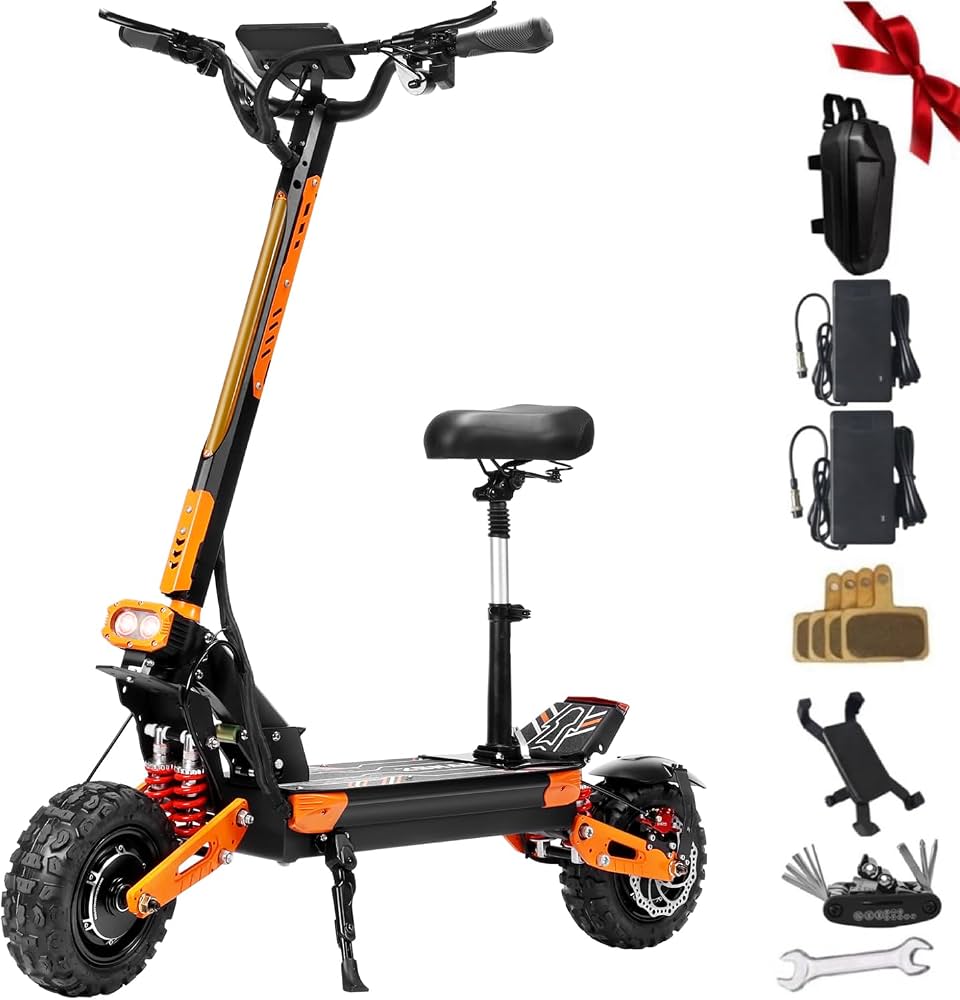
Dual 3,000W peak-rated brushless motors combine for a 6,000W peak total output (the manufacturer does not publish a separate continuous/nominal figure, so treat the 6,000W number with the same peak-vs-nominal caution covered later in this guide), and both motors stay engaged in every ride mode — Sport, Standard, and Eco — rather than switching to single-motor at lower settings. That gives it the highest advertised top speed here, up to 52 mph, with a claimed range of 60+ miles from its 60V battery pack, recharging in roughly 5–8 hours via dual charging ports.
It rides on 11-inch tubeless all-terrain tires, backed by a front triple-clamp hydraulic suspension and rear dual-spring suspension. Stopping power comes from front and rear hydraulic disc brakes with EBAS (Electronic Brake Assist), and it’s rated to climb roughly 40-degree grades. Max rider load is listed at 330 lbs, with a detachable seat, quick-fold frame, and full 360-degree lighting.
Best for riders who want the highest top speed and most aggressive off-road suspension here without stepping up to flagship pricing — though treat the 52 mph figure as a best-case number and verify local classification before riding anywhere but private property or off-road terrain.
HLOIE H1 GEN2
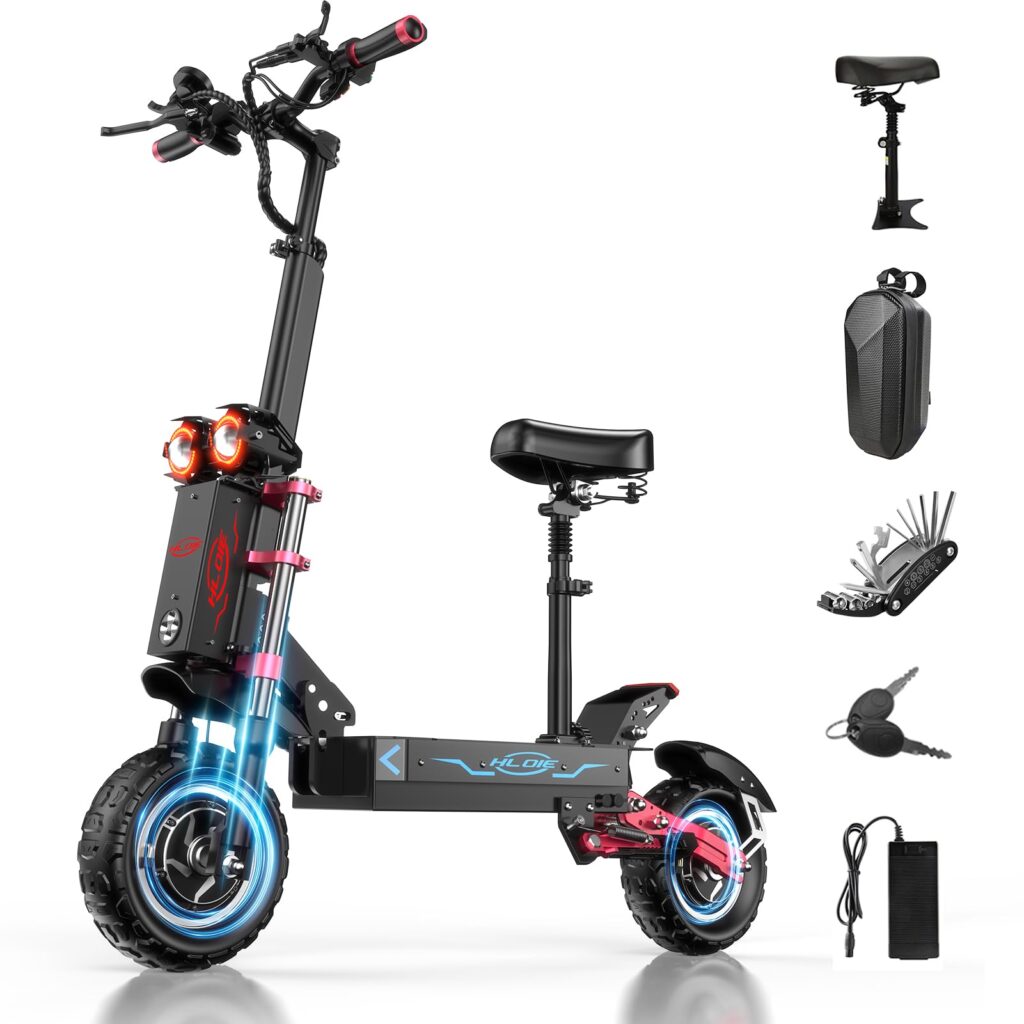
This one is a good example of the peak-vs-nominal confusion covered later: manufacturer listings describe the H1 GEN2 as a “peak 5600W” dual-motor system, each motor rated at 2,800W peak — so the headline number here, like the ZSNAKE’s, is a peak figure rather than sustained output. Claimed top speed is up to 50 mph, and retailer listings show a 48V battery (commonly 26Ah) with a claimed range of roughly 45–55 miles.
Its standout spec is a listed maximum load capacity of up to 800 lbs — well above most scooters in this class. That number is worth verifying directly with the seller before relying on it for a specific rider weight, since listings for this model aren’t fully consistent on load figures, but it does point clearly toward heavier riders and cargo-style use as the intended niche. It rolls on 11-inch off-road pneumatic tires, uses a front disc brake with a rear hydraulic brake, and adds heavy-duty shock absorption. It keeps a removable seat, quick-folding frame, and full 360-degree lighting.
Best for heavier riders or anyone priced out of higher-load-capacity scooters elsewhere — confirm the load rating and battery specifics with the seller before buying, since listings vary.
NAVEE UT5 Ultra X
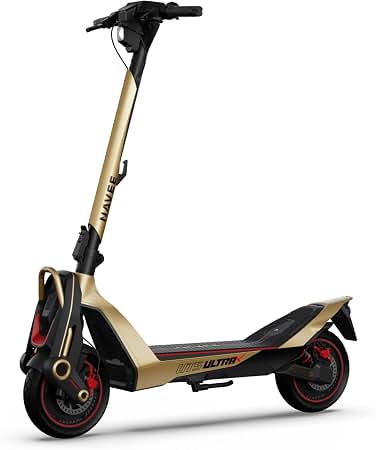
NAVEE’s flagship standing scooter is built more around sustained range and refined hardware than outright peak wattage. Its dual 1,200W-rated motors combine for 2,400W continuous / 4,800W peak — just under the 5000W mark on paper, though in practice it rides in the same speed and feature bracket as the other three scooters here, which is why it’s included. NAVEE claims a 43–43.5 mph top speed, and independent GPS testing from at least one reviewer measured it at 42.9 mph — an unusually close match between advertised and tested figures for this category.
Range is the real selling point: the 1,284Wh battery is rated for up to 74.6 miles at a 9.3 mph economy pace, dropping to 49.7 miles at 15.5 mph and 37.3 miles at 24.9 mph. Real-world mixed riding (higher speeds, hills, stops) puts most riders in the 40–55 mile range per charge. It rides on 12-inch self-healing tubeless tires with dual hydraulic suspension and an adjustable steering damper (NAVEE’s “NavXride”) for switching between pavement and rough-terrain settings. Braking comes from 130mm hydraulic discs front and rear with app-adjustable traction control. At 90.4 lbs it’s the heaviest scooter here, with a 330 lb max rider weight, plus Apple Find My tracking, auto-unlock, and scheduled charging.
Best for riders who want the most range and the most polished hardware/software package here, and who are willing to pay a premium for it.
T50 PRO
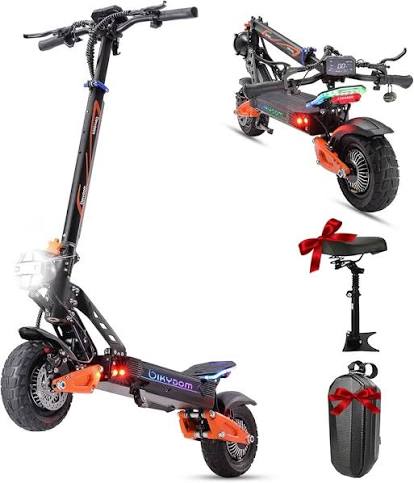
The most accessible entry point on this list. Manufacturer listings for the T50 PRO are inconsistent even with each other on some numbers — some describe it as a straight “5000W dual-motor system,” others qualify it as high-speed output rather than a strict continuous rating, and top-speed claims across listings range from about 42–45 mph. Treat the 5000W figure with the same nominal-vs-peak caution as the other models here. It pairs with a 60V/25.6Ah (~1,536Wh) battery, claimed range in the 50–55 mile range, and recharges in about 6–8 hours.
It’s built on 10.5-inch off-road tires with dual hydraulic disc brakes, an E-ABS system for reduced stopping distance, and front/rear suspension. Listed max load capacity varies by retailer, from 330 lbs to 440 lbs — check the specific listing you’re buying from. It includes NFC keyless start, three customizable speed modes with cruise control, and full lighting. The electrical system carries UL certification with a fire-retardant battery casing, backed by a 12-month motor/battery warranty and manufacturer technical support.
Best for riders who want a genuinely capable 5000 Watt Scooter without premium pricing, and who value UL certification on the electrical system — confirm your local wattage classification before assuming it’s street-legal where you live.
Quick Comparison
| Model | Motor (Nominal/Peak) | Battery | Top Speed | Range | Max Load | Best For |
|---|---|---|---|---|---|---|
| ZSNAKE Z37 | 3,000W ×2 peak / 6,000W peak total (nominal not disclosed) | 60V | ~52 mph | 60+ mi (claimed) | ~330 lb | Off-road performance & top speed |
| HLOIE H1 GEN2 | 2,800W ×2 peak / 5,600W peak total | 48V, ~26Ah | ~50 mph (claimed) | ~45–55 mi (claimed) | Up to 800 lb (listed; verify) | Heavy riders, high load capacity |
| NAVEE UT5 Ultra X | 1,200W ×2 nominal / 2,400W nominal, 4,800W peak total | 1,284Wh | ~43 mph (GPS-tested ~42.9 mph) | Up to 74.6 mi (eco); ~40–55 mi mixed | ~330 lb | Long range & premium build |
| T50 PRO | ~5,000W dual (rating basis unclear across listings) | 60V/25.6Ah | ~42–45 mph (claimed) | ~50–55 mi (claimed) | 330–440 lb (varies by listing) | Budget entry into the class |
Note: always cross-check advertised speeds and ranges against independent riders or third-party test data where available.
What Does “5000 Watt Scooter” Actually Mean?
This is where most buyers get confused, and it’s worth sorting out before looking at any product list.
5000 Watt Scooter usually refers to one of two things: a single motor rated at 5000W, or two motors (often ~2,500W each) whose figures are added together to advertise a combined 5000W. Both get marketed identically, but they don’t ride the same. Dual-motor setups generally handle bumps and uneven terrain better, since power is distributed over both wheels instead of concentrated in one.
There’s also a real difference between peak and nominal wattage that’s almost never clarified — and, as the models above show, manufacturers are inconsistent about which one they’re actually advertising:
- Nominal (continuous) power is what the motor can sustain without overheating. This is the number that reflects real long-term performance.
- Peak wattage is a brief rating, typically 1.5–2x the nominal figure, hit only for a few seconds during hard acceleration before the scooter settles back down.
If you’re comparing two scooters both labeled “5000W,” they may not be measuring the same thing — one manufacturer’s “5000W” may be a peak spec, another’s may be closer to sustained output. The more reliable numbers to compare are voltage (48V, 60V, 72V, 84V) and battery capacity in amp-hours (Ah), since these — not the wattage headline — largely determine real top speed and range.
| Spec | What It Controls | Typical Range |
|---|---|---|
| Voltage | Top speed potential | 48V–84V |
| Battery capacity (Ah) | Range | 20Ah–35Ah |
| Controller amperage | Acceleration and torque | 40A–60A |
| Motor configuration | Stability, hill climbing | Single-hub or dual-hub |
| Tires | Speed and control | 10″–13″, pneumatic preferred |
How Fast Is a 5000 Watt Scooter, Really?
Manufacturer claims and real-world results don’t always match, which is why the distinction matters.
Based on the models covered above, well-built dual-motor scooters in this class — on 48V–60V systems — realistically top out in the low-to-mid 40s through low 50s mph range under good conditions (flat roads, street tires, rider close to the manufacturer’s test weight, usually 165–175 lbs). A few tuned or higher-voltage models in this broader power tier can push into the high 50s or low 60s, but that’s closer to the upper edge of the range than the norm — treat any single-model claim above roughly 55 mph as something to verify independently rather than assume.
Speed can drop below the claimed figure in these situations:
- Rider weighs more than the manufacturer’s test base
- Knobby off-road tires instead of street tires
- Battery isn’t fully charged
- Cold weather, which reduces battery discharge efficiency
- Headwind or an incline
If an ad claims 70+ mph for a 5000 Watt Scooter, treat that as a marketing ceiling, not something you’ll regularly hit on the street.
Is a 5000 Watt Scooter Legal to Ride?
Short answer: in most places, a 5000 Watt Scooter is not treated as a standard e-scooter — this is where many buyers go wrong.
Personal electric vehicle regulations were generally built around low-power e-bikes and scooters. In the U.S., the federal definition of a low-speed electric bicycle under Public Law 107-219 caps those vehicles at 750W with functioning pedals — this law applies specifically to pedal-equipped e-bikes, not throttle-only scooters, but state scooter regulations commonly borrow the same 750W benchmark, and most state e-scooter rules cap street-legal use at 15–20 mph and 750W. A 5,000W scooter is well over both figures.
That doesn’t automatically mean it’s illegal everywhere — it means it generally doesn’t qualify for the simpler “bicycle-style” treatment that low-power scooters get. In the roughly 3,000W–8,000W range, most jurisdictions start classifying the vehicle as a moped, motorcycle, or off-highway vehicle, per guidance from agencies like the NHTSA on vehicle classification. That reclassification can bring registration, titling, licensing, and insurance requirements that a regular scooter doesn’t need.
Some states, including California and Colorado, don’t cap wattage directly but still apply speed limits and equipment requirements, and local ordinances can be stricter than state law. Outside the U.S.:
- Canada: provinces with e-scooter pilot programs typically regulate road use well below 5000W; higher-wattage scooters are usually treated as off-road-only or unregistered vehicles.
- UK and much of the EU: private ownership of high-powered e-scooters for public road use is heavily restricted or limited to licensed rental programs.
- Australia and parts of Asia-Pacific: rules vary by state/territory, but high-wattage scooters commonly fall outside standard personal-mobility-device categories.
Before buying, it’s worth doing the following:
- Search “[your state or country] moped or motorcycle classification wattage limit.”
- Check your city’s official micromobility/scooter ordinance page — city rules can be stricter than state or national law.
- Call your local non-emergency police line if the statute language is unclear.
Assume a 5000 Watt Scooter is meant for private-property or off-road use unless you can confirm otherwise. The fact that it’s available to buy online is not proof that it’s legal to ride on public streets — those are two separate questions. Riding an unregistered high-wattage machine on public roads can lead to impoundment, fines, and denial of an insurance claim if you’re in an accident — a real financial risk to weigh before buying.
Who Should (and Shouldn’t) Buy One
A 5000 Watt Scooter isn’t just an upgrade over a commuter model — it’s a different category of vehicle.
Good fit if you:
- Are an experienced rider comfortable at 40+ mph on two wheels
- Have access to private property, an enclosed course, or a legally registered pathway
- Want a scooter specifically for off-road use
- Need extra motor power and payload capacity beyond a typical commuter scooter (most 5000W-class models support 250–400+ lbs)
Probably not the best fit if you:
- Are still learning to ride scooters
- Plan to use it in bike lanes, on sidewalks, or for daily urban commuting
- Don’t want to invest in real safety gear
- Live somewhere with strict moped/wattage regulations you can’t realistically comply with
5000W Compared to Other Power Tiers
| Class | Typical Top Speed | Legal Path | Best For |
|---|---|---|---|
| 1000W commuter | 15–20 mph | Typically street-legal as scooter/e-bike | Everyday urban commuting |
| 3000W | 30–40 mph | Often borderline; check local laws | More punch without full moped registration |
| 5000W | 42–55 mph | Usually classified as moped or motorcycle | Experienced riders, off-road, motorbike alternative |
| 7000W–8000W+ | 50–65+ mph | Almost always requires registration | Riders prioritizing speed above all else |
If everyday street legality matters more to you than raw speed, a Class 3 electric bike (pedal-assist, generally capped around 750W/28 mph) or a properly titled electric motorcycle will give you more legal clarity and less hassle.
Safety Gear Isn’t Optional at This Speed
At 40+ mph, a 5000 Watt Scooter behaves more like a motorcycle than a bicycle. Gear accordingly:
- A DOT- or ECE-certified full-face helmet — a bicycle helmet isn’t enough
- Armored gloves and an abrasion-resistant jacket
- Closed-toe, ankle-supporting shoes
- Eye protection if your helmet isn’t full-face
- Reflective gear and lighting for night riding
Budget for this as part of the total cost of ownership, not an afterthought — and practice braking and low-speed handling in an empty lot before opening the throttle fully.
Common Mistakes Buyers Make
- Riding on public roads without checking local classification rules first
- Comparing scooters by peak wattage instead of nominal/continuous power
- Skipping proper safety gear because “it’s just a scooter”
- Mismatching tires to use case — street tires off-road, knobby tires on pavement
- Leaving the battery charging unattended in an unsafe location
- Assuming the advertised speed and range are what you’ll actually get
Keeping It Running
A 5000 Watt Scooter needs more regular maintenance than a basic commuter model due to the extra stress on battery, motor, and brakes:
- Check tire pressure and tread regularly
- Inspect brake discs and pads monthly
- Re-torque fasteners after the first 50 miles, then every few months
- Store the battery at 40–80% charge if it will sit unused for a while
- Keep firmware updated if the model has an app
- Clean and lubricate the belt drive or chain per the manufacturer’s schedule
FAQ
Is a 5000 Watt Scooter legal to ride on the street?
Usually not as a standard e-scooter. Most jurisdictions cap street-legal e-scooters at 750W and 15–20 mph, so a 5000 Watt Scooter typically gets reclassified as a moped, motorcycle, or off-highway vehicle — which can mean registration, licensing, and insurance requirements. Always check your specific state, province, or country before riding one on public roads.
Do I need a license or registration to ride one?
In most places that classify 5000 Watt Scooters as mopeds or motorcycles, yes — some form of registration, titling, or a license is required. Some regions treat them as off-road-only or unregistered vehicles instead. This varies enough by location that you need to check your local rules directly rather than assume.
How fast does a 5000W scooter actually go?
Realistically, low-to-mid 40s up to low 50s mph under good conditions (flat road, street tires, rider near the manufacturer’s test weight). A few tuned or higher-voltage models can reach the high 50s or low 60s, but claims above roughly 55 mph should be verified independently rather than taken at face value.
What’s the difference between “peak” and “nominal” wattage?
Nominal (continuous) wattage is what the motor can sustain without overheating — the number that reflects real long-term performance. Peak wattage is a short burst rating, typically 1.5–2x the nominal figure, hit for only a few seconds during hard acceleration. Manufacturers often advertise the peak number without labeling it clearly, so two scooters both marketed as “5000W” may not be comparable at all.
Is a single-motor or dual-motor 5000W scooter better?
Dual-motor setups generally handle bumps and uneven terrain better since power is split across both wheels rather than concentrated in one. A single 5000W motor and two motors totaling 5000W combined are marketed identically but ride differently, so check which configuration a listing actually describes.
How far can a 5000W scooter go on a single charge?
It depends heavily on the model, riding speed, and terrain — figures in this class range from roughly 45 miles up to 70+ miles at economy speeds, dropping noticeably at higher speeds, on hills, or in cold weather. Voltage and battery capacity (Ah) are more reliable indicators of real range than the wattage figure.
How much weight can a 5000 Watt Scooter carry?
Most models in this class list a max rider load somewhere between 250–440 lbs, though at least one model advertises up to 800 lbs. Load ratings vary noticeably by retailer listing for some models, so confirm the figure directly with the seller before relying on it for a specific rider weight.
What safety gear do I need for a scooter this fast?
At 40+ mph these scooters behave more like a motorcycle than a bicycle. A DOT- or ECE-certified full-face helmet (not a bicycle helmet), armored gloves, an abrasion-resistant jacket, closed-toe ankle-supporting shoes, eye protection, and reflective/lighting gear for night riding are all recommended as part of the real cost of ownership.
Can I ride a 5000W scooter off-road or on private property without registering it?
Generally yes — the legal complications mainly apply to public roads. Private property, enclosed courses, or dedicated off-road terrain are the safest and most straightforward use cases if you can’t or don’t want to meet your area’s registration requirements.
Is a 5000W scooter a good choice for daily commuting?
Usually not, unless you can confirm it’s legally classified and registered for road use where you live. For everyday urban commuting, a lower-wattage e-bike or scooter that qualifies for standard bicycle-style treatment (generally capped around 750W) will be far less hassle.
How is a 5000W scooter different from a regular commuter e-scooter?
It’s a different category of vehicle, not just a faster version of the same thing. Commuter scooters (around 1000W) top out around 15–20 mph and are typically street-legal as-is. A 5000 Watt Scooter reaches 40+ mph, usually requires moped/motorcycle-style classification, and demands motorcycle-level safety gear and rider experience.
The Bottom Line
A 5000 Watt Scooter delivers genuinely motorcycle-adjacent power in a scooter’s body — but that comes with legal and safety responsibilities most marketing skips over. Before buying one:
- Confirm how your state, province, or country actually classifies vehicles over 750W — don’t assume.
- Decide whether you need off-road tires, street tires, or a hybrid setup for your actual riding terrain.
- Budget for safety gear as part of the scooter’s real cost, not an add-on.
- Compare voltage and battery capacity, not just the “5000W” headline — and check whether that figure is peak or nominal.
- If you can’t legally ride it on the street where you live, a lower-wattage or properly titled electric motorcycle will likely give you a better experience than fighting local rules for a 5000W machine.
Confirm you’re legally in the clear first. Cost, speed, and range are easy to evaluate once that’s settled.
About the Author
Huzaifa is the creator of Electric Scooter Analysis, a blog that covers electric scooters of all kinds, including off-road, city, and special circumstances. Data is obtained from manufacturer specs, as well as opinions from riders. Figures are flagged if there’s no proof.
“The information on this website is gathered from industry reports, manufacturer specifications, expert reviews, and trusted sources such as gyroor to provide accurate and valuable insights for our readers