Written by Huzaifa, co-founder of Electric Scooter Analysis
If you’ve considered the possibility of a cargo electric scooter — whether for business trips, deliveries, or even for transporting groceries without needing a vehicle — you’ve likely noticed that the marketplace is overcrowded and the specifications can be confusing. Manufacturers love to promote top-of-the-line numbers such as maximum payload, maximum distance, and speed. However, those numbers usually don’t hold up once you’ve actually loaded the scooter and taken it for a ride.
This guide outlines the basics behind that confusion. It explains what a cargo electric scooter is, what payload and range actually look like once you’ve added weight, and how to choose between a trike and a two-wheel scooter. It also explains what drives cost — whether you’re an individual courier or a small business building a delivery fleet.
4 Best Cargo Electric Scooters in 2026
The specs on a manufacturer’s website are only half the story — the other half is how those specs hold up against the load you’re carrying, your route, and your budget. Here are four cargo-capable models worth considering, and who each one suits best.
Razor EcoSmart Cargo
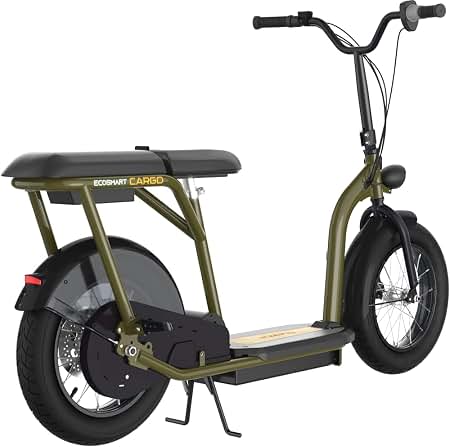
Razor’s entry into this category has less to do with maximum capability and more to do with flexibility. A chain-driven, 48V, 1,000-watt motor enables an average speed of 19.9 mph (32 km/h), with a range of up to 16.6 miles (26.7 km) on a full charge. One of its most useful features is the adjustable rear rack: switch between a removable passenger seat, a detachable basket, or an accessory rack depending on whether you’re hauling cargo or giving someone a ride. Combined rider-and-cargo capacity is 300 lbs (136 kg), and a manual rear disc brake handles stopping.
Best for: Riders who want a single scooter that can double as a light cargo hauler and a passenger scooter, and who don’t need commercial-grade payload. It suits casual errands or personal use rather than daily commercial delivery. Worth knowing before you buy: the motor runs louder than most competitors in this list.
iScooter F7
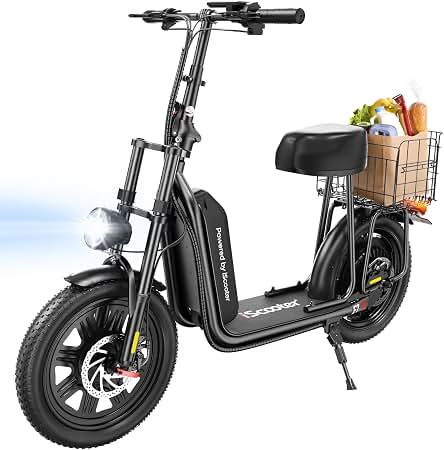
The F7 stands out for terrain versatility. Its 16 x 3.0-inch tires are built to handle grass, gravel, and uneven surfaces, and the 1,000W motor has three adjustable speed settings — 9, 21, and 28 mph — letting you slow down when carrying fragile cargo.
The 48V 10.4Ah battery is rated for up to 45 miles, though real-world range under load typically comes closer to 30 miles, depending on rider weight and terrain. The carbon steel alloy frame supports up to 330 lbs. Front and rear disc brakes handle stopping, and an easily removable seat lets you switch between standing and seated riding.
Best for: Riders whose routes aren’t smooth — mixed campus terrain or rough sidewalks — and who want extra range headroom to offset the load-related range loss covered later in this guide.
Gyroor C1S Electric Scooter with Seat
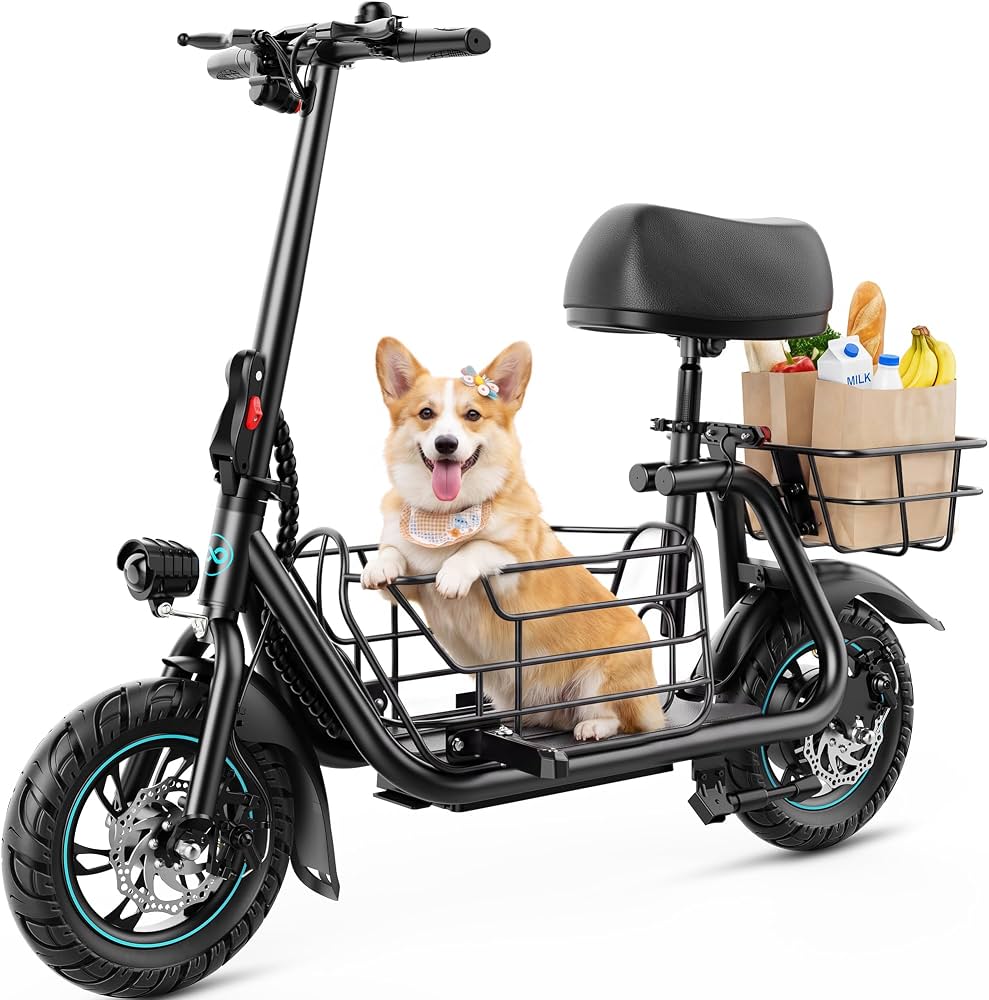
The C1S takes a different approach by building the whole scooter around seated comfort. A 550W motor (800W peak) paired with a 36V 7.8Ah battery gives it a top speed of 18.6 mph and up to 20 miles of range on flat ground, unloaded. What makes it useful for cargo duty is its two-basket layout: a large, detachable middle basket sized for pets, groceries, or work essentials, plus a smaller rear basket for extra storage. A 9.5-inch-wide deck, an adjustable soft seat (fitting riders from 5’1″ to 6’1″), and 12-inch shock-absorbing pneumatic tires help longer errand runs feel less tiring. Dual disc brakes, a front headlight, and a rear brake light round out the safety features, and the unit is UL2272 certified (the relevant U.S. safety standard for electric scooters and similar personal mobility devices), rated for riders up to 265 lbs (120 kg).
Best for: Riders who want a genuinely comfortable, seated way to run everyday errands — grocery trips, pet transport, short parcel runs — at a more accessible price point than most seated cargo scooters. It’s not built for heavy, all-day delivery work, and the 20-mile unloaded range will shrink noticeably once a basket is loaded and hills get involved — but for light, frequent hauling close to home, the seat and dual storage are a real advantage over standing-only budget scooters.
Misodo GT10
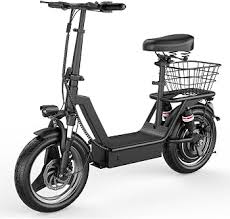
The GT10 is the most capable all-rounder of the four once cargo, distance, and hills are all in play together. It runs a 1,000W peak motor that can handle inclines up to roughly 25 degrees, drawing power from a 48V 15Ah (720Wh) battery rated for up to 35 miles per charge, with a 5–6 hour recharge time. Top speed comes in around 25 mph. Front and rear suspension smooths out the ride on 14-inch pneumatic tires, and the rear box is purpose-built for cargo rather than an afterthought basket, making it easier to secure groceries, parcels, or gear than an open rack. The seat is removable if you’d rather ride standing, and the frame folds for storage or trunk transport. The manufacturer does not clearly publish a maximum payload figure for this model — if payload capacity is a deciding factor for you, confirm this directly with the manufacturer or retailer before buying.
Best for: Riders who need the longest range and strongest hill-climbing of this group, in a seated package that still folds for storage — think longer commutes with a grocery stop on the way home, or routes with real inclines. It gives up some of the compactness and lower price point that budget-focused riders may want, so anyone with tight apartment storage or only occasional light errands may be better served by a smaller model like the Gyroor C1S above.
Comparison Table
| Model | Motor | Battery / Range | Top Speed | Max Payload | Best For |
| Razor EcoSmart Cargo | 1,000W, chain-driven | 48V / up to 16.6 mi (26.7 km) | 19.9 mph (32 km/h) | 300 lbs (136 kg) | Convertible cargo-or-passenger use, casual errands |
| iScooter F7 | 1,000W | 48V 10.4Ah / up to 45 mi claimed (~30 mi loaded) | 28 mph (45 km/h) | 330 lbs (150 kg) | Mixed or rough terrain, longer routes |
| Gyroor C1S | 550W (800W peak) | 36V 7.8Ah / up to 20 mi claimed | 18.6 mph (30 km/h) | 265 lbs (120 kg) | Comfortable seated errands, pet transport, value-focused buyers |
| Misodo GT10 | 1,000W peak | 48V 15Ah (720Wh) / up to 35 mi claimed | 25 mph (40 km/h) | Not published by manufacturer | Long-range commuting with hills, seated comfort |
As with every spec sheet in this guide, treat the speed and range numbers above as best-case figures. Expect a noticeable decrease once your own cargo is loaded, particularly on hills.
What Is a Cargo Electric Scooter?
A cargo electric scooter is a battery-powered, reinforced electric scooter built around a basket, platform, or rack designed to transport goods, rather than just a passenger. Instead of the slim deck you’d see on a commuter scooter, it typically has a wider frame, stronger suspension, and a motor sized to handle extra weight beyond just a standing rider.
Put simply: a cargo electric scooter is purpose-built to haul loads. Personal-use models are commonly designed to carry up to around 15 kg, while commercial-grade platforms can support 150 kg or more. Range typically falls in the 20–80 km range per charge before cargo weight is factored in.
This category sits alongside cargo e-bikes and cargo trikes (3-wheel scooters) or cargo mopeds, but it’s more compact and easier to park than an e-bike or trike, and cheaper to maintain than a van or moped.
Why Cargo Electric Scooters Matter Right Now
Two factors are driving demand. First, online shopping and food delivery have made last-mile logistics a daily reality for millions of freelancers, and a cargo scooter is often the most affordable and efficient way to cover a 2–15 km delivery radius. Second, many cities are restricting combustion-engine vehicles in urban centers, pushing individuals and small businesses toward electric alternatives.
The economics matter too. A small business running local deliveries on a cargo electric scooter instead of a vehicle can save significantly each year once fuel, insurance, depreciation, and parking costs are factored in. For a freelance courier, the math is even simpler: faster deliveries and no fuel cost typically let a scooter pay for itself within weeks.
Who Actually Uses These, and When
Cargo electric scooters serve more people than you’d expect:
- Food delivery couriers running gig delivery or parcel apps
- Small grocery and retail businesses handling their own local delivery
- Campus and warehouse logistics teams moving goods across large sites
- Urban families and individuals running errands without a car
They’re the best fit for short-radius trips — usually under 15 km — in dense urban areas, campuses, and places where parking a car or van is difficult or costly. If you regularly travel farther than this, or need to haul very heavy cargo, a cargo e-bike, moped, or trike is generally a better fit.
How a Cargo Electric Scooter Actually Works
Five components work together to determine performance:
| Component | What It Does |
| Motor (hub or mid-drive) | Provides torque for moving added mass; more wattage means better load and hill performance. |
| Battery (Li-ion, 36V–60V) | Determines range. Heavier cargo draws more current, cutting range down. |
| Frame | Steel or reinforced aluminum, rated for combined rider + cargo weight. |
| Suspension | Absorbs load-bearing stress; heavier-duty models use dual suspension. |
| Brakes | Disc brakes are most common, since stopping distance under load is longer than when empty. |
This is the part most spec sheets don’t explain clearly: load changes how the vehicle behaves. A moderate 20–25 kg load typically reduces real-world range by around 20–35% compared to running empty on flat terrain. On hills, that reduction can reach 40%, since the motor draws much more current on every climb.
Braking distance also increases with added weight, and load placement matters more than most buyers realize. Heavier items should go in a front or middle basket rather than a rear rack — overloading the back can cause the front wheel to lift under hard acceleration or while climbing.
A rule experienced riders follow: don’t load a cargo electric scooter beyond about 80% of its stated max payload. Manufacturers test that maximum figure under straight-line, ideal conditions. Real streets have potholes, corners, and sudden stops, and handling degrades before you actually hit the number printed on the spec sheet.
Types of Cargo Electric Scooters
By Cargo Configuration
- Front-basket models — best for smaller, heavier items like food orders or small parcels
- Rear-rack models — better weight distribution for moderately heavy loads
- Flatbed/platform models — used for commercial applications
- Modular trailer-attachable models — useful for light hauling without permanently modifying the scooter
By Duty Class
- Standard-duty (up to ~25 kg payload): personal errands and light deliveries
- Medium-duty (~25–75 kg payload): food service or parcel delivery professionals
- Heavy-duty/commercial (~75–150+ kg payload): fleet operators, warehouse and campus logistics
2-Wheel vs. 3-Wheel: Which Should You Pick?
This is a choice that’s often overlooked, and it deserves its own consideration.
Three-wheel cargo scooters (cargo trikes) typically carry larger payloads — often 135 to 250 kg — and offer noticeably better low-speed stability, which matters if you’re new to riding or carrying unbalanced loads. The trade-off is size: trikes are larger, harder to park, and some front-wheel-drive designs lose traction on hills compared to rear-hub-motor layouts.
Two-wheel cargo scooters are compact, easier to maneuver on narrow streets, and generally simpler to park. They demand more balance and rider skill, particularly with a loaded front basket.
If you’re riding narrow urban streets with tight parking, a two-wheel model usually wins. If you’re carrying heavy or unevenly balanced loads, or want more confidence at low speed, the extra footprint of a trike is worth it.
(Note: all four models recommended above are two-wheel scooters. If a trike better fits your payload needs based on the comparison above, that’s a separate category worth researching on its own.)
Cargo Electric Scooter vs. Cargo E-Bike vs. Cargo Moped
| Feature | Cargo Electric Scooter | Cargo E-Bike | Cargo Moped |
| Typical payload | 15–150 kg | 20–100 kg | 50–250 kg |
| Typical range | 20–80 km | 40–100 km | 60–150 km |
| Parking convenience | High | Medium | Low |
| License/insurance required | Sometimes | Rarely | Usually |
| Relative purchase cost | Low–Medium | Medium | Medium–High |
| Best for | Short-radius delivery | Longer, eco-conscious routes | Heavier loads, longer distances |
If your routine involves short trips and limited parking, a scooter usually wins on convenience and cost. If your routes are longer with lighter, frequent loads, an e-bike may get you farther on less energy. Mopeds make sense when weight or distance exceeds what a bike or scooter can handle.
What Drives the Cost of a Cargo Electric Scooter
Rather than quoting specific prices — which vary by retailer, region, and time of year — it’s more useful to understand the general tiers this category falls into:
- Entry-level models: suited for light tasks and small basket loads
- Mid-tier delivery models: built for regular courier use, with reinforced frames and dedicated cargo platforms
- Commercial/industrial models: aimed at fleet operators and heavy daily use, with the highest payload ratings and durability
Some retailers also offer rental or subscription options as an alternative to buying outright, which can remove the upfront cost and maintenance burden — potentially useful if you’re not yet sure whether delivery work will be an ongoing commitment.
Import duties and regional taxes can shift real-world pricing significantly, so treat any price you find online as a reference point, not a guaranteed local price — and always check current pricing directly with the retailer or manufacturer before buying.
How to Choose the Right One: A Simple Decision Framework
Step 1 — Know your typical payload. Under 15 kg: a standard basket-style scooter works fine. 15–50 kg: look for a moderate-duty rack or platform model. Over 50 kg: consider commercial/heavy-duty designs, or look into trikes.
Step 2 — Know your daily range needs. Under 15 km/day doesn’t require a large battery. 15–40 km/day benefits from a mid-sized battery. Beyond that — especially for full-shift couriers — a swappable battery system helps avoid getting stranded mid-shift.
Step 3 — Check your local legal classification. Depending on top speed and power output, your area may treat a given scooter as a low-regulation electric scooter, or as a moped-equivalent requiring registration and insurance. Rules vary widely by country and city, so confirm this before buying, not after.
Step 4 — Match the scooter to your terrain. Flat urban roads tolerate lower-powered motors fine. Mixed terrain or hills reward higher wattage and torque — and remember that load and hills compound each other’s drain on range.
Step 5 — Decide between buying and subscribing. If you’re still testing whether delivery work fits your routine, or want to avoid maintenance costs, a subscription option (where available) may make more financial sense than an upfront purchase.
Buying Checklist
- Base your payload rating on your heaviest typical load, with room to spare
- Treat range figures as loaded, real-world estimates — not unloaded best-case numbers
- Front and rear disc brakes
- A recognized safety certification for the vehicle type (e.g., UL2272 for scooters, UL2849 for e-bikes), or an equivalent local standard
- Fast-charging or a swappable battery, if you ride frequently
- Confirm the legal status of this vehicle class in your local area before purchasing
- A warranty covering frame, battery, and motor
- An authorized dealer or service network nearby for parts and repairs
- A secure, lockable cargo rack if you’re using it for delivery or other work
Common Mistakes to Avoid
- Taking unloaded range or payload numbers at face value — mentally discount them by 20–40% depending on terrain
- Choosing a model based on top speed alone — braking performance and torque matter more once you’re hauling cargo
- Skipping the legal check — a scooter unregulated in one area may require insurance or registration in another
- Overloading the battery beyond its rated capacity — this strains the motor, shortens battery life, and increases accident risk
- Ignoring battery storage conditions — extreme heat or cold significantly reduces battery lifespan
- Buying the cheapest basket-equipped model for professional delivery use — commercial use causes constant wear that a budget model isn’t built to handle, which often costs more in the long run
Maintenance and Battery Care
Keep the battery charge roughly between 20% and 80% during daily use rather than always charging to 100% — an occasional full charge is fine. Avoid leaving the scooter in extreme heat or cold for long periods. Check tire pressure regularly, since underinflated tires make the motor work harder. If you’re using the scooter for daily commercial deliveries, inspect brake pads on a regular schedule.
FAQ
What is a cargo electric scooter used for?
Most often, last-mile delivery — food, parcels, groceries — as well as small business errands and short-distance logistics where a car or van isn’t practical.
What’s the maximum weight a cargo electric scooter can carry?
From around 15 kg on entry-level personal models up to 150 kg or more on commercial-grade platforms. In practice, safe real-world handling capacity is closer to about 80% of the stated maximum.
Do you need a permit to operate a cargo electric scooter?
It depends on local laws and the scooter’s power/speed class. Some low-speed models don’t require registration, while higher-powered, moped-like models usually require registration and insurance. Always check with your local transportation authority.
How far can a cargo electric scooter travel on a single charge?
Typically 20–80 km unloaded, falling by roughly 20–40% once realistic cargo is added — especially on hills.
Is a cargo scooter more efficient than a cargo e-bike for transporting goods?
Scooters tend to be smaller and easier to park. E-bikes typically offer greater range and a better payload-to-weight ratio. Which is best depends on your trip length, cargo type, and local regulations.
Can you make money delivering with a cargo scooter?
Many gig couriers use cargo electric scooters because of their low running costs — the speed and cost savings can help the scooter pay for itself within weeks compared to using a car.
What’s the difference between a cargo electric scooter and a cargo trike?
A cargo trike (3-wheel scooter) usually carries more weight and offers better low-speed stability, but is larger and harder to park than a typical two-wheel cargo electric scooter.
Should I buy or subscribe to a cargo electric scooter?
Buying generally makes sense for ongoing, long-term use and lower total cost. Subscribing (where available) reduces upfront cost and maintenance risk, which can suit couriers still evaluating whether delivery work fits their routine.
Final Thoughts
A cargo electric scooter can effectively replace a vehicle for short-distance transport — but only if you match the scooter to your actual payload needs, range requirements, and local rules, rather than the best-case numbers on the spec sheet. Start by being honest about your heaviest typical load and daily distance, confirm the legal classification in your area, and decide whether buying or subscribing fits your situation better. Get those three things right, and the rest of the decision becomes straightforward.