Written by Huzaifa, who is the co-founder of Electric Scooter Analysis
Have you spent any time browsing performance electric scooters and noticed their price tags surpass those of used vehicles? What exactly is the most costly model currently on the market, and is any of it worth investing in?
The short answer: as of 2026, the WEPED Sonic S Dual holds the title among true production scooters, priced around $16,700–$19,200 depending on retailer. Close behind it sit the WEPED Sonic Expander and the RION Thrust, both landing in the $9,500–$10,320 range, with the WEPED Dark Knight Cyberfold and RION Apex rounding out the top tier just under $10,000. Beyond that tier, a handful of limited-run models push even higher, and one branded novelty item — a scooter bundled with a six-figure Mercedes-Benz EQS — occasionally shows up in search results and confuses the whole conversation.
This guide breaks down what’s actually driving these prices, which models deserve the “Most Expensive Electric Scooter” label, and — more importantly — whether you’re the kind of rider who should be spending this much in the first place.
What Counts as “Most Expensive,” Exactly
Before ranking anything, it’s worth drawing a line most articles skip: there’s a real difference between a production hyperscooter and a novelty item that happens to include a scooter.
A production hyperscooter is a standalone vehicle you can order, with its own specs, warranty, and price. The models in this guide all fall into that category. The Mercedes-EQS-bundled scooter that occasionally tops “Most Expensive Electric Scooter” search results doesn’t — it’s a giveaway accessory tied to a $125,950+ car, not something you can buy on its own. It’s worth knowing about, but it doesn’t belong in a real buying comparison.
With that distinction out of the way, let’s look at the Most Expensive Electric Scooter models currently leading the market.
Top 5 Most Expensive Electric Scooter
1. WEPED Sonic S Dual — ~$16,700–$19,200
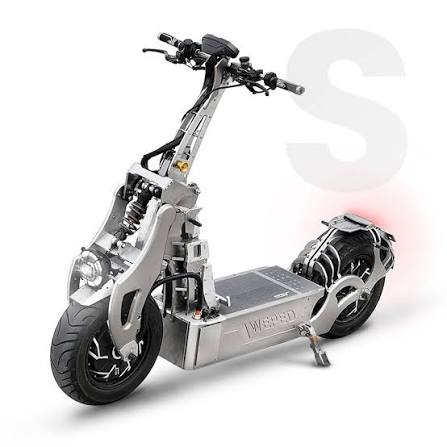
The Sonic S Dual sits at the top of WEPED’s lineup and is widely considered one of the most expensive electric scooter models available to the public. It runs off an immense 100.8V, 100Ah battery pack (10,080Wh), constructed of Samsung SDI 21700 50E cells for power. Dual BLDC hub motors supply a combined 8 kW of power; manufacturer-listed top speeds typically fall around 160 km/h (100 mph); however, there is a “safe” speed limiter around 140 km/h (87 mph) designed to make everyday riding safer.
As one of the Most Expensive Electric Scooter models available, it’s built on a POSCO 6061 aluminum CNC-machined frame with Brembo brakes and Mercedes-Benz S-Class-style oil shock suspension front and rear — hardware that’s closer to a lightweight motorcycle than a commuter scooter. It’s also foldable, which is unusual at this performance level, though its weight still keeps it firmly out of “carry it onto a train” territory.
Who it’s for: enthusiasts and closed-course riders chasing the fastest scooter WEPED sells. It’s overkill — deliberately — for anyone else.
WEPED Sonic Expander: hyper-scooter costing $16.7K-$20.2K.
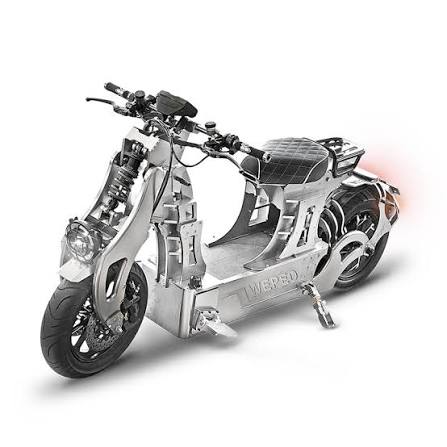
The Sonic Expander is essentially the Sonic Dual reengineered as a sit-down scooter rather than a stand-up one — WEPED describes it as the same core platform with a seat added for long-distance comfort. The base version runs an 84V, 100Ah battery (8,400Wh) with the same 8kW dual BLDC hub motor setup, a claimed top speed near 140 km/h (87 mph), and a manufacturer-claimed range up to 200 km depending on conditions, listed at $16,700 on WEPED’s official store. A higher-capacity “S” trim bumps the pack to 100.8V/10,080Wh and lists at $20,200.
Note: an earlier version of this guide listed the base Sonic Expander at ~$10,320 — that figure actually belongs to a different WEPED model, the “Dark Sonic X” (84V, 50Ah, 4,200Wh), which has a smaller battery and is not the same scooter. It’s been corrected here.
It shares the Sonic Dual’s Brembo brakes, POSCO 6061 aluminum frame, and oil-shock suspension, just packaged for seated riding over longer distances.
Who it’s for: riders who want Sonic-level power and range but don’t want to stand for the whole ride.
3. RION Thrust — ~$9,499–$10,000
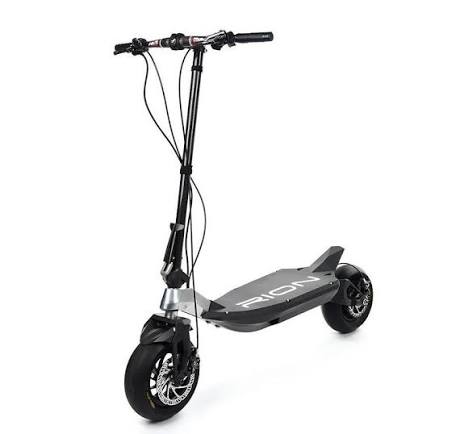
Built by Los Angeles-based RION, the Thrust is a hand-built, made-to-order hyperscooter rather than a mass-production model — expect a wait of six months to a year for delivery. It runs an 84V–88.2V battery (2,646–2,940Wh depending on the pack you choose) feeding a dual-motor system, with a top speed around 120 km/h (80 mph) and roughly 50 miles of range in Eco mode.
Braking comes from Magura MT7NSL carbon 4-piston calipers front and rear, paired with a carbon-fiber undercarriage designed to shed weight without sacrificing rigidity. RION also offers cosmetic customization — anodized colors, custom pole height, even a name engraved on the deck — that you won’t find on mass-produced competitors.
Who it’s for: riders who want a boutique, made-in-the-USA hyperscooter and are willing to wait for it.
4. WEPED Dark Knight Cyberfold — ~$9,500
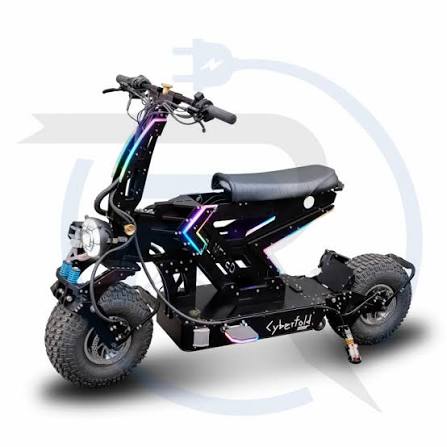
The Most Expensive Electric Scooter, Dark Knight Cyberfold, takes a distinct approach from WEPED’s Sonic line. Instead of trying to achieve top speeds, it’s designed around off-road ability. This vehicle is powered by an 84V 50Ah Samsung SDI 21700 50E battery (approximately 4,200Wh), featuring a dual motor configuration paired with WEPED’s Sonic controller and equipped with 16” tires designed to withstand rougher terrain than its street-oriented Sonic models.
Who it’s for: riders who want WEPED build quality and power delivery but plan to ride somewhere other than smooth pavement.
5. RION Apex — ~$8,999
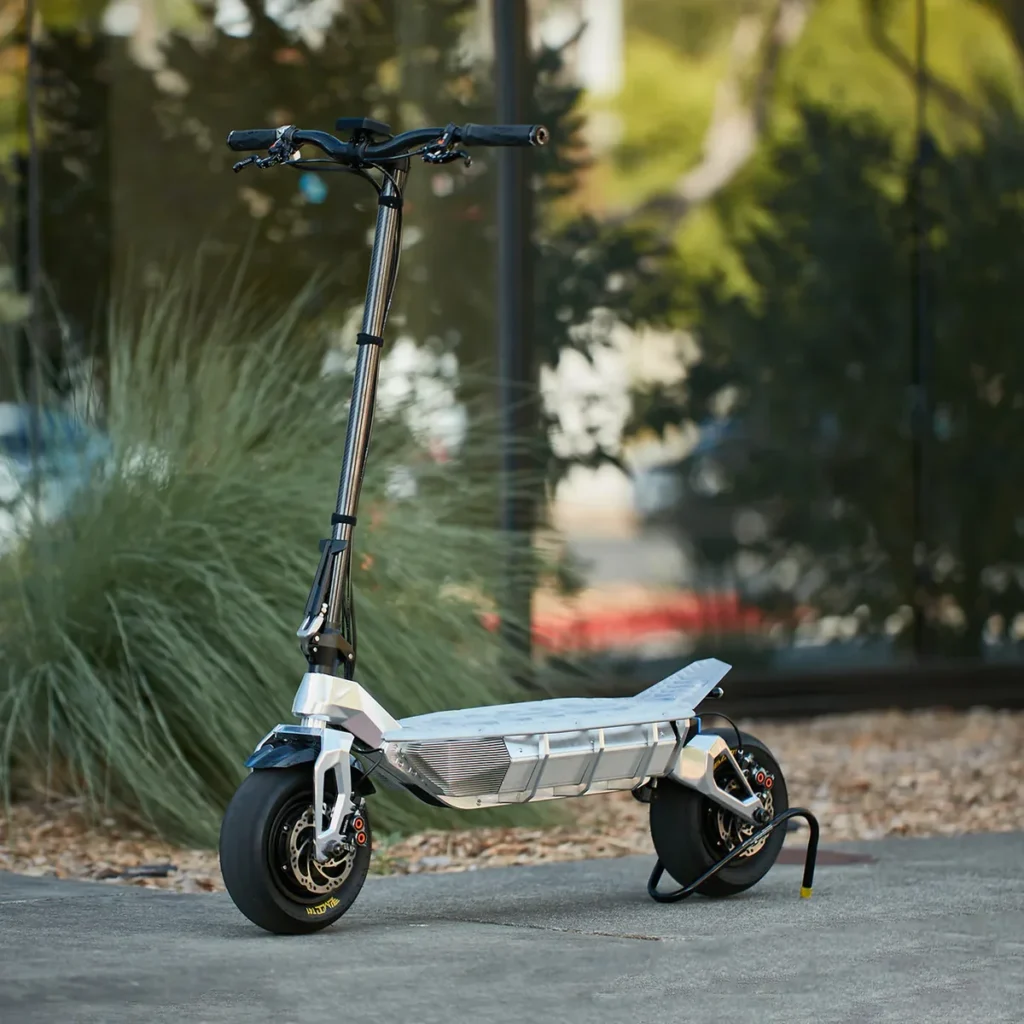
RION’s second hyperscooter, the Apex, is the only model on this list built entirely in the United States — CNC aluminum machined in Los Angeles, with carbon-fiber handlebars and steering column. It runs a custom 88.8V, 29.4Ah Molicel P42A battery powering dual 5kW vented hub motors, with a top speed around 128 km/h (80 mph) and a claimed range of 40–75 miles depending on riding mode.
Braking is controlled by dual Magura MT7 HC3 4-piston hydraulic calipers that have regenerative brakes through the company’s own Curve throttle. It is mounted on 11-inch Italian race slicks, which come with a RockShox Monarch RL rear suspension. With a weight of around 92 pounds, it’s the lightest scooter in the class; however, some reviewers have noted that it could overheat under prolonged hard riding in hot conditions.
Who it’s for: riders who want the most refined, boutique build quality in this tier and don’t mind a long production wait.
Quick Comparison
| Model | Price (USD) | Top Speed | Range | Battery |
| WEPED Sonic S Dual | ~$16,700–$19,200 | ~100 mph (limited to ~87 mph) | ~174 mi claimed | 100.8V, 10,080Wh |
| WEPED Sonic Expander | ~$16,700–$20,200 | ~87 mph | ~124 mi claimed | 84V–100.8V, 8,400–10,080Wh |
| RION Thrust | ~$9,499–$10,000 | ~80 mph | ~50 mi (Eco) | 84–88.2V, 2,646–2,940Wh |
| WEPED Dark Knight Cyberfold | ~$9,500 | Not street-speed focused | Off-road oriented | 84V, 4,200Wh |
| RION Apex | ~$8,999 | ~80 mph | 40–75 mi | 88.8V, ~2,614Wh |
Prices shift with seasonal promotions, configuration, and shipping, so treat these as a snapshot rather than a fixed number. Every Most Expensive Electric Scooter on this list offers premium engineering, but the right choice depends on your riding needs. Several of these are made-to-order or limited-run, so availability and lead times matter as much as price.
Why These Scooters Cost So Much
The battery is the single biggest reason a scooter’s price climbs into the thousands. Every Most Expensive Electric Scooter uses a high-capacity battery pack that plays a major role in its premium price. It typically accounts for 30–50% of the total build cost, and the packs in these flagship models are massive — 2,600 to over 10,000 watt-hours, built from premium lithium-ion cells (commonly Samsung SDI or Molicel) with battery management systems designed to handle sustained high-amp discharge without degrading.
Beyond the battery, a few other things push prices up:
- Motor power. A Most Expensive Electric Scooter often uses dual motors rated at several thousand watts, requiring heavier controllers, thicker wiring, and better cooling than a commuter scooter’s single 350–500W motor.
- Braking hardware. A Most Expensive Electric Scooter typically uses Hydraulic 4-piston disc brakes from brands like Brembo or Magura cost significantly more to engineer than the cable-actuated drum brakes on entry-level models — and at 60+ mph, they’re not optional.
- Frames and suspension. A Most Expensive Electric Scooter may use precision-machined 6061 aluminum, carbon-fiber components, and specially designed suspension systems that require advanced engineering rather than simply adding heavier metal.
- Production volume. Many Most Expensive Electric Scooter models are handmade or built to order for enthusiasts, so they do not benefit from the economies of scale that help keep mass-market commuter scooters affordable.
None of this is marketing fluff — it’s the actual reason a $9,000–$19,000 scooter and a $400 scooter can look similar in photos but perform in completely different worlds. This is why a Most Expensive Electric Scooter delivers a completely different riding experience than a standard commuter scooter.
Who Should (and Shouldn’t) Buy One
This is the part most buying guides skip, and it matters more than the spec sheet.
This tier makes sense if you:
- Are replacing short motorcycle or moped trips and want something that doesn’t require a motorcycle license where you live
- Ride on a track or private land where 50+ mph is actually usable and legal.
- Are willing to wait months for a hand-built model and want boutique-level fit and finish
- Need real range and are fine carrying a heavy, non-folding (or barely folding) machine to get it.
This tier doesn’t make sense if you:
- Commute daily in a city — a $600–$1,100 mid-range scooter covers the vast majority of urban commuting needs
- Need to carry your scooter up stairs or onto public transit — none of these fold down compactly, and most weigh more than an adult can comfortably lift
- Are new to scooters — the acceleration and stopping distances at 60–80+ mph require real experience to manage safely, and these are not forgiving machines to learn on
A Simple Framework for Deciding
- Be honest about your top-speed needs. If you will never safely or legally exceed 30 mph, paying for a Most Expensive Electric Scooter may mean spending money on performance you will never use.
- Check your local vehicle classification. Many regions cap “scooter” status at a specific wattage or speed. Cross that line and the vehicle may legally need moped or motorcycle registration, insurance, and a license — this catches more buyers off guard than any spec on the sheet.
- Factor in lead time, not just price. Models like the RION Thrust and RION Apex are hand-built to order, with waits that can stretch to a year. If you need the scooter soon, that changes the calculus as much as the sticker price does.
- Don’t skimp on braking. At speeds above 40 mph, hydraulic disc brakes — ideally from a name like Brembo or Magura — aren’t a luxury feature.
- Budget beyond the scooter. A full-face helmet, armored jacket, and gloves typically add $300–$800, and they’re not optional at these speeds.
- Account for shipping and duties. These scooters ship on pallets or in custom crates. Delivery can add several hundred dollars depending on your country, and international orders may carry import duties on top of the sticker price.
Common Mistakes Buyers Make
- Buying a Most Expensive Electric Scooter purely for its top speed without checking whether it is legal to use on public roads where they live
- Underestimating weight — an 80+ pound scooter can’t be carried up an apartment stairwell or tossed in a car trunk
- Skipping the warranty and service-network check, which matters more on a $9,000–$19,000 purchase than a $400 one
- Not accounting for production lead times on hand-built models, then being surprised by a multi-month wait
- Treating “most expensive” as a synonym for “best for me,” when the fastest scooter on the market is rarely the best-value scooter for a specific commute or terrain
FAQ
What’s the most expensive electric scooter you can find?
As a true production scooter, the WEPED Sonic S Dual is the top-rated model at $16,700 to 19,200 based on the retailer. The Most Expensive Electric Scooter “Sonic S Expander” trim is priced at around 20k, while a Mercedes-branded novelty bundle is sold for more than $125,000, even though it’s not an individual scooter model.
Are electric scooters that cost a lot of money worth the cost?
If you’re a rider who really needs speeds of 60+ mph as well as long-range or motorcycle-quality braking, it is possible. A 600-$1,100 mid-range bike usually provides more value for money.
What speed can the most expensive electric scooters travel?
Flagship cars typically reach speeds between 80 and 100. The WEPED Sonic line has the most impressive number of miles among the group.
Do you require a permit to operate a high-speed electric scooter?
It is contingent on the location you reside in. A lot of regions classify high-wattage speed scooters as mopeds or motorbikes when they exceed an arbitrary power or speed threshold. This can lead to registration, insurance, or registration regulations.
What’s the reason why electric scooters are so expensive?
The battery capacity is the largest expense driver. It is followed by motor power, hydraulic brake systems, precise-machined frames, and the small manufacturing volumes that are typical for enthusiast-market, hand-built vehicles.
Is the WEPED Sonic Expander or the RION Thrust the better buy?
The Sonic Expander generally wins in terms of top speed, raw power, and battery capacity. The Thrust is custom-built and custom-built to order, offering the ability to customize and has a more exclusive design. The ideal choice will depend on whether you prefer the numbers on the outside or prefer a custom design.
What’s the shipping cost to the price?
Freight delivery on pallets, or in crate shipping scooters, usually costs hundreds of dollars, according to the location, and International buyers must also account for any import taxes that may be incurred.
The Bottom Line
The most expensive electric scooters on the market — the WEPED Sonic S Dual, WEPED Sonic Expander, RION Thrust, WEPED Dark Knight Cyberfold, and RION Apex — all sit in the $9,000–$20,000 range, and every one of them is built for performance or boutique craftsmanship, not for the daily commute. If you don’t need 80+ mph or extended range, the $2,000–$4,500 performance tier gets you most of the experience for a fraction of the price. And if you do need it, go in knowing your local laws, your total landed cost, the production lead time, and the gear you’ll need to ride it safely.
About the Author
Huzaifa is the creator of Electric Scooter Analysis, a blog that covers electric scooters of all kinds, including off-road, city, and special circumstances. Data is obtained from manufacturer specs, as well as opinions from riders. Figures are flagged if there’s no proof.
“The information on this website is gathered from industry reports, manufacturer specifications, expert reviews, and trusted sources such as gyroor to provide accurate and valuable insights for our readers