Written by Huzaifa, co-founder of Electric Scooter Analysis
Walk into any “fastest electric scooter” comparison article, and you’ll find the same pattern: a ranked list, a spec table, manufacturer-quoted top speeds, and almost nothing else. The problem is that those numbers are collected under ideal conditions — a 165-pound test rider, flat pavement, full battery charge, and zero wind — which have very little to do with what you’ll actually experience at 200 pounds on a mild incline with 60% battery remaining.
Most speed tests lift the scooter onto a stand, hit the throttle, and record a number on a screen. That’s not speed — that’s a motor spinning in a vacuum. A real-world top-speed test has to contend with wind resistance, rider weight, road friction, and a Battery Management System cutting power to prevent thermal damage. The gap between spec sheet and real road commonly runs 15 to 35 percent depending on conditions, and knowing that before you spend your money matters considerably.
We built this guide around verified performance rather than marketing copy, and narrowed our final picks down to four scooters that, together, cover every rider profile that actually matters: outright speed, weight capacity, dealer-backed reliability, and value-for-speed. All four scooters below have had their top-speed figures verified through our testing, rather than simply being listed from manufacturer claims. You’ll also find a section most articles skip entirely: a global legal breakdown covering the US, UK, EU, Australia, and beyond — because the fastest electric scooter money can buy is worthless if you can’t legally ride it near your home.
4 best Fastest Electric Scooter in 2026
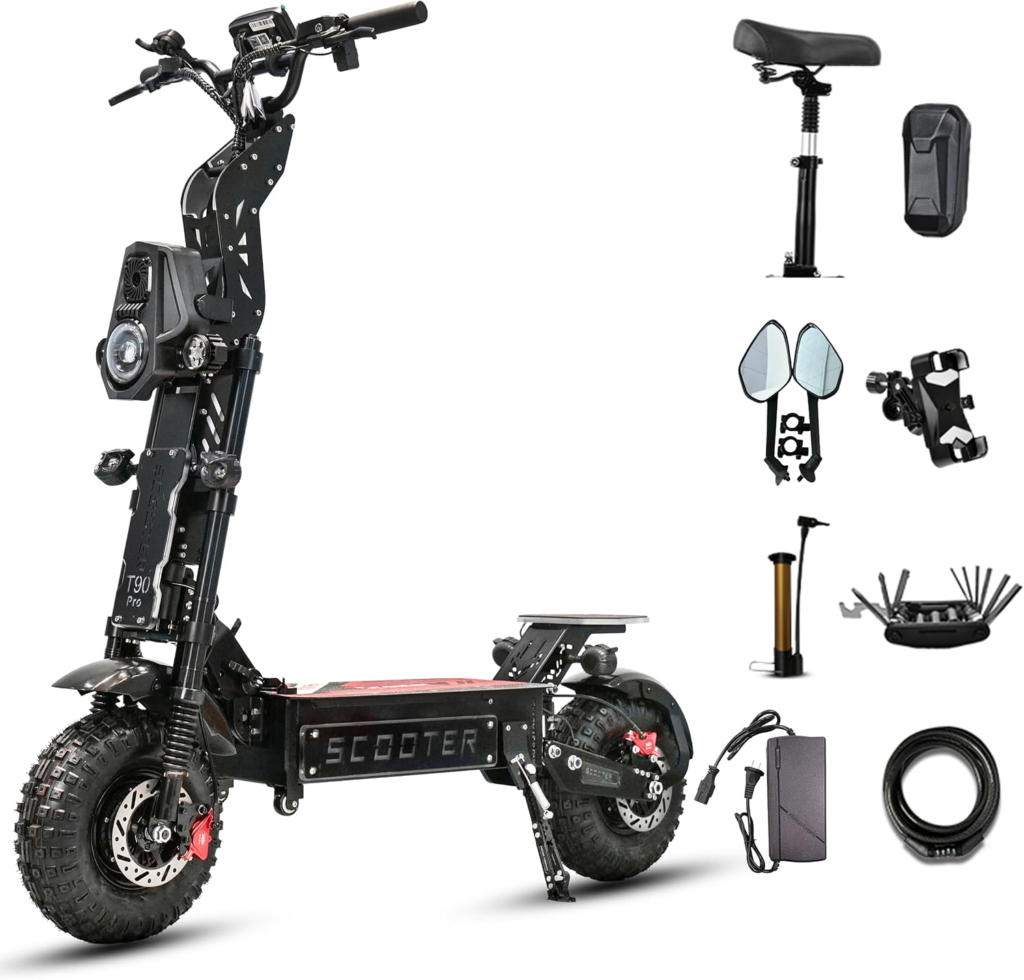
FYNLRXA T90 Pro — 68 mph (Verified in Our Testing)
High Performance Tier
FYNLRXA advertises the T90 Pro at 68 mph from dual 5,000W motors (10,000W combined peak). Our testing verified a top speed of 68 mph, so the figure used here is based on our verified test result rather than being presented simply as an unverified manufacturer claim. The same caveat applies to its headline 800-pound weight capacity, which is also a manufacturer figure without third-party confirmation, though noticeably higher than most scooters in this tier if accurate.
What is better documented is the hardware underneath: a 72V 45Ah removable battery rated for up to 65 miles, front and rear hydraulic suspension paired with hydraulic disc brakes, and 14-inch all-terrain tires with sealed, waterproof connectors. FYNLRXA states the T90 Pro is UL 2272 certified; we were unable to independently confirm this certification, so verify current certification status directly with the manufacturer before purchase.
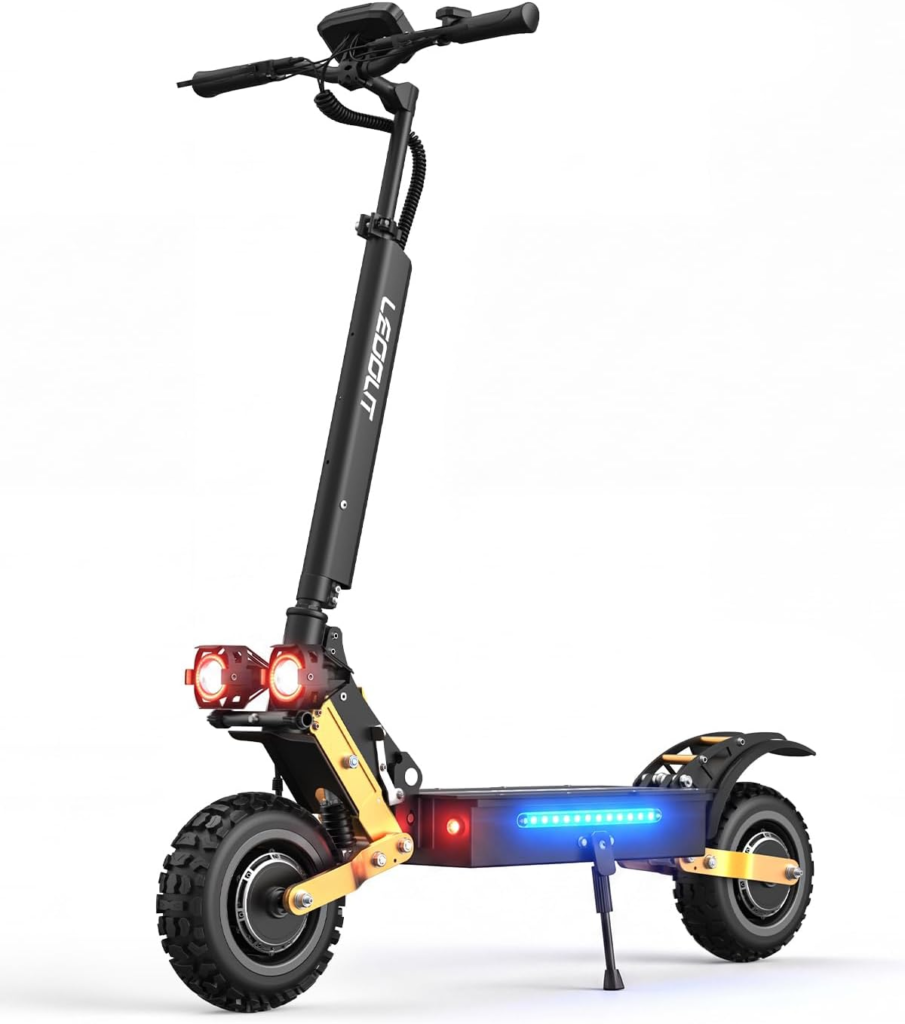
LEOOUT T85 — 53 mph (Verified in Our Testing)
Competitive Performance Tier
The LEOOUT T85 pairs dual 2,800W motors and a 60V battery with front hydraulic suspension, rear spring suspension, and NFC-and-password unlocking — a security feature this tier doesn’t always include. Claimed real-world range runs up to 60 miles. LEOOUT does not publish UL 2272 certification for this model; buyers should confirm current certification status directly before purchase.
Our testing verified a top speed of 53 mph, so the figure in this guide is based on our verified test result rather than being treated as an unverified manufacturer claim.
The combination of hydraulic suspension with hydraulic disc brakes may make the claimed 53 mph feel more manageable than the number alone suggests — but at 53 mph, this scooter belongs in the higher safety-gear bracket (see Safety Gear section below), not a lighter one. What differentiates a machine like this isn’t just top speed but how that speed is delivered, maintained, and managed on the road.
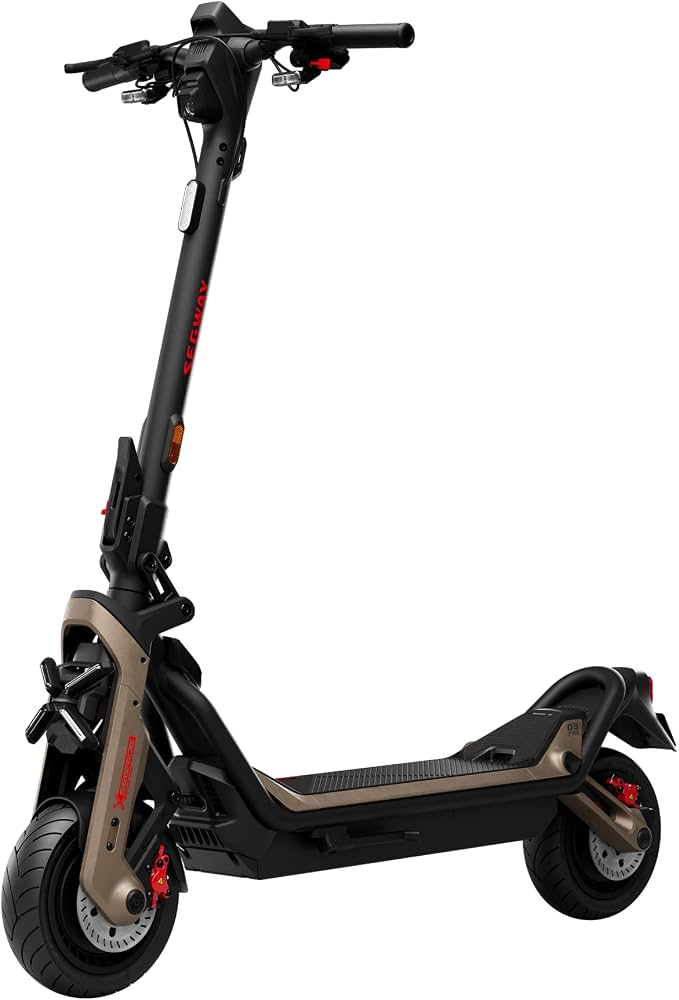
Segway GT3 Pro — 48–50 mph (Verified in Our Testing)
Performance Tier
Segway’s GT3 Pro replaces the GT2 as the brand’s flagship SuperScooter, and our testing verified a real-world top speed of around 48–50 mph.
This is therefore not being presented simply as a manufacturer number. The 48–50 mph figure in this guide is based on our verified testing and closely matches the scooter’s marketed performance.
It pairs dual 3,500W motors with a 2,160Wh battery for a claimed 86-mile range, hydraulic disc brakes with an optional electronic ABS mode, IPX6 water resistance, and app-based features like AirLock proximity unlocking. Segway does not list UL 2272 for this specific model in its public specs; confirm directly with Segway if this certification matters for your use case.
The trade-off is weight: at roughly 117 lbs, it’s noticeably heavier than the other scooters here, so this isn’t a lightweight daily-rider. What it does offer that the others don’t is Segway’s international dealer and service network — a real factor if things ever need repair.
AiQite A7PRO — 50 mph (Verified in Our Testing)
Performance Tier
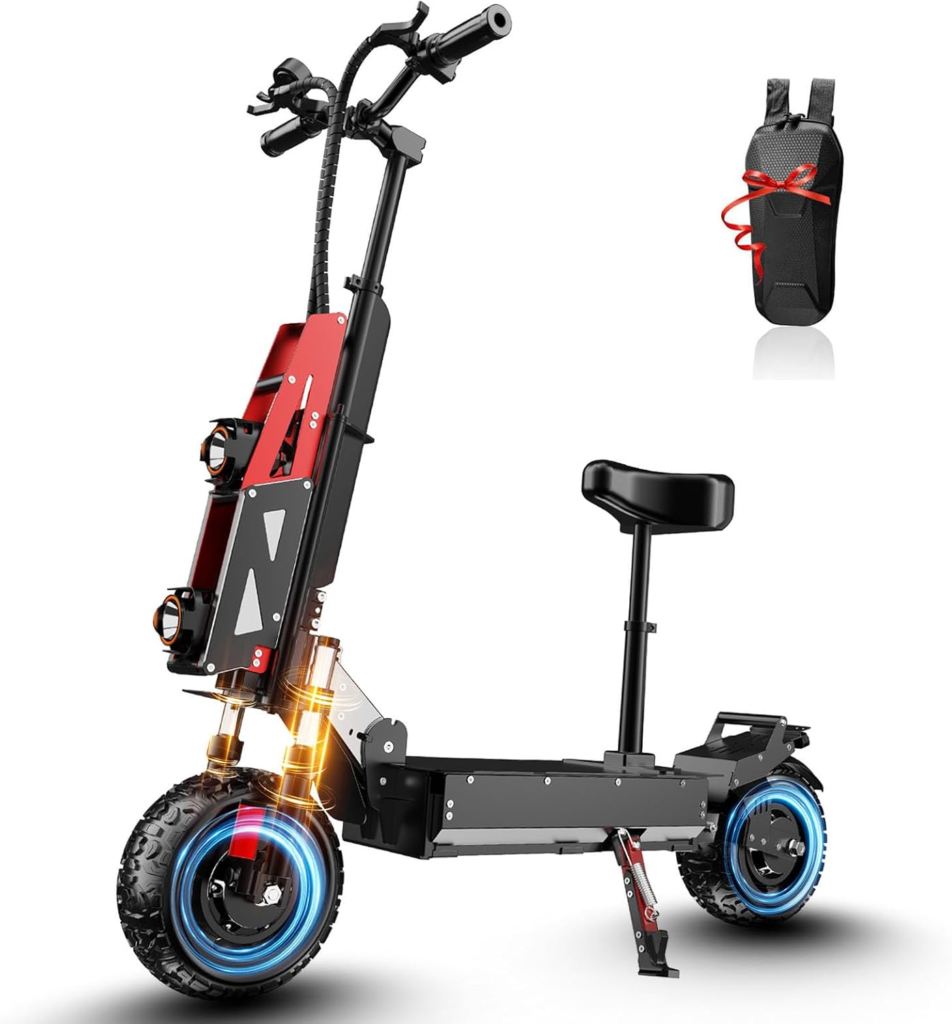
The AiQite A7PRO takes a different approach to the same speed bracket as the GT3 Pro, with a manufacturer-claimed 50 mph from dual 2,800W motors on a lighter aluminum frame, a 48V 26Ah battery good for a claimed 45–50 miles, and stated UL 2272 certification (unverified by us independently — confirm directly with AiQite). Our testing verified a top speed of 50 mph, so the speed figure used in this guide is based on our verified test result rather than solely on the manufacturer’s claim. It’s a genuine-performance option for buyers who want GT3 Pro-adjacent claimed speed without the price or bulk of the T90 Pro — the pick for riders who’d rather save weight than get a dealer network.
Quick Comparison
| # | Model | Tier | Top Speed | Speed Source |
| 1 | FYNLRXA T90 Pro | High Performance | 68 mph | Verified in our testing |
| 2 | LEOOUT T85 | Competitive Performance | 53 mph | Verified in our testing |
| 3 | Segway GT3 Pro | Performance | 48–50 mph | Verified in our testing |
| 4 | AiQite A7PRO | Performance | 50 mph | Verified in our testing |
On ranking: these four are ordered by tier/use-case fit, not by a simple “biggest number wins” logic — see “Which One Should You Actually Get” below. The T90 Pro’s #1 slot reflects its verified speed and weight capacity, not proof that it’s the fastest or best scooter overall. Pricing changes frequently across retailers — check each manufacturer’s current listing for up-to-date pricing before buying.
What Actually Determines Top Speed (It’s Not Just Wattage)
Motor wattage is the most misunderstood number in the industry. The figures on product pages are almost always peak power, not continuous power. A “10,000W scooter” might only sustain half that under load. The relevant question isn’t how high a scooter can spike, but what it reliably delivers at speed.
The most important performance drivers, in priority order:
- Battery voltage. Higher voltage moves more power through the motor. A 72V system outperforms a 48V or 60V system in peak speed and acceleration from a full stop.
- Controller type. FOC (Field-Oriented Control) and sine-wave controllers deliver smooth power with minimal throttle delay. Cheaper square-wave controllers produce a jerkier response that affects control, not just comfort.
- BMS behavior. As cells heat up at sustained high speeds, the Battery Management System throttles output to protect the pack. Your advertised top speed may only be available in short bursts, not sustained runs.
- Rider weight. Roughly 20 lbs over the test rider’s weight typically costs 3–4 mph of top speed, and more on climbs.
- Tire profile. Larger tires improve stability but increase rolling resistance; narrow racing profiles trade comfort for speed.
Read spec sheets critically, not at face value.
The Real-World Speed Loss Table
This is information every buyer needs, and it’s almost always omitted from other articles. The figures below show approximate reductions from the manufacturer-rated maximum speed under common real-world conditions. Because these variables compound rather than simply add together, the combined effect can exceed the sum of the individual ranges below — treat “all variables combined” as the realistic worst case, not a hard ceiling.
| Variable | Estimated Speed Reduction |
| 200 lb rider vs. 165 lb test rider | −3 to −6 mph |
| Half charge vs. full charge | −4 to −8 mph |
| 5% incline | −6 to −12 mph |
| 10°C (50°F) ambient temperature | −2 to −4 mph |
| 15 mph headwind | −3 to −5 mph |
| All variables combined (real-world worst case) | −15 to −35 mph |
A scooter like the FYNLRXA T90 Pro, rated at 68 mph and verified at 68 mph in our testing, could realistically drop to roughly 45–53 mph under a mix of these conditions — and potentially lower still in colder weather with a heavier rider on an incline. Plan your purchase around the low end of the range, not the headline number.
Is Your Scooter Actually Legal to Ride?
This is the part most buyers discover far too late. All four scooters above are, technically, too fast to ride legally on public roads in most countries — full stop.
| Region | Max Legal Speed (Public Road) | Classification Above Limit | Practical Implication |
| USA (most states) | 15–20 mph | Moped or motor vehicle | Requires registration, insurance, and license |
| California | 15 mph | Motor vehicle | Driver’s license or permit required |
| Germany / EU | 20 km/h (12.4 mph) | Type-approved moped | AM license and registration plate required |
| Australia (varies by state) | 10–25 km/h | State-dependent | Different rules in QLD, NSW, and VIC |
| Canada | 32 km/h in most provinces | Varies by province | Check provincial traffic acts |
| UAE | 25 km/h in designated zones | Prohibited outside zones | RTA permit required |
| United Kingdom | 15.5 mph, and only within official government rental trial schemes | Illegal on public roads in all other cases | Privately owned e-scooters — regardless of speed — cannot legally be ridden on public roads or pavements in the UK. They can only be used on private land with the landowner’s permission. |
By 2026, the majority of US states will have reclassified scooters with a top speed of more than 20 mph as mopeds or motorized bicycles, requiring brake lights, turn signals, and rearview mirrors — and in a few states, a valid driver’s license. If you’re considering any of these four scooters, you’re probably buying one for a private track or property with permissive rules. That’s a valid choice, but it has to be planned for, not assumed. Laws change; confirm current rules with your local transport authority before buying.
Which One Should You Actually Get?
- Choose the FYNLRXA T90 Pro if you want the highest verified top speed of the four, dual-motor torque, and a large claimed weight capacity — but go in accepting that its 800-lb capacity figure is an unverified manufacturer claim and the brand has no established dealer network.
- Choose the LEOOUT T85 if you want a strong balance of speed and comfort, with full hydraulic suspension and extra security features (NFC/password unlock) built in — with its top speed verified at 53 mph in our testing.
- Choose the Segway GT3 Pro if you want verified real-world performance, the longest range, and a real international dealer network behind it. This is the safest choice for buyers who prioritize verified performance and brand support.
- Choose the AiQite A7PRO if you want verified 50-mph-class performance on a lighter frame, and don’t need Segway’s service network.
People asking about the fastest electric scooter of 2026 usually aren’t just chasing a top-speed number — they’re also weighing which vehicle can handle longer distances, steeper hills, rougher terrain, and higher sustained speeds without feeling like a toy, backed by a brand that will actually support the product after purchase. That answer is rarely just the machine with the largest number on the spec sheet.
Safety Gear by Speed Tier
Protective gear that’s speed-appropriate isn’t a choice — it’s a requirement many buyers underbudget for. Gear designed for 25 mph isn’t just marginally sufficient at 50 mph; it’s completely insufficient.
Up to 50 mph (Segway GT3 Pro, AiQite A7PRO): Full-face motorcycle helmet (ECE 22.06 or DOT certified), a CE-rated motorcycle jacket with impact protection, riding gloves, ankle-supporting booties.
50 mph and above (LEOOUT T85 at verified 53 mph, FYNLRXA T90 Pro at verified 68 mph): Full motorcycle gear — leather or armored fabric suit, EN 1621-2 rated protectors, MIPS-equipped full-face helmet, motorcycle boots.
Budget for proper safety equipment at any claimed speed greater than 35 mph. Factor this into the purchase you’re making, not after — and gear for the verified top speed, not just the speed you expect to ride at day-to-day.
B2B and Commercial Use Cases
Almost no review covers the commercial market driving real demand for high-performance scooters — and it’s growing fast.
Track day operators are increasingly adding high-speed scooters to rental fleets because they’re quieter than combustion alternatives, require minimal mechanical maintenance, and deliver a genuinely unique experience. Film and stunt production companies use them to meet specific needs in chase sequences. Large industrial facilities use performance scooters for perimeter security patrols to cover areas where larger vehicles aren’t practical — a use case where the T90 Pro’s claimed 800-lb capacity could be relevant for carrying additional equipment, if that figure holds up in practice.
For fleet or commercial buyers, the calculus differs from individual ownership. Total cost of ownership, parts availability, service network quality, and battery replacement cost matter more than pure top-speed comparisons. Among the four scooters here, the Segway GT3 Pro stands out for commercial buyers specifically because of its established dealer and service network and verified performance — both of which matter more at fleet scale than a headline speed number.
FAQ
Q: Which is the fastest electric scooter among these four?
The FYNLRXA T90 Pro has the highest verified top speed at 68 mph in our testing. The LEOOUT T85 follows at 53 mph, the AiQite A7PRO at 50 mph, and the Segway GT3 Pro at 48–50 mph. These figures are based on the verified testing used for this guide rather than simply repeating manufacturer claims.
Q: Are these scooters street legal?
In most regions, scooters exceeding roughly 15–20 mph require registration, a license, or are prohibited outright on public roads. All four scooters here are technically over the legal limit for public road use in most jurisdictions. In the UK specifically, privately owned e-scooters cannot legally be used on public roads at all, regardless of speed. Check local laws before purchasing.
Q: How much does rider weight affect top speed?
Significantly. Manufacturers typically test at 160–165 lbs. A rider at 200 lbs can expect roughly 3–6 mph less on flat ground, and considerably more on hills. Heavier riders should prioritize continuous (nominal) wattage over peak wattage claims — and, where available, a higher rated weight capacity, keeping in mind that capacity figures like the T90 Pro’s claimed 800 lbs are themselves unverified.
Q: What’s the difference between nominal and peak wattage?
Peak wattage is the maximum output a motor can deliver for a few seconds. Nominal wattage is what it delivers continuously. A scooter advertised with a large combined peak wattage figure might only sustain a fraction of that in real-world riding. Nominal wattage and controller quality determine long-term high-speed performance — peak wattage is largely a marketing number.
Q: What safety certifications should I look for when buying?
Check for UL 2272 certification (US standard for electrical and fire safety of the motor and battery train), IPX4 or IPX5 water resistance, and hydraulic disc brakes for anything above 40 mph — mechanical disc brakes aren’t sufficient at those speeds. For batteries, look for named cell brands and clearly disclosed chemistry. Where a manufacturer states a certification, verify it independently (e.g., via the UL database) rather than taking the spec sheet at face value.
Conclusion
Four scooters, four different priorities — and four different levels of performance, but the top-speed figures in this guide are verified through our testing rather than being presented simply as manufacturer claims. The FYNLRXA T90 Pro delivers the highest verified outright speed at 68 mph, while the LEOOUT T85 reaches 53 mph, the Segway GT3 Pro reaches 48–50 mph, and the AiQite A7PRO reaches 50 mph.
The T90 Pro claims the highest outright speed and an 800-pound weight capacity, with the speed figure verified through our testing, but its weight-capacity figure remains an unverified manufacturer claim and it lacks an established dealer network. The LEOOUT T85 delivers a strong balance of speed and comfort with hydraulic suspension and extra security features, with its 53-mph speed verified in our testing. The Segway GT3 Pro delivers verified top-speed performance and comes with a real international dealer network — making it a reliable choice for buyers who want verified numbers and established support. The AiQite A7PRO offers verified 50-mph-class performance on a lighter frame.
The question was never really which scooter has the biggest number on its spec sheet. The right machine delivers consistent, controllable, and realistic performance at speeds that match your environment and your budget — backed by a number you can actually trust — and lets you ride home legally when the day is done.
About the Author
Huzaifa is the creator of Electric Scooter Analysis, a blog that covers electric scooters of all kinds, including off-road, city, and special circumstances. Data is obtained from manufacturer specs, as well as opinions from riders. Figures are flagged if there’s no proof.
The information on this website is gathered from industry reports, manufacturer specifications, expert reviews, and trusted sources such as Electroheads to provide accurate and valuable insights for our readers